


Download Deriving 120 degree and 60 degree triples.
triples10.pdf
 means
means  divides
  .
.
 means
does not divide
.
means
does not divide
.
 means ``implies''.
and
are integers then
means ``implies''.
and
are integers then  means that
  is
their greatest common divisor. If
is
their greatest common divisor. If  then
and
are
relatively prime.
then
and
are
relatively prime.
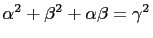 will be called a
120 degree triangle. And I will write ``the 120 degree triangle
''.
will be called a
120 degree triangle. And I will write ``the 120 degree triangle
''.
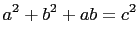
A 120 degree triple  is a solution in positive integers
to the equation
is a solution in positive integers
to the equation
If, additionally,  , and
, and  are pairwise relatively prime
then
is a primitive 120 degree triple, and
are pairwise relatively prime
then
is a primitive 120 degree triple, and
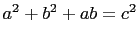 is a primitive 120 degree triangle. Clearly, if
some integer
is a primitive 120 degree triangle. Clearly, if
some integer  divides any two of the variables
  ,
,  , and
then it divides the remaining variable, therefore
can be divided
out. Similarly, if
is primitive then multiply through by
the appropriate integer to get your chosen non-primitive solution.
Hence, to find all solutions, it's sufficient to find all primitive
solutions.
, and
then it divides the remaining variable, therefore
can be divided
out. Similarly, if
is primitive then multiply through by
the appropriate integer to get your chosen non-primitive solution.
Hence, to find all solutions, it's sufficient to find all primitive
solutions.
We will need a preliminary result.
 , and
, and  are positive integers such that
 then
then
 , and
, and

 where
is a positive integer. We
have, since
,
where
is a positive integer. We
have, since
,
 . So,
. So,
![$ d\mid m^2-n^2\ [3pt]=(m+n)(m-n)$](img628.gif) and
and
 and
and
 . Let
. Let
 where
where  and
and  are positive integers.
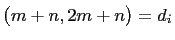 where
where  or 2, then
![$ d_i\mid 2m+n-m-n=m\ [3pt] \Rightarrow d_i=1$](img635.gif) .
This implies that
.
This implies that
![$ d\mid m-n\Rightarrow d\mid m-n + 2m+n=3m\ [3pt]\Rightarrow
d=3$](img636.gif) or 1. Therefore, if
or 1. Therefore, if
 then
then
 , and if
  then
then
 .
.

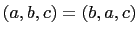 . Then
is a 120 degree
triple if and only if there exists relatively prime, positive
integers,
and
,
, and
. Then
is a 120 degree
triple if and only if there exists relatively prime, positive
integers,
and
,
, and  , such that
 and
and 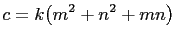
where
is some positive integer.
Let
be a primitive 120 degree triangle. From the
triangle inequality, and since
and
are each non-zero,
the sum of the lengths of any two sides is greater than the length
of the remaining side. That is,  . Therefore, there exists
relatively prime positive integers
and
,
, such that
. Therefore, there exists
relatively prime positive integers
and
,
, such that
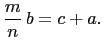
Thus

reduced to lowest terms. From whence
Square both sides of (29), multiply through by  , then
cancel and rearrange terms to get the result,
, then
cancel and rearrange terms to get the result,
There are two cases,
and
.
Case I,
 . From Lemma (1),
 . Also
  . Thus, from
(30),
. Thus, from
(30),
 and from (29), and from (29), |
(31) |
Case II,
 . From Lemma
(1),
. From Lemma
(1),
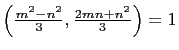 .
Then, from (30),
.
Then, from (30),
 and
and
 . So let
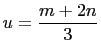 and
and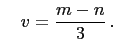
Then
 and
and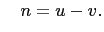
Substituting these values for
and
into (32) yields
 and
and  are relatively prime, positive integers,
  and
and
 . Hence (33), with the labels for
and
interchanged, is identical to (31). And in the other
direction of the if and only if, indeed
. Hence (33), with the labels for
and
interchanged, is identical to (31). And in the other
direction of the if and only if, indeed

Therefore, all 120 degree triples where
is considered the
same as  are given by the parametric equations,
and
are relatively prime, positive integers,
,
, and
is some positive integer.
satisfies the integer-sided
equation
if and only if there exists relatively
prime, positive integers
and
,
,
such that
 and
and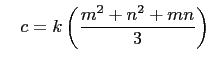
for some positive integer
..
Let
, and
are pairwise, relatively prime, positive
integers. Set
 , and let
 and
and
 where
where
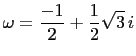 and
and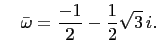
Then
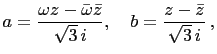
 and
and
 are Eisenstein Integers, and
is the conjugate of
. Note that
are Eisenstein Integers, and
is the conjugate of
. Note that
 , and
, and
 . Thus
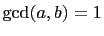 then
then
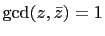 . Hence each of
and
is a square. That is, there exists integers
and
such that
. Hence each of
and
is a square. That is, there exists integers
and
such that
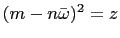 and
and
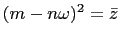 . So,
from equation (36),
. So,
from equation (36),
 |
 |
|
 |
 |
|
and |
 |
is a positive integer,
and
must be positive
integers,
. And since
then
and
must be
relatively prime, and
.
If  , and
, and  are positive integers such that
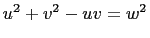 then
then  is a 60 degree triple. If additionally
,and
are pairwise relatively prime then
is a primitive 60
degree triple. If
is a primitive 60 degree triple then
is a primitive 60 degree triangle, and vice versa.
is a 60 degree triple. If additionally
,and
are pairwise relatively prime then
is a primitive 60
degree triple. If
is a primitive 60 degree triple then
is a primitive 60 degree triangle, and vice versa.
Parametric equations for finding all 60 degree triples can be easily derived from the parametric equations for finding all 120 degree triples. (34)
First note that for any positive integer
,  is a 60
degree triple. That is,
is a 60
degree triple. That is,
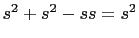 where
is the length of
each side of an equilateral triangle. Clearly, if
is a 60
degree triple where
where
is the length of
each side of an equilateral triangle. Clearly, if
is a 60
degree triple where  then
then  . So, since we already know how
to write down the side lengths of an equilateral triangle, the
triples such that
need not be included in our derivation.
. So, since we already know how
to write down the side lengths of an equilateral triangle, the
triples such that
need not be included in our derivation.
is a
 triple such that
  if and only if there exists a
 triple,
,
where either
triple,
,
where either  ,
,  , and
, and  or
or  ,
,  , and
.
triples, it's sufficient to
find all primitive solutions. There are two cases,
and
, and
.
triples, it's sufficient to
find all primitive solutions. There are two cases,
and  .
We have already covered the case where
.
.
We have already covered the case where
.
 ] We have
 .
Hence
.
Hence  is a
triple. Set
is a
triple. Set  ,
,  ,
and
,
and  . Then
,
, and
.
. Then
,
, and
.
And in the other direction,
 .
.
 ] We have
 . Hence
 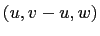 is a
triple.
Set
is a
triple.
Set  , b=
, b= , and
. Then
,
, and
.
, and
. Then
,
, and
.
And in the other direction,

From equation (34) and Claim (7), where
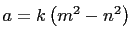 and
and
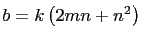 , if
,
is a 60 degree triple if and only if there exists
relatively prime positive integers,
and
,
, and
such that
, if
,
is a 60 degree triple if and only if there exists
relatively prime positive integers,
and
,
, and
such that
 and
and
or
 and
and
Where
is some positive integer.
Figure (1) illustrates Claim (7) where in
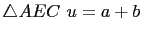 and
, and in
and
, and in
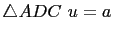 and
.
and
.

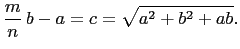

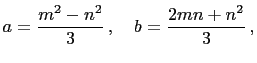 and
and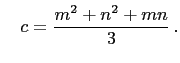
 and
and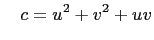
 and
and
 and
and
![\includegraphics[width=3.0in]{../../../texdocs/ip13}](img719.gif)