


The difference of two squares is easily factored: We have,

 is the difference of two
positive integer squares.
is the difference of two
positive integer squares.
 is greater than 1,
  for some odd positive integers
  and
and  ,
,  .
So,
.
So,
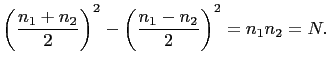
Since
and
are both odd,
 and
and
 are integers.

Note that
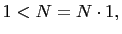 hence we can always choose
  and
and
 Then
Then
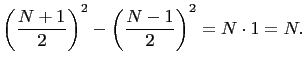
is an even positive integer then
is the
difference of two positive integer squares if and only if  for
some integer
for
some integer  .
.
 Let
Let
 where
where
 and
and  are positive integers,
  Set
Set  and
and
 So,
So,  Then
Then
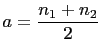 and
and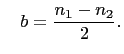
Since
and
are integers then
and
are both odd or
they are both even. They can not both be odd since
is even.
Hence for some integers  and
and  ,
,  ,
,  and
and
 . Therefore
 ,
.
,
.
 If
,
, then
If
,
, then  for some positive integers
and
,
. Therefore
for some positive integers
and
,
. Therefore

Example:
 Therefore

Example:  . So
. So
 Therefore

The only positive integers that can not be written as the
difference of two positive integer squares are exactly  , and
those integers
such that
, and
those integers
such that
 divides
  (that is,
 ).
).
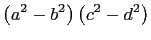
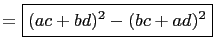
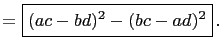
 . The Diophantus identity is easily derived
straightforwardly.
. The Diophantus identity is easily derived
straightforwardly.
 |
 |
|
 |
||
 |
||
 |
||
 |
||
 |
||
 |
Example:
 |
 |
|
 |
Example: Solving the equation
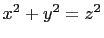 in relatively prime positive integers.
Solution: We know that if  and
and  are
relatively prime and
then one of
and
is odd.
Without loss of generality let
are
relatively prime and
then one of
and
is odd.
Without loss of generality let  be an odd positive integer.
Then there exists relative prime odd positive integers
and
,
, such that
be an odd positive integer.
Then there exists relative prime odd positive integers
and
,
, such that
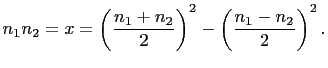
 and
and  is one such pair.
Set
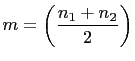 and
and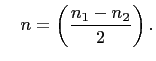
Thus, from equation (45),

From whence
 and
and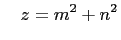
where
 and
and  are relative prime positive integers of opposite
parity,
are relative prime positive integers of opposite
parity,  . This implies that positive integers
  and
and  are pair-wise relatively prime.
From equation (45) we have the inequality,
 and
and  for some integer
  .
.
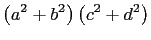
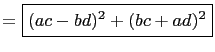
Compare equation (45) to the Fibonacci identity (
another special case of Brahmagupta's identity. Set  in equation (46) and note that
 ),
),
Similarly Fibonacci's identity can easily be derived
straightforwardly. Set  That is, we will factor each sum
of two squares into Gaussian numbers. Hence
That is, we will factor each sum
of two squares into Gaussian numbers. Hence
 |
 |
|
 |
||
 |
||
 |
||
 |
||
 |
||
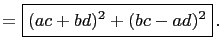 |
This identity implies Cauchy's inequality for reals in two dimensions,

In the Fibonacci identity, set
 |
||
 |
|
 |
|
 |
Similarly, the Diophantus identity (45), set
 |
||
 |
|
 |
|
 |



