


This section in pdf form. complex.pdf
It's shown that generalized complex numbers arise naturally from
the law of cosines,
 , where side
  is opposite
 . These numbers can be plotted on an
"extended" Argand diagram using the natural coordinates where the
imaginary axis is rotated clockwise
. These numbers can be plotted on an
"extended" Argand diagram using the natural coordinates where the
imaginary axis is rotated clockwise  degrees out of the
negative real axis. Similarly, the conjugate axis is rotated
counter clockwise
degrees out of the negative real axis.
Hence if
degrees out of the
negative real axis. Similarly, the conjugate axis is rotated
counter clockwise
degrees out of the negative real axis.
Hence if
 then the imaginary and
conjugate axes are coincident resulting in the "standard" Argand
diagram, and the "standard" complex numbers.
then the imaginary and
conjugate axes are coincident resulting in the "standard" Argand
diagram, and the "standard" complex numbers.
Consider the triangles in fig (4). From the law
of cosines,
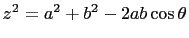 and
and
 . If
. If
 be the set of all ordered pairs (a,b) such that a and b are
real numbers, and
be the set of all ordered pairs (a,b) such that a and b are
real numbers, and
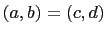 iff
iff  , and
, and  .
.
is defined as
 .
.
 and
and  in
,
in
,
 .
.
 .
.
 ,
,  , and
, and  are elements of
, then
are elements of
, then
(i) |
 and and |
(multiplicative and additive closure) | ||
| (ii) |
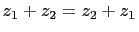 and and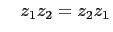 |
(commutativity) | ||
| (iii) |
 and and 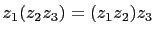 |
(associativity) | ||
| (iv) |
 |
(distributive) | ||
| (v) |
 is the additive identity. is the additive identity. |
|||
| (vi) |
 then then 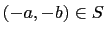 is its additive inverse. is its additive inverse. |
|||
| (vii) |
 is the multiplicative identity. is the multiplicative identity. |
|||
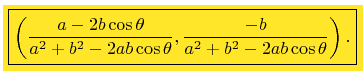
| (viii) |
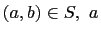 and and  not both not both then the multiplicative inverse is then the multiplicative inverse is |
|||
 |
, under addition and multiplication as defined, is a
field.
The multiplicative inverse was found by noting that if
is
the multiplicative inverse of
then

Hence,
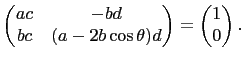
So, from Cramer's rule,
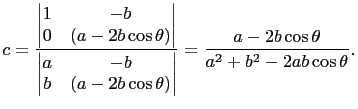
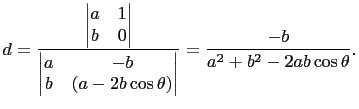
can be written as a sum. Note that
 and
and
 is equivalent to
  ; so let
  then
can be
written as
then
can be
written as  . I want to find an expression for
  . We have,

Hence
 . Set
. Set

If
 and
and
 then
then

And,From equation (43),
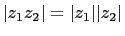 .
.
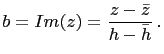
The real part of
is
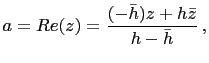
and the imaginary part of
is
Note: If  and
and
 then
then
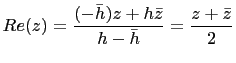 and
and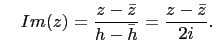
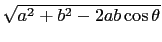
From equation(43), we know that if
is plotted in
the plane, then  , the distance from the origin to the point
, is
, the distance from the origin to the point
, is
 . This can be
accomplished if the positive
. This can be
accomplished if the positive  axis is rotated
degrees
clockwise out of the
axis is rotated
degrees
clockwise out of the  axis as in figure (5).
Rotate the positive conjugate axis counterclockwise 90
degrees out of the negative real axis. Then
axis as in figure (5).
Rotate the positive conjugate axis counterclockwise 90
degrees out of the negative real axis. Then  can be plotted
along with
, as shown in figure (5).
can be plotted
along with
, as shown in figure (5).
In figure (6)
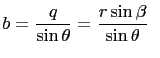 where
where 

Then

And

In equation (44), for
 ,
if and only
if
,
if and only
if
 . That is, if and only if the imaginary and
conjugate axes are rotated
. That is, if and only if the imaginary and
conjugate axes are rotated  degrees from the
axis,
clockwise and counterclockwise respectively in figure
(5). This brings them into coincidence at right angles to
the real axis as shown in figure (7).
degrees from the
axis,
clockwise and counterclockwise respectively in figure
(5). This brings them into coincidence at right angles to
the real axis as shown in figure (7).
Replace
with
 throughout. Since
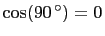 , multiplication becomes
 ,
, and
. Then
becomes the field of complex numbers.
,
, and
. Then
becomes the field of complex numbers.
![\includegraphics[width=5in]{../../../texdocs/ip9}](img1012.gif)
 and
and 


![\includegraphics[width=4.5in]{../../../texdocs/ip10}](img1065.gif)
![\includegraphics[width=3.0in]{../../../texdocs/ip11}](img1070.gif)
 and
and
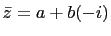
![\includegraphics[width=3.5in]{../../../texdocs/ip12}](img1083.gif)