


A perfect number is a positive integer that is equal to the sum of
its divisors excluding itself. For example  is a perfect number
since its divisors are
is a perfect number
since its divisors are  and
where
and
where 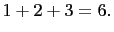 All
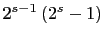
even perfect numbers are of the form
All
even perfect numbers are of the form
 where
where  is a prime. Such primes are called Mersenne primes.
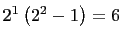
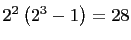
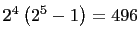
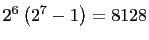
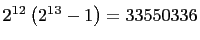
The first five perfect numbers are
is a prime. Such primes are called Mersenne primes.
The first five perfect numbers are
It's not known if there are any odd perfect numbers.
From corollary (1) and theorem (2) we see that
it is no coincidence that the area of the  triangle, the
smallest Pythagorean triangle, is
triangle, the
smallest Pythagorean triangle, is
 , the smallest perfect
number.
, the smallest perfect
number.
Let  be a positive integer such that
  is a prime
(Mersenne prime). And let
is a prime
(Mersenne prime). And let
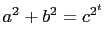 be a primitive
Pythagorean triangle. Then, as table (4) shows, the area
be a primitive
Pythagorean triangle. Then, as table (4) shows, the area
 is a multiple of the perfect number
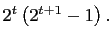
Examples
Consider the two primitive Pythagorean triangles
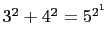 and
and
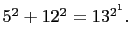 In this case
Since
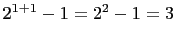 is a prime, we know that each area must be
a multiple of the perfect number
is a prime, we know that each area must be
a multiple of the perfect number
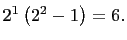 And
indeed,
And
indeed,
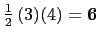 and
and
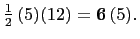
Consider the two primitive Pythagorean triangles
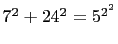 and
and
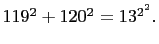 In this case
Since
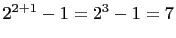 is a prime, we know that each area must be
a multiple of the perfect number
is a prime, we know that each area must be
a multiple of the perfect number
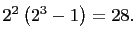 And
indeed,
And
indeed,
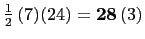 and
and
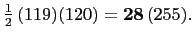
Consider the two primitive Pythagorean triangles
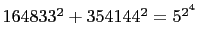 and
and
 In this case
Since  is a prime, we know that each area must be a
multiple of the perfect number
is a prime, we know that each area must be a
multiple of the perfect number
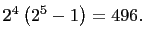 And
indeed,
And
indeed,
 and
and

Note: Since
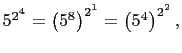
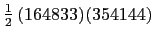 is also a multiple of each of 6 and
28.
is also a multiple of each of 6 and
28.
That is,
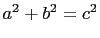 is a primitive Pythagorean triangle
then its area is a multiple of the perfect number
is a primitive Pythagorean triangle
then its area is a multiple of the perfect number
 .
.
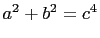 is a primitive Pythagorean triangle
then its area is a multiple of each of the perfect numbers
and
is a primitive Pythagorean triangle
then its area is a multiple of each of the perfect numbers
and
 .
.
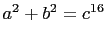 is a primitive Pythagorean triangle
then its area is a multiple of each of the perfect numbers
is a primitive Pythagorean triangle
then its area is a multiple of each of the perfect numbers
 , and
, and
 .
.
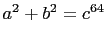 is a primitive Pythagorean triangle
then its area is a multiple of each of the perfect numbers
is a primitive Pythagorean triangle
then its area is a multiple of each of the perfect numbers
 , and
, and
 .
.
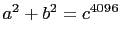 is a primitive Pythagorean triangle
then its area is a multiple of each of the perfect numbers
is a primitive Pythagorean triangle
then its area is a multiple of each of the perfect numbers
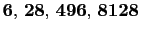 , and
, and
 .
.
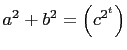 is a primitive Pythagorean
triangle where
is a Mersenne prime then the
triangle's area is a multiple of each perfect number less
than or equal to the perfect number
is a primitive Pythagorean
triangle where
is a Mersenne prime then the
triangle's area is a multiple of each perfect number less
than or equal to the perfect number