

NEWS - HISTORY - ARCHIVE - TEAMS - RESULTS
SCHEDULE - MARMADUKES - HOW IT WORKS - RULES
TEAMS CHAMPIONSHIP - DRIVERS CHAMPIONSHIP
TEAM SIGN-UP - HOSTING SIGN-UP
NEWS -
HISTORY -
ARCHIVE -
TEAMS -
RESULTS
SCHEDULE -
MARMADUKES -
HOW IT WORKS -
RULES
TEAMS CHAMPIONSHIP -
DRIVERS CHAMPIONSHIP
TEAM SIGN-UP -
HOSTING SIGN-UP
FORMULA MARMADUKE
RACING
RULES
Formula Marmaduke Racing™ (FMR) is the future of motor sport in NationStates. It used to be that we took a small furry-feathery animal, strapped it into a superpowered small race car-like vehicle and let it loose to conquer the FMR world. Those days are gone. FMR is now much more sophisticated...
THE TRACK
The track is where the entire race takes place. The term 'track' is somewhat deceptive, as the race could conceivably cover an entire nation. The race is divided into four legs, each designed to be about an hour long. The first is a motorbike leg (2-wheeler) where Marmadukes will ride an engine-powered two wheel vehicle around the streets of a host city. The 2-wheelers can reach top speeds of around 200 km/h but have an average speed of 125 km/h, hence 125 km needing to be completed by 2-wheeler Marmadukes before they can peel off to the next leg. At the end of the specified number of street laps, drivers floor it on a special transitional road where they will meet with their teams and swap vehicles. Drivers will have to get off their 2-wheeler and into the 4-wheeler as fast as possible. The 4-wheelers are much more like the traditional FMR vehicles of old. They cover 200 km on a proper race track, a little bit shorter than the 250 km/h than was used in the below example. 4-wheelers have a top speed of about 300km/h but given corners and such, will hover around 200 km/h as an average speed.
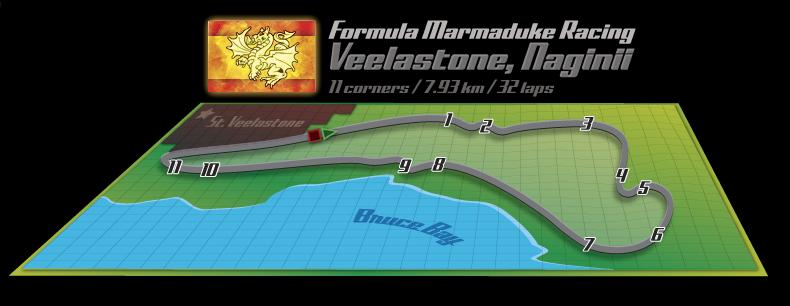
Fig 1:
Veelastone in Naginii. This is a prime example of a 4-wheeler racetrack
and was used in the first international FMR season in Ile de France.
Similar to the 2-wheeler to 4-wheeler transition, drivers of the 4-wheeler vehicles drive off on a different transitional road to meet their teams once more. This time its to change into the AG vehicle, better known as the 0-wheeler. The 0-wheeler can hit a top speed of around 700 km/h but will more likely race at around 500 km/h over its 500 km course. Given the length of the course, the 0-wheeler is used as a method of transport, albeit over a winding, long course, to get drivers out to the landmark (eg: forest, mountain, swamp) where the rally event will be held. The rally event, the R-wheeler leg, is, as stated before, held in some sort of difficult terrain. Here the cars are much sturdier than their other leg counterparts and are built more for strength than speed. They are closed-wheel rally cars with four specially-designed mud tyres to cover the 75 km of rallying required. The whole grand prix covers about 900 km and usually provides some spectacular vistas across the varied nations that it is held in.
THE RACE
The simple aim of a FMR GP is to cover the 900 race kilometres as quickly as possible. This usually involves avoiding accidents with other drivers and man-made barriers. Unfairly infringing on another racer may result in disqualification. Tampering of any kind with anyone's vehicle will also be severely punished. On a race weekend, there are two races. On Sunday, the race is run. All safety standards, as set out by the MSA, must be met by teams, otherwise they will be unable to race. Teams must be ready to submit to an MSA inspection at any time. All equipment, except for T/AG generators, chassis material or engine, must be provided by teams. The other equipment must come from official sponsors of FMR. No team may run more than the three drivers. No animals, except Marmadukes, may drive in a grand prix. The grid order will be decided on the previous race's results, with the winner taking pole, second taking the other front row position, etc. There are no pit stops, other than those used to make a vehicle transition.
SEASON SETUP
Depending on finishing position, points will be awarded to drivers. Usually the top quarter to top third of finishers will gain points in a fixed system, with the most going to first place, then second place, etc. Two trophies will be given out over a tour (the normal part of the season is divided into regional tours): Champion Driver and Champion Team. The points a driver accumulates are added to their partners point to get the team results. The highest points at the end of a tour walks away with the trophy. The season's tours are open to all teams and are a stepping stone to the next level: the MarmaCup. This is the grand prix where most drivers are excluded and only the best may race. There are three methods for qualification. Some grands prix within a tour will give the winner automatic qualification. Occupying top positions of a championship at the conclusion of a tour will also give qualification. Finally, a threshold of points will be set and if a driver/team exceeds this threshold over the season, they will be eligible. The details of which grands prix wins, what positions in tours and what number of overall season points required to gain qualification changes from season to season and will be set at the time when the points distribution for a grand prix is announced.
SIDENOTE: All decisions of the MSA are final and no correspondence will be entered into.
That's how the game works in game terms. If you would like to know more about it mathematically, see the How It Works.