FORBES CULTURAL PLAN: a community initiative by the Forbes Arts & Culture Working Group to develop a new vision for the Shire of Forbes, NSW
|
What is the Forbes Arts & Culture Working Group? NSW State Gov's Cultural Planning Guidelines (pdf download)
|
COMMUNITY
NEWSLETTER: CONTENTS
NB: ORGANIZATIONS ARE REQUESTED TO NOMINATE A MEMBER TO REPRESENT THEM AT THIS IMPORTANT MEETING. WHAT IS THE FORBES ARTS & CULTURE WORKING GROUP? Forbes Shire Council’s Arts and Culture Working Group began its life in early 2004 as the Arts and Cultural Sub-Committee of the Forbes Shire Council. The sub-committee lapsed after the last Council elections but was revived in 2005 as an independent working group after local writer, Merrill Findlay, reluctantly accepted Mayor Alister Lockhart’s invitation to chair it.
The Working Group’s primary task will be to develop a 3-5 year cultural plan for the Forbes Shire through a process of community consultation and participation. It will also seek to support, facilitate and inspire creative endeavours that both enrich the lives of Shire residents and attract more people to visit and settle in the shire. At its meeting on 19th April 2005 the Working Group will host a broad-ranging discussion about local arts and culture as a first step in the cultural planning process. All schools, churches, service organisations, arts, crafts and theatre groups in the shire are invited to nominate representatives to contribute their ideas to this meeting. The interim Chairperson, Merrill Findlay, also extends a personal invitation to all the Shire’s cultural practitioners: to our community writers, painters, musicians, choristers, photographers, historians, computer geeks, software and web designers, sculptors, landscapers, revegetation experts, gardeners, graphic designers, farmers, teachers, cooks, rappers, rockers, poets, bush balladeers, wood workers, knitters, spinners, weavers, potters, builders, welders, collectors, performers, folklorists, video/film makers, theatre directors, actors, singers, composers, restaurateurs, publicans, café proprietors, beer and wine makers, fashionistas, ‘dags’, couch-potatoes and story-tellers of all ages and all backgrounds. To anyone, indeed, who does anything creative and/or cares about the future of Forbes and the many small communities and districts that are part of our Shire. WHAT IS CULTURAL PLANNING & WHY IS IT IMPORTANT FOR FORBES? Local government in the twenty-first century is about much more than Roads, Rates and Rubbish; it’s even about more than sound economic, environmental and social management. Because, these days, councils are expected to also consider the cultural dimensions of people’s lives through an integrated and strategic process of cultural planning.
The NSW Department of Local Government and Ministry of Arts recent publication, Cultural Planning Guidelines for Local Government, suggests that good cultural planning contributes to a community’s ongoing wellbeing and future sustainability by ‘providing opportunities and removing obstacles to people’s cultural expression, creativity and sense of place’. It claims that in healthy and vital communities all residents, regardless of their backgrounds, have opportunities to express themselves creatively; to engage with local cultural heritage, such as historic buildings and landscapes, literature and music, community traditions and folklore; to experience new artistic productions, such as travelling exhibitions, theatre, books and music productions that challenge them with new ideas; and to develop uniquely local forms of cultural expression through individual or collaborative projects. Such opportunities can be encouraged and facilitated by local government through strategic and integrated cultural planning. The State Government’s Cultural Planning Guidelines (pdf download) suggests that culture is about individual and community values as well as material things. ‘Culture’ is our ‘relationships; shared memories, experiences and identity; diverse cultural, religious and historic backgrounds; values and aspirations; and what we consider to pass on to future generations.’ ‘Culture’ is also ‘the performing and visual arts including digital and website art, craft, design and fashion; media, film, television, video and language; museums, art galleries, artefacts, local historical societies, archives and keeping places; libraries, literature, writing and publishing; the built environment, heritage, architecture, landscape and archaeology; sports events, facilities and development; parks, open spaces, wildlife habitats, water environment and countryside recreation; children’s play, playgrounds and play activities; tourism, festivals and attractions, and informal leisure pursuits’ (Cultural Planning Guidelines, p. 22). Cultural planning is therefore a way of identifying the values and things that contribute to our quality-of-life and give us our ‘sense-of-place. It is also a necessary first step in conserving, nurturing, supporting, enhancing and promoting them in ways that enrich the lives of all Shire residents now and in the future, and attract more people to the region. The State Government’s Cultural Planning Guidelines are also available from www.arts.nsw.gov.au/WhatsNew/CPG.htm. ‘CULTURE’
IS WHAT MAKES LOCALS WHO THEY ARE & OUR SHIRE UNIQUE Local culture, in its broadest sense, is everything that makes Forbes Shire special and unique: all the traditions, memories, buildings, landscapes, experiences and practices that make Forbes people who they are, Hannah Semler told the Working Group. These values and things can be identified, or ‘mapped’, as part of a cultural planning process. Cultural mapping can also identify the gaps in people’s cultural experience, as well as ways of filling those gaps. A number of Central Western councils have already developed cultural plans, Hannah noted. One of the most successful of these was completed for Cowra by members of the Cowra Cultural Council, a Section 355 Committee of the Shire Council. It was adopted in October 2003, and a Culture and Recreation Officer has been appointed to implement its strategic goals.
Cowra, a town of comparable size to Forbes, already has some excellent arts amenities, Hannah told the meeting. These include a modern cultural precinct with a sophisticated art gallery that is now staffed by a full-time professional director and offers a year-round exhibition program. Cowra also boasts an impressive Visitor Information Centre on the Mid Western Highway, with space for local artists and crafts workers, a book shop, and a hologram theatre commemorating one of the shire’s most historically significant events, the breakout of Japanese POWs in 1944. These cultural facilities, along with Cowra’s beautiful public gardens, are an inspiration for other towns along the Lachlan River, Hannah said. Parkes Shire also offers some enviable cultural amenities, including a well-resourced new library, a new theatre, and public spaces that are ideal for art exhibitions, receptions and chamber music recitals. Parkes also has a functioning Arts Council to support and facilitate local arts events. All the cultural plans that Hannah Semler discussed were developed before the Ministry for Arts and Department for Local Government published their ‘How To’ guide, and are not as comprehensive as they might be, she commented. In particular, they lack a reviewing process and are not adequately integrated across all spheres of government. Most cultural plans also tend to echo motherhood statements about ‘sense of place’ and local identity without really capturing what Hannah Semler calls the ‘heart and soul’ of a place. ‘So for Forbes, the most important thing will be that your cultural plan reflects the true heart and soul of the Shire as a whole -- in all of its parts, not just what we assume and what we have seen elsewhere, or what has already been tagged as significant,’ she said. Hannah emphasised, however, that cultural planning requires an integrative whole-of-Council approach so that the social, environmental, economic and cultural dimensions of all Council decisions are considered. Forbes Shire is much more than a single town. It includes many small rural communities and localities, each of which has its own unique local heritage that needs to be considered in the cultural planning process. In spatial terms, the Shire includes the following communities and localities: Back Yamma, Bandon, Bandon South, Bareenong, Bedgerebong, Bonny Dell, Bundaburrah, Calarie, Carawandool, Carrawabbity, Cookamidgera, Corinella, Corridgery, Cumbijowa, Daroobalgie, Derriwong, Eugowra, Forbes, Forbes North, Forbes South, Garema, Grawlin, Grawlin Plains, Grudgery, Gunning Gap, Inchgower, Ironbarks, Jemalong, Jemalong Weir, Mackay’s Creek, Mafeking, Mandagery, Mulguthrie, Mulyandry, Mungarra, Ootha, Paytens Bridge, Pinnacle, Red Bend, Riversleigh, Slimbridge, South Lead, Tomanbil, Vychan, Wandary, Warroo, Weelong, Wirrinya, Wongajong, Wowingragong, Yarrabandai, and Yarragong. The Shire is also home to 10 000 people from diverse traditions, backgrounds and ethnicities, including Wiradjuri, Irish, English, Scottish, Welsh, Chinese, Italian, French, German, Greek, Dutch, Sikh, Korean, Filippina, Vietnamese, Lebanese, African and Afghan, to name but a few. The contributions each of these groups has made to the Shire need to be acknowledged and celebrated, and their different cultural aspirations included in the cultural planning process. The Working Group is committed to giving everyone an opportunity to participate in this project. Next meeting: 19 April, 5.30 pm, at the Council Concourse. Please attend to have your say.
|
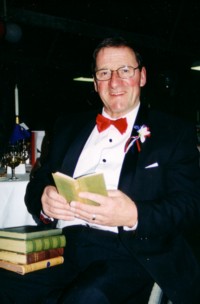 Mayor
Alister Lockhart with books from the historic Paul & Hettie
Wenz Collection, 12 June 2004. Photo by Merrill Findlay.
Mayor
Alister Lockhart with books from the historic Paul & Hettie
Wenz Collection, 12 June 2004. Photo by Merrill Findlay.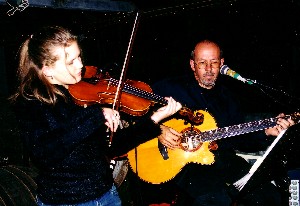 Local
musicians performing at Champsaur Winery, Forbes, 12 June 2004.
Photo by Merrill Findlay.
Local
musicians performing at Champsaur Winery, Forbes, 12 June 2004.
Photo by Merrill Findlay.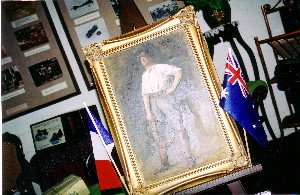 Portrait
of local writer and farmer,
Portrait
of local writer and farmer, Forbes
Arts & Culture Working Group 2005:
For more information please contact [email protected]
Site created 2 May 2005, last revised 2 May 2005