NOTES
FROM THE APRIL 2005 MEETING
Tuesday
19 April at the Forbes Town Hall
Report
on this meeting in the Forbes Advocate: Shire
needs a cultural plan, Thursday 12 May 2005 more
ATTENDANCE:
Richard Barwick, Forbes Shire Council;
Elaine Imrie, Upstairs Gallery; Denise Sheridan-Smith, SOPHIA Women's
Group; Clr Ron Penny, Forbes Shire Council; Mary Laksito, Forbes
Museum; Robyn Kenny, Forbes Town Band; Sian Dyce, Forbes Promotion
& Development Inc; Carmen Dundon, St Laurence's School; Michelle
Herbert, Forbes North Public School; Clr Graham Falconer, Forbes
Shire Council; Duncon Williams, Rural Land Protection Board; Ian
Taylor, Rural Land Protection Board; Marg Willmott, Mitchell Conservatorium;
Merrill Findlay, interim chair/convener.
APOLOGIES:
Clr Alister Lochart; Mandy McMahon; Jo Erskine; Bob Lytton.
PRE-MEETING
PRESENTATION
Interim
Chairperson/convener Merrill Findlay gave a brief overview of the
envisaged cultural
planning process, based on the Guidelines
for local government developed by the NSW Ministry for the Arts
and Department of Local Government in 2004.
Overhead
1: What is culture?
[pdf download]
Overhead 2: Three
dimensions of culture [pdf
download]
Overhead 3: What
is cultural planning? [pdf
download]
Overhead 4: 9-step
cultural plan & proposed timeline [pdf download]
Merrill
suggested that the planning process should take at least 18 months,
as recommended by the State Government’s Guidelines, and that
we were still in the preliminary preparation stage. She then handed
the meeting over to Graham Falconer to facilitate a general discussion
while she recorded people’s cultural interests, concerns,
and aspirations for future reference.
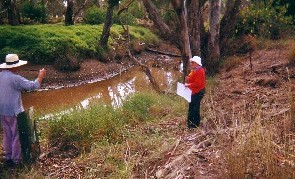 Art
& Culture & Sense of place:
'But where on earth do I begin?' student Carol asks Patrick Shirvington.
This landscape painting workshop was organised through the Forbes
Upstairs Gallery. Art
& Culture & Sense of place:
'But where on earth do I begin?' student Carol asks Patrick Shirvington.
This landscape painting workshop was organised through the Forbes
Upstairs Gallery.
Photo by Pamela Watson, 1 May 2005.
GENERAL
BUSINESS
Discussion during the meeting covered a range of topics that may
be organised under the following themes:
1. The problem with ‘culture’
2. Why Forbes Shire Council needs a community Cultural
Plan
3. Preliminary data required for the
proposed Cultural Plan
4. The River and natural heritage
5. Wiradjuri heritage
6. Non-indigenous cultural heritage/history
7. Deeper issues about the future
8. SWOT analysis [Strengths,
Weaknesses, Opportunities, Threats - more
info]
9. Community Consultation
Draft
Cultural Mapping questionnaire for comments
1.
The problem with ‘culture’
In her brief overview Merrill Findlay noted that, ‘culture’
had at least three dimensions, in that it referred to:
1. our sense of place, values and identities;
2. material ‘things’ produced through creative processes,
such as paintings, poetry, music and craft work, buildings, gardens,
landscapes and streetscapes; and
3. our engagement in creative processes (eg story-telling, painting,
writing, singing, performing in a theatre group, band or choir).
All three of these dimensions need to be addressed in the proposed
cultural plan, according to the State
Government’s Guidelines (see www.arts.nsw.gov.au/WhatsNew/CPG.htm)
A
number of people commented that because ‘culture’ is
such a complex and difficult concept, we need a more accessible
word. Sian Dyce suggested that instead of asking people about ‘local
culture’ we ask them ‘what’s special about their
way of life’.
Graham
Falconer emphasised that the range of issues we needed to cover
in developing a cultural plan was all-encompassing, because it included
everything from local cuisine to rural landscapes along with all
the diverse values people attached to them. He made a quick list
of Forbes Shire's cultural dimensions that covered several pages!
2.
Why Forbes Shire Council needs a community Cultural Plan
Graham Falconer told the meeting that we required a cultural plan
for at least one very pragmatic reason: to obtain funding for arts
and cultural activities, and/or for a cultural centre. Without a
cultural plan all local organisations wishing to apply for grants
would be disadvantaged.
Ron Penny suggested that the proposed cultural plan would be a first
step in developing new public cultural amenities for the Shire,
as discussed by the Heritage Committee and other groups (See Lachlan
Valley Cultural Complex Proposal 2004 - pdf
download). Ron specifically mentioned Gilgandra's Cooee
Heritage Centre as a useful model for what might be possible
in Forbes.
Merrill
Findlay noted that the Cowra Shire’s Cultural Plan was developed
by the Cowra Cultural Council, an independent community group similar
to the Forbes Arts and Culture Working Group. She reported on a
recent conversation with Cowra’s Councillor Ruth Fagan who
claimed that their cultural planning process ‘electrified’
the Cowra community and inspired many unique creative endeavours.
Cowra now has a modern
art gallery, a tourist centre with a holographic interpretation
of the POW Breakout with space for local writers and artists and
a national sculpture exhibition in the Japanese gardens. A council
officer has also been appointed tp implement the recommendations
made by the community through the cultural planning process. Cowra
also has an annual multicultural Festival which, over forty years,
has enriched the lives of several generations of children by exposing
them to a broad range ofpeople from many different cultural backgrounds,
and other diverse cultural experiences.
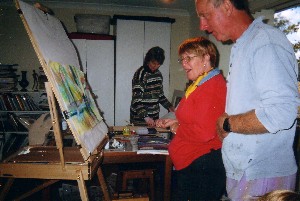 Sense
of place - the Patrick Shirvington Landscape Painting Workshop:
Carol seeks inspiration from Patrick as she adds watercolour to
her sketch of Billabong Creek, while fellow student Claire works
in the background. The Workshop at Allandale near Tichborne was
organised through the Forbes Upstairs Gallery, 31 April-4 May. Sense
of place - the Patrick Shirvington Landscape Painting Workshop:
Carol seeks inspiration from Patrick as she adds watercolour to
her sketch of Billabong Creek, while fellow student Claire works
in the background. The Workshop at Allandale near Tichborne was
organised through the Forbes Upstairs Gallery, 31 April-4 May.
Photo by Pamela
Watson.
3.
Preliminary data required for the proposed Cultural Plan
Council already has demographic and other information, including
an audit of community venues and a list of people involved in past
Carnivales which would be helpful in mapping local culture and identifying
diverse groups within the community who need to be consulted as
part of the process of developing a cultural plan. Some of this
data could be adapted from community research now being done for
Council’s Sports and Recreation Plan and Social Plan. A calendar
of events held within the Shire throughout the year could also be
readily compiled. Several people suggested that it would be helpful
to identify the range of skilled people involved in cultural activities
within the Shire.
Recommendation:
that Council ‘dig out’ the demographic data, venue
audit, list of people involved with Carnivale and other relevant
information for use by the Working Group.
Richard Barwick undertook to do this.
4.
The River and natural heritage
Duncan Williams noted that there was ‘a huge amount of natural
things that are culturally important, especially the river that
makes us what we are’. Elaine Imrie agreed that the Lachlan
River was central to both the existence of the town of Forbes itself,
and to the identity of shire residents. Both Duncan Williams and
Elaine Imrie emphasised that ‘we don’t make enough of
our river’ and should ‘play it up for all it’s
worth’. Elaine spoke about her own memories of the Lachlan
and how important it was for her. She used the example of the Apex
Caravan Park to emphasise the continuing cultural significance of
the river: every second Thursday there’s a river-side barbecue
and concert at the site of the old Forbes swimming pool and open
air dance floor that were so important when she was growing up,
she said. [The local choirs were singing at the next Thursday gig.]
Duncan noted that thousands of people still camp along the river
on weekends, which is another indication of how important the river
is to visitors and locals alike. It is also the primary source of
our water for domestic, agricultural and manufacturing needs –
so in a very basic sense we wouldn’t exist without the river.
Graham Falconer recalled the Probis tour along the Lachlan. He still
has the information from this tour which, he suggested, might be
useful.
5.
Wiradjuri heritage
Ian Taylor, speaking for the Rural Land Protection Board, commented
that a good place to start in mapping the Shire's culture would
be Aboriginal the cultural connection Aboriginal people have to
sites on the Travelling Stock Routes. Richard Barwick added that
Council has some of this data as a result of its Scarred Tree Project.
Michelle Herbert, representing Forbes North Public School, advised
the Working Group that her school was now teaching Wiradjuri, and
that ‘little kids’ were beginning to speak the Shire’s
first language. Aboriginal culture was therefore now taking place
in her class room. Many Shire place names are derived from Wiradjuri
words, such as Wirinya (a place to lie down), and these meanings
were also important to the Shire’s cultural heritage, Michele
observed. Graham Falconer noted that it was only in the last twenty
years that Aboriginal people had begun returning to this town.
6.
Cultural heritage/history
Mary Laksito emphasised the importance of heritage to the identity
of Forbes people. Ron Penny reminded us that the Shire had some
very significant cultural heritage assets ranging from Burrawang
Station and its 5-star resort, to the river, the lake and the town
itself, which presented great potential for the future. (The recent
Heritage study identified 240 items that are of cultural significance
within the Shire.) Ron suggested that we all had many ideas in common
and needed to have something to aim for, and referred to several
ideas that had been proposed to Council’s Heritage Committee,
including the need for somewhere to house the Wenz
Collection. He also believed the Shire needed a community facility
that was something like the Cooee
Heritage Centre at Gilgandra. Many people emphasised that because
Forbes has so many historically significant sites and identities,
heritage is very important to local people, both young and old.
For Margaret Willmott and others of her generation, the most important
thing in Forbes was the town hall, for example, because that was
where they went to dances and have experienced so many significant
events in their lives. Marg said she wanted to be sure that it would
always be preserved, that it would never be turned into Council
offices, for example. ‘It would be a crime to destroy it,’
she said. And even local children were ‘wrapped’ in
their local heritage and stories about the past, Carmen Dundon reported.
Her students at St Laurence’s especially loved the recent
Heritage Week.
7.
Deeper issues about the future
Ian Taylor pointed out that we needed to ‘look at the now
and the future with a view to looking at what will attract people
to stay here, and ways of connecting people in the city to here’
in our cultural plan. Denise Sheridan-Smith commented that this
meant we needed to look at things that were much deeper than putting
a sign up that says Forbes is ‘warm, friendly and inviting’,
or a 'tidy town', for example. Denise emphasised that many of the
issues that were of concern to women were often overlooked and these
could also be highlighted in the cultural planning process.
8.
SWOT analysis
(Strengths, Weaknesses, Opportunities, Threats)
Ron Penny suggested we need a firm strategy and proposed doing SWOT
analysis to determine the cultural needs and aspirations of
Shire inhabitants and define a series of goals and objectives for
the Working Group. Graham Falconer added a range of other analytical
tools he thought would be useful in defining the key issues and
actions we needed to focus on, who should undertake the work, and
when it should be done.
9.
Community Consultation
Carmen Dundon commented that many people involved in cultural activities
do not belong to groups and asked how we might tap into their concerns
and aspirations. She suggested we needed to develop a list of people
from diverse backgrounds to talk to in the community in developing
the cultural plan. Denise Sheridan-Smith agreed that it was important
to go to the community to ask people what was important, because
consultation makes people feel valued. She suggested we consult
with ‘our elders’ in Jemalong retirement village, for
example. Others emphasised the cultural needs and aspirations of
‘the mobile phone generation’ who were the Shire’s
future. Richard Barwick suggested that the coordinator of the Youth
Centre, Chelsea Ridley, might be able to help with accessing young
people. Duncan Williams suggested that the ‘average joes’
in the pubs could give us more culturally significant information
than many of the organisations around town.
Merrill
Findlay distributed a preliminary
draft questionnaire designed to collect cultural information
and asked that people ‘test drive’ it at the meeting.
Sian Dyce recommended some changes to simplify the draft questionnaire,
and commented that many people are uncomfortable with reading, or
may be illiterate, so other modes of consultation will be required.
The next draft will incorporate Sian’s recommendations and
be refined at future meetings. A number of people tested the form
by filling it in.
Marg
Willmott proposed that we send the final form to each household
in the Shire, and asked how this might be facilitated. Richard Barwick
advised that it would cost around $350 dollars, and suggested that
it would be possible for Council to fund this. Other people observed
that phone conversations and personal contact might be more effective
ways of consulting people.
Recommendation:
that council be asked to pay for delivery and production of questionnaire
to the cost of no more than $350.
Moved by Marg Willmott
Seconded Denise Sheridan-Smith
Carried
Merrill Findlay also proposed that the Working Group, Forbes Shire
Council, the Forbes Advocate and Community Radio 97.9FM co-sponsor
a writing ‘competition’ asking local people to write
up to 1000 words about something that means a great deal to them
and their family in the Shire, as a way of collecting cultural information
for the proposed cultural plan. The Advocate and radio station have
offered their support for this, with a view to publishing and broadcasting
the winning entries. Merrill suggested that the Schools might be
interested in setting an essay as a school project, but Michele
Herbert reported that schools were already so busy that another
competition would be asking too much of them. The teachers at the
meeting suggested that, in their experience, people might also need
some kind of incentive to write, and that in the past the promise
of a Freddo Frog for each entry had been successful in encouraging
primary school students to enter!
Recommendation:
that the Working Group invite Council to sponsor a competition
asking people to write about ‘what’s special about
Forbes for you and your family’.
Moved Graham Falconer
Seconded Elaine Imrie
Carried
The meeting ended after 7pm.
Next
meeting will be on Monday 16 May at 5.30 pm at the Council Meeting
Rooms. (Monday was chosen so the Working Group meeting wouldn’t
clash with Council meetings.)
|