On October 18, 1890, the NSDAR Insignia and Seal Committee reported that the
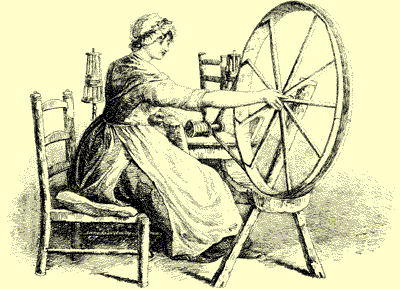
design for the first DAR seal should be "the figure of Abigail Adams in the
costume of 1776 seated at a spinning wheel;" however the committee
reported on November 11, 1890, that it should be "charged with the figure of a
dame sitting at her spinning wheel."
The Committee chairman, Mrs. G. Brown Goode, took the design to her husband,
Dr. G. B. Goode, who was the Chairman of the Advisory Board and assistant
secretary of the Smithsonian Institution. After carefully studying the design,
he was able to make a most unique emblem for the Daughters of the American
Revolution. It reminded him of the spinning wheel of his grandmother, Rebecca
Hayes Goode of Amelia County, Virginia, who had done her part for the American
Revolution while seated at her spinning wheel. However his grandmother's old
spinning wheel had been made sometime between 1775 and 1825 and had fourteen
spokes, but Dr. Goode decided to use only thirteen spokes to represent each of
the thirteen colonies.
The first DAR Seal showed a lady dressed in a 1776 period costume, seated at
her spinning wheel, with the motto, "Amour Patriae," meaning "Our Love of Our
Country." The motto was approved and accepted at the first Continental
Congress on February 22, 1892, but was changed in 1972 to "God, Home and
Country."
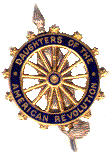
For its insignia pin, the DAR uses only the wheel of the spinning wheel,
which has been described as: "the gold wheel over a distaff filled with platinum
flax, the wheel with thirteen spokes, having opposite the end of each a star
intended for the reception of a jewel," which included a rim with letters of
gold on blue enamel with the words, "Daughters of the American Revolution."
J. E. Caldwell & Co. was authorized to make the first insignia pin on
July 1, 1891, and has long remained the official jewelers for the NSDAR. At that
same time, Dr. Goode was also granted a patent for Design No. 21053, Serial No.
401,584 in the name of the National Society Daughters of the American
Revolution. (A Century of Service, The Story of the DAR, Ann Arnold Hunter,
NSDAR, pp. 19-21)