









|
|
|
|
|
|
|
|
||
|
|
|
||
|
|
|
|
|
|
|
|
||
|
|
|
||
|
|
|
||
|
|
|
||
|
|
|
||
|
|
|
||
Language
| Nigeria | Canada |
|---|---|
| English | Englsih |
| Nigeria | Canada |
|---|---|
| The school year runs from January to December. It consists of three semesters with a month between semesters. | The school years runs from September to June. There is a two week Christmas break and a one week spring break. |
| Nigeria | Canada |
|---|---|
| During primary and secondary school, students wear a uniform specific to the school. During special functions or events, students may sometimes be allowed to wear what they choose. | Public schools usually allow students to wear whatever they choose. Private or separate schools may require their students to wear a uniform. |
| Each school has specific guidelines for hair, shoes, jewelry, and other accessories. | Schools also have specific guidelines for hair, shoes, jewelry, and other accessories. |
| Nigeria | Canada |
|---|---|
| Begins at the age of six. | Also begins at the age of six. |
| Students spend a compulsory six years in primary school. | Student spends eight years in primary school. |
| Subjects taught in primary school are mathematics, English, religion, science, and one of the three main native languages (Hausa, Toruba and Igbo). Private schools also offer computer science, French and art. | Subjects taught in primary school are mathematics, English, religion, science, geography, history, physical education, and either French or Inuktitut. |
| Students need to pass a National Common Entrance Exam to move onto secondary school |
| Nigeria | Canada |
|---|---|
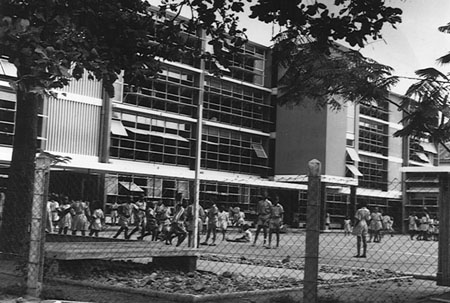
| Students spend six years in secondary school. | Students spend four years is secondary school. |
| Secondary schools are managed by private organizations, the State government or the Federal government. | Secondary schools are also managed by private organizations, the State government or the Federal government. | After three years, students take the Junior Secondary School exam, which qualifies them for senior secondary school. |
| At the end of senior secondary school, students need to pass a Senior Secondary Certificate Examination for admission to a Nigerian University. | In the second year of secondary school, students must pass the Secondary School Literacy Test to receive a diploma. |
| Nigeria | Canada |
|---|---|
| Subjects Taught at Junior Secondary School | Subjects Offered in Secondary School |
|
- fine art - music - English - business studies - integrated science - social studies - introductory technology - agricultural science - home economics - French - Nigerian language (Ibo, Hausa and Yoruba) - Arabic - Christian religious knowledge - Islamic religious knowledge - mathematics - physical education - health education |
- dramatic carts - music, instrumental music - music, vocal music - music, piano - music, music and computers - music, music theatre - fine arts - visual arts - media arts - film and video - applied journalism - business - financial accounting - marketing - organizational studies - computer and information science - computer engineering - geography - history - economics - law - environment and resource management - politics - English - French - mathematics - fuctions and relations - geometry and discrete mathmatics - mathemcatics and data management - physical education - science - biology - chemistry - phyics - food and nutrition - individual and family living - managing personal resources - fashion and creative expression - parenting - religion - integrated technologies - construction technology - manufacturing technology - technological design - communications technology |
| Subjects Offered at Senior Secondary School | |
|
- English - mathematics - literature in English - Nigerian languages (Igobo, Hausa and Yoruba) - biology - chemistry - physics - economics - commerce - food and nutrition - clothing and textile - home management - computer science\typing - French - music - applied electricity - auto mechanics - technical drawing - history - geography - Christian religious knowledge - Islamic religious knowledge - accounting - government - physical education - agriculture - Arabic - wood work - metal work - visual |
There are usually two Federal Government Colleges in each of Nigeria?s thirty-six states. These schools are funded and managed by the Ministry of Education. All staff and teachers are government employees. Teachers must have a Bachelors degree in Education or in another subject area such as mathematics, english, etc. Federal Government Colleges are intended to be the model secondary schools and admission is only reserved for exemplary students. Students do well in the National Common Entrance Examination in their final year of elementary school to qualify for Federal Government Schools. Tuition fees are only about $100 because there is funding from the Federal Government.
State owned schools are mediocre in contrast to Federal Government Colleges. Students do not have to pay a tuition fee, but still end up paying about $200 for books and uniforms. Teachers in state owned schools need a National Certificate of Education or a Bachelors Degree. These schools are usually understaffed because of low state budgets.
Private schools are much more costly than state owned or Federal Government schools. Tuition fees range from about $1000 to $2000 a year. Private schools have a better learning environment, newer equipment, and there are only ten to fifteen students per class. All teachers in these schools have a Bachelors degree or higher and continue their education through workshops on a regular basis.
The government of Nigeria mainly controls this university system. The government views education as a way for individuals to become a beneficial citizen of society and for the nation to develop.
To enroll in a university, students must pass the Universities Matriculation Examination (UME). This exam was first conducted in 1978 by the Joint Admissions and Matriculation Board (JAMB). A fifty percent score is considered a pass for the UME-JAMB although different schools have different requirements.