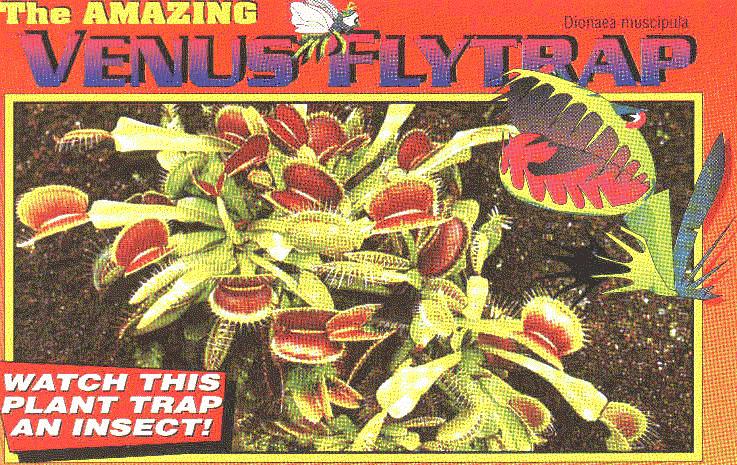
This year we are going to experiment with a new plant - the Venus Fly Trap. In the past, we have simply killed them. To try something different, we have decided to learn about them - and boy were we surprised...
The first surprise was that these plants have a dormant period. Like a Bear in hibernation, they simply shut down for part of the year. Unlike a bear, and more like a Poinsettia plant, they look like they are dead when they are hibernating. In the past, we figured they were dead and threw them out.
The second surprise, is that these plants need distilled water. Tap water, mountain spring water - Perrier, or not - will kill these guys.
In the past, either the plants went dormant and we threw them out, or they died a horrible death of water poisoning, died, and we threw them out.
So this year, as a start, we are not going to throw them out, and give them distilled water.
Carnivorous plants, like the Venus Fly Trap, require a bit of education. Universally recommended is Savage Garden, Ten Speed Press 1998, (ISBN 0-89815-915-6). While success with these plants is an open question for us, I recommend this book too. Many garden books are filled with pictures of wonderful gardens that landscape architects or floral designers have created; a lot of money and only a little information. Savage Garden is filled with information on a wide variety of Carnivorous Plants, and loaded with instructions for each that even we can understand. Buy the book...if you are going to but $10 worth of these plants, cough up the $20 for the book and keep them alive.
The author of Savage Garden also owns a nursery. He has placed information on growing Venus Fly Traps on his California Carnivores web site, probably to avoid the merciless slaughter of these plants at the hands of people like us.
Carnivorous plants are capable of attracting, capturing and digesting, using their own enzymes, insects. Other plants, which have a symbiotic relationship with other insects or bacteria, allow the guest to digest it and take advantage of the waste left over, are "semi-carnivorous." These plants are native to places with low nutrient soils, heavily saturated by rain. Thus, the roots have little nutrient material to absorb. Carnivorous plants,like other plants, absorb the nutrients through their leaves. Carnivorous plants go a few steps further than other plants, by catching and digesting insects.
The Venus Fly Trap is native to a 100 mile radius around Wilmington North Carolina. It was first noted by Arthur Dobbs, in 1763, when he was Governor of North Carolina; he called it the "Fly Trap Sensitive."
The Venus Fly Trap, and other carnivorous plants were studied by Charles Darwin (1809-1882), author of the Origin of Species (1859). Darwin published Insectivorous Plants in 1872 (later published in the United States in 1875). This book is calls into question the sanity of the father of the Theory of Evolution. Most of the book deals with another carnivorous plant, the "Sun-dew" or Drosera which he came across in 1860 during a walk on "...a heath in Sussex." However, he devotes 5 chapters of the book to various experiments that one can only describe as torturing the little Sun-dew plants to death.
The first of these experiments is reported in the chapter titled "The Effects of Heat on the Leaves." Darwin notes that during these experiments "Another interesting point presented itself, namely, at what degree was life extinguished...when the leaves after heated are immersed in solution of carbonate of ammonia." By chapter 8 he has become more sick, where he reports on his further experiments as "The Effects of Various Other Salts, and Acids,on the Leaves," and yes, he did use sulfuric acid along with others.
He gave the plant Chloroform and noted after a minute "...the lobes began to move at an imperceptibly slow rate..." and further, "The dose, however, was much too large, for in between 2 and 3 [hours] the leaf appeared as if burnt, and soon died."
Suprisingly, to Darwin at least, he determined that the plant can also be killed with Strychnine. The effect of Cobra venom was reported by Darwin as follows: "...it is manifest that the poison of the Cobra, though so deadly to animals, is not at all poisonous to Drosera; yet is causes strong and rapid inflection of the tentacles, and soon discharges all color from the glands."
Drosera does like to party though. Darwin immersed the plant in booze for 5 minutes and noted that the leaves became "...insensible for a time..." thus leading to his conclusion that "[S]ome anesthetic effect is here probable, but by no means certain." As to the effects of Morphine, Darwin notes "I tried a great number of experiments with this substance, but with no certain result" only noting that after dropping morphine on the leaves "...the movement...was greatly retarded."
Here at the Flying Liquor Bottle Ranch, we will continue on in the spirit of Darwin, but we will not be torturing our Venus Fly Trap. We will report on its behavior at parties in the near furture.