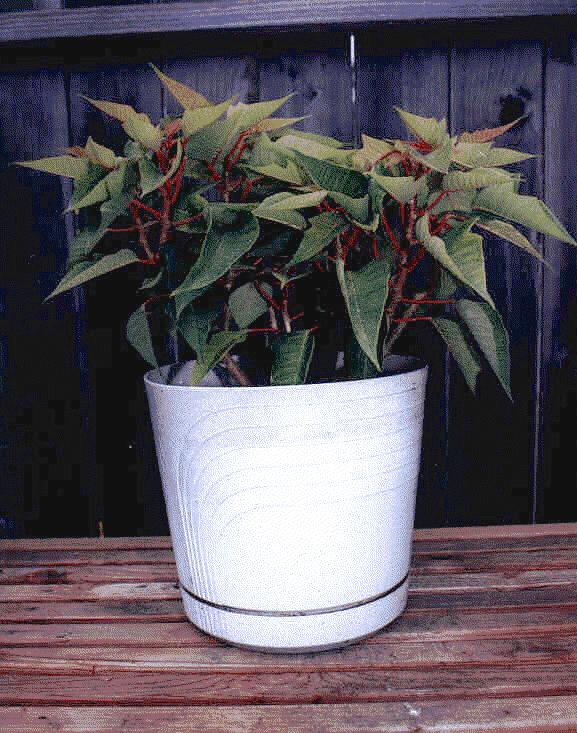
This traditional Christmas plant comes back year after year. A 10 foot Poinsettia tree grew outside of an apartment I once had in Santa Monica, each Christmas it displayed the traditional bright red leaves, long after other trees had lost all of theirs.
In November, our one year old Poinsettia is starting to show its Christmas color.
Poinsettia is a native of southern Mexico. It was popularized in the United States in the 1800's. That process is loaded with stories and persona from the late 1800's and early 1900's that are quite interesting.
Most people buy the plants, keep them around for the holidays, and throw them out. We like to keep ours in part because watching them grow in late summer, and begin to change color is a nice visual reminder that the seasons re changing and Christmas is coming. Before the plants show up in the stores, you can have one.
Poinsettia have been bred in a variety of colors, mostly by one grower, the Paul Ecke Ranch. I have seen plants with the Paul ecke Ranch label on them as far away as Japan. Ecke has developed 30 cultivars of the plant.. It sells plants to various greenhouses around the world, which in turn propagate the plant for holiday sales. Chances are that even un-labeled Poinsettia have roots back at the Paul Ecke Ranch in Encintas, California. It has a good web site with clear instructions of caring for Poinsettia throughout the year, and pictures of the numerous cultivars it has created.
Re-blooming the Poinsettia requires that you keep it alive. Some plants do not drop their leaves after blooming - ours does, and then it looks dead. In the spring it tentatively comes back, with strong growth in mid-to-late summer. The Cooperative Extension of the University of Nebraska recommends the following: "If a poinsettia drops its leaves or is no longer attractive, let the soil dry out and keep the plant in a cool location such as a basement window ledge; it still needs some light...Bring the plant out of its resting stage in late April or Early May and cut the stems back to about 3 to 5 inches above the soil. If there is more than one plant per pot, separate them and replant in individual containers." It also notes: "If the plant retains its leaves, treat it like any house plant."
The poinsettia derives its name from Joel Roberts Poinsett, who is usually described as a diplomat. However the description does not do him justice. Born in 1779, he attended a variety of private schools before taking to traveling "extensivly" in Europe an the Americas from 1801 through 1809.
At the age of 30, he gets what appears to be his first job - he is appointed by then United States President Madison to investigate revolutionists in South America who are fighting with Spain. Seven years later, he returns and becomes a member of the South Carolina House of representatives. - his second job. That job lasted until 1819, when he began successive terms in the United States Congress in 1821. At age 42, a single term State representatives, nearly three years terms completed in Congress, but no plant named after him, he quit.
Poinsett resigned from Congress in 1825, when he was asked by then United States President Madison to become the first U.S. ambassador to Mexico, a job titled "Minister of Mexico." That was a tumultuous time, Poinsett's job was to buy what is now the State of Texas from Mexico, for about a million dollars. The Mexicans did not want to sell Texas and asked him to leave in 1829. However, while he was in Mexico he visited the state of Taxco, in 1828, where he first saw the that would be named after him. He sent back plants to his plantation in South Carolina.
He too returned and took up his former job in the sate House of Representatives. He also sent samples of the new plant to friends and botanical gardens. The story goes that he sent one such plant to a Philadelphia nurseryman, John Bartram, who in turn sent a sample to a Pennsylvania nurseryman Robert Buist. Busit is credited with being the first to sell the plant, but under it botanic name, Euphorbia Pulcherrium.
Re-naming the plant "poinsettia" is sometimes credited to William Prescott. Prescott is famous for authoring The Conquest of Mexico. Some references ascribe the publishing of the book, with the naming of the plant. However, the plant became known as the "poinsettia" around 1836, six years before the book was first published.
There began the "dark ages" of the poinsettia. The story does not pick-up until 1900, when Albert Ecke, the son of a European health spa owner, stopped over in Hollywood California, on his way to Fiji. Like so many others after him, he liked it and returned in 1906 to start a ranch with dairy cows, fruit orchards and flowers.
In 1920, his son Paul Ecke enters the scene. The Paul Ecke Ranch web site puts it like this: "The poinsettia's yearly cycle of blooming during the winter, near the holiday season, gave Paul the notion that this would make an ideal official holiday flower. But the question remained: how to promote and market a plant that most people had never heard of or even seen, let alone associate it with the holiday season?"
Paul Ecke then takes up the task, first by selling it to the local Hollywood and Beverly Hills areas. Ecke followed this with a large national marketing effort. In 1923 the main business of the ranch had been transformed into the poinsettia business. The rest is history.
The poinsettia, like other 1920's Hollywood starlets, had some near misses with fame before she finally made it big. the flower is reported to have been part of religious ceremonies in the Seventeenth Century, by Franciscan priests near its native habitat in Taxco, Mexico. It is reported to have been part of the "Fiesta of Santa Pesebre" a nativity procession. The flower is said to be symbolic of the Star of Bethlehem. The "Legend of the Poinsettia" from Mexico has it that two kids were going to visit the local nativity scene, when one grabbed a few "weeds" as a gift for the infant Christ. The weeds being given to the statuette, burst into the red flowers that we know today. and were assigned the Spanish name Flores de Noche Buena, "Flowers of the Holy Night."
Before the weed pulling kids were the Aztecs. They called the plant Cuetlaxochitle and used it to make red dye. the sap was also used to heal fevers. Aztec kings Netzahualycotl and Montezuma enjoyed the plants and had them imported to the then capitol, now Mexico City.
Poinsett himself did not disappear after the plant was named after him. He once again quit his job - as a State representative, to accept an appointment as Secretary of War to United States President Van Buren. There was no war during this time.
Poinsett became interested in the "United States Exploring Expedition" which sailed around the world from 1838 to 1842, collecting material and spreading good will. Poinsett was instrumental in setting up a "National Institute for the Promotion of Science" in 1840. This group maintained a museum of the materials collected on the expedition. Previously, in 1835, the United States inherited a large amount of materials from James Smithson. Both collections were housed in borrowed room in the United States Patent Office, which wanted them moved. Pionsett's "Institute" became the group that propelled the collections to be merged into a National Museum, which is now the Smithsonian Institute. Thus, both things Poinsett is remembered for had nothing to do with the job he was being paid to do at the time.
Here at the Flying Liquor Bottle ranch, we honor the memory of Aztec kings, Franciscan monks, the great State of Texas, the Smithsonian Institute, 1920'2 Hollywood starlets by keeping our Poinsettia alive.
This year we even bought another one. The packaging for this plant claims that, before the name poinsettia was assigned, the plant was known as the "Mexican Flame Leaf." We will check into that...