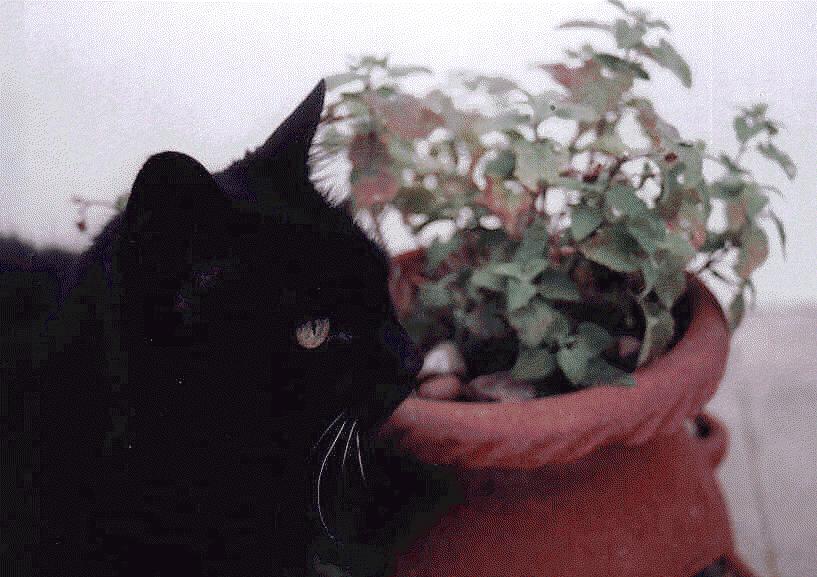
The only livestock we have on the Flying Liquor Bottle Ranch is a cat. The cat loves fresh catnip, and it is easy to grow.
Cats attack catnip plants; they maul it, eat it, tug on it, rub their heads and backs in, roll in it - anything to "become one" with the plant. Because of this, we keep the catnip in a strawberry pot, after experimenting with other containers. The plants will recover from a "cat-attack" after a day or so. If the plant is knocked out of its pot, it can take a lot longer to come back. The strawberry pot is heavy enough that the cat can not knock it over, and because of its height, the cat can not roll in it. ("Strawberry pots", have been used as herb containers for centuries; their shape originates from were cracked wine jars).
When the plant has taken a beating, we can pick up the pot and move it away to recover. Planting the catnip directly in the ground does not allow for this, and other nearby plants can be damaged as the cat goes on its drug crazed rampage.
Our cat has become quite popular with the neighbors cats, who come over to enjoy our catnip. However, not all cats respond to catnip; about 90% do. Kittens do not, until they are around 4 months old.
The Journal of the American Medical Association published an article in 1969 claiming that humans smoking catnip have experience psychoactive effects (JAMA 1969; 207:1349-1350). The article had a picture of catnip labeled as marijuana and vice-versa. The article received a lot of criticism, and I have heard of no results from "amateur medical experimenters" claiming the same effects.
However, humans have used catnip for other purposes:
"Agnus castus, a Middle English herbal known by the first two words of the manuscript, recommends catnip tea for 'evils that a man has about his throat.'"
"Catnip tea has suffered a decline in popularity. It was a standard beverage in England, where it was grown commercially, before trade with China and new-fangled imports crowded it out."
"Catnip came to America along with other culinary necessities for pioneer living. America's first geographer listed it in 1796 as a commercial crop. It escaped cultivation and invaded the landscape. It even worked its way into American literature, appearing in the writings of Washington Irving, Nathaniel Hawthorne, and Harriet Beecher Stowe."
From Rodale's Illustrated Encyclopedia of Herbs (1987)
Catnip tea is still sold by at least one company: Catnip Cafe
In August 2001, Iowa State researchers found that catnip oil can be 20 times more effective at repelling mosquitoes than the commercial repellent DEET.
Catnip, a perennial, is part of the mint family originating from the Mediterranean. It is also known as catmint, catrup and catwort. The generic name "nepete" is derived from a town in Italy.
Rodale's states that here is an old adage that seeded catnip is of less, if any, interest to cats, than catnip grown from cuttings from another plant. This leads to the "proverb":
"If you set it,
the cats will eat it.
"if you sow it
the cats don't know it."
Philip Miller, A Gardeners Dictionary (1854), quoted in Rodale's Illustrated Encyclopedia of Herbs (1987).
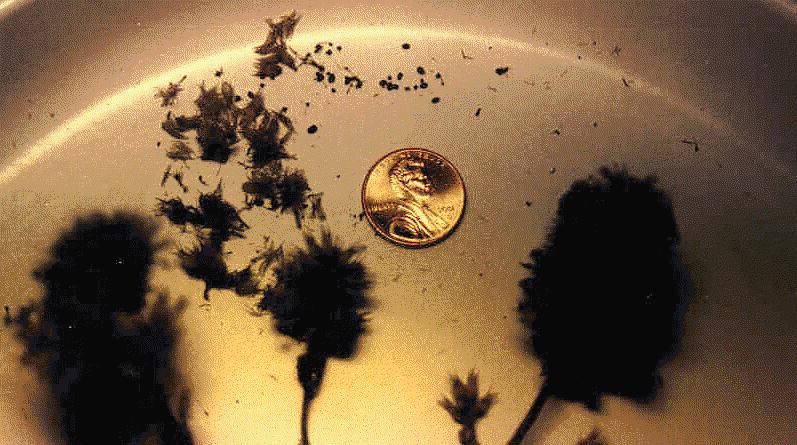
We have given cuttings to neighbors, whose cats do like the new plants. this is the first year we have collected seeds from the plant. the seed pods are about the size of your thumb and are very fluffy. Inside are numerous seeds, which you can see at the top of the following photo.
Burpee Seeds sells 600 seeds for $1.55. Shepard's Garden Seeds sells 250 seeds for $1.95.