| |
|
Humans have been skating for thousands of
years. The first skates were made from animal bones and attached to the
feet with leather straps. People used skates as a way of crossing frozen
lakes and rivers in the winter. In the 1850s, figure skating started
when skaters started trying various spins and jumps on ice. The first
World Figure Skating Championships for men were held in 1896 in Russia.
The first World Figure Skating Championships for women were held in
Switzerland in 1906.
source:
http://www.kidzworld.com/site/p5204.htm
accessed June 24, 2006
1860 Skate patent in a shopping catalogue!
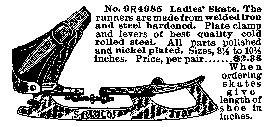 The early
skate patent image dates back to 1860. The skate ad comes from the 1902
Sears & Roebuck catalog. The other images come from the 1880's through
the 1920's. The early
skate patent image dates back to 1860. The skate ad comes from the 1902
Sears & Roebuck catalog. The other images come from the 1880's through
the 1920's.
source:
http://www.icesk8.com/
The World's Oldest Known Skating Image
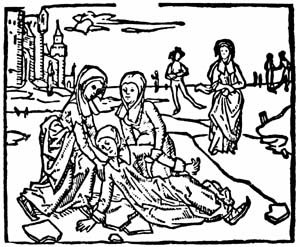 In 1396
Lydwine (also Ludwina and Lidwina), a beautiful 16 year old girl, from
Schiedam in Holland was visited by friends, who invited her to go
skating. Legend says that Lydwine's friends insisted that she go skating
even though she said she wasn't feeling well. Once they were on the ice
Lydwine was knocked down. She broke 6 ribs and was bedridden for the
rest of her life. After the accident Lydwine had visions and was given
credit for performing many miracles. Lydwine was canonized in 1890 and
was named the Patron Saint of Skating in 1944. This image of the fateful
fall was made in 1498 by the Dutch artist, Johannes Brugman. This image
provided courtesy of the
SchaatsMuseum
(Netherlands). source:
http://www.icesk8.com/ In 1396
Lydwine (also Ludwina and Lidwina), a beautiful 16 year old girl, from
Schiedam in Holland was visited by friends, who invited her to go
skating. Legend says that Lydwine's friends insisted that she go skating
even though she said she wasn't feeling well. Once they were on the ice
Lydwine was knocked down. She broke 6 ribs and was bedridden for the
rest of her life. After the accident Lydwine had visions and was given
credit for performing many miracles. Lydwine was canonized in 1890 and
was named the Patron Saint of Skating in 1944. This image of the fateful
fall was made in 1498 by the Dutch artist, Johannes Brugman. This image
provided courtesy of the
SchaatsMuseum
(Netherlands). source:
http://www.icesk8.com/
|
|
What is
figure skating today? |
|
|
Figure Skating is a
sport with many dimensions. its
many disciplines include: Singles Freestyle, Pairs Freestyle,
Dance, Precision, Figures, and Moves-in-the-Field.
More about them later. But first, what about
the sport in general?
Skaters normally
begin to skate in a group lesson environment, such as the USFSA's
Learn-to-Skate program, often called "Basic Skills".
Basic Skills classes are taught at most rinks on a regular basis
throughout the year, and are a very cost-effective way to learn the
basics of skating, whether your interest is in competitive figure
skating, recreational skating, or hockey. When
skaters have learned the basic elements of skating in this group
environment, many will join a skating club and begin to further develop
those skills by working with a private instructor, or "Pro".
In order to join most clubs, skaters must have passed through, or
have demonstrated capability in all of the skills through the "Basic 6"
or "Basic Eights 8" level of the Basic Skills
program.
Club skaters
typically practice anywhere from 1 to as many as 12-15 hours per week,
depending on their level of interest, competitiveness, and budget.
Many skaters compete,
and when they do so, they compete within groups of other skaters with
similar ability levels. These abilities are proven
by the passage of official USFSA tests, taken in front of USFSA
appointed judges at designated "test sessions". The
tests establish several "Levels" of skating in each discipline.
When you watch skating on TV you are watching skaters who have
passed all the way to the top of the test structure, called the "Senior"
level. But there are many levels below Senior, and
most club skaters are somewhere on that ladder, moving upwards.
Competitive skating levels are not determined by age,
although often in competitions, age will be used as a secondary factor
to group smaller "flights" of skaters within a single test level.
Freestyle
This is the discipline in Figure Skating that most spectators are
familiar with. In Freestyle skating, or "Singles
Freestyle" skating, a competitive skater performs a "program" that lasts
anywhere from 1 to 4-1/2 minutes, is composed of elements such as jumps
and spins, and is usually skated to music.
In freestyle
competition, both "long" and "short" programs are skated.
The "short program" at each level has a very specific list of
elements which must be performed, and the skater is marked on his/her
performance of those elements. Specific deductions
are taken for missing or failed elements, and for added or repeated
elements. The "long program" has
no list of required elements, only a general set of guidelines for what
should or should not be included. Skaters are marked
on both the quality of elements performed and the difficulty & content
of the program. Contrary to popular belief, there
are no required deductions for falls in a long program, however the
skater is given no credit for having executed or tried the maneuver
which caused the fall.
In Singles
Freeskating, there are 8 Test Levels defined. With
the exception of the very first one, each test is a program skated to
music, with very specific required elements (sort of like a "short
program" for competition). In the very first, or "PrePreliminary"
freestyle test, the skater is asked to perform jumps and spins as
separate elements. The singles freestyle test levels
are: Pre-Preliminary, Preliminary, Pre-Juvenile, Juvenile,
Intermediate, Novice, Junior, and Senior.
Pairs
Pairs skating is similar in many respects to singles freeskating, except
that 2 skaters perform together. This adds all sorts
of opportunities for new moves, such as lifts, throws, and pair spins
and jumps. Pairs skating has both "long" and "short"
programs, just like singles freeskating, and a test structure which
includes: Preliminary, Juvenile, Intermediate, Novice, Junior,
and Senior.
Dance
Ice Dancing is the discipline within skating that most emphasizes the
"beauty" of the sport, rather than the athleticism.
Dance emphasizes the techniques of edgework, flow, and motion of 2
skaters together in rhythmic interpretation of music.
Ice Dancing has 2 main focus areas, the "Compulsory Dances", and
the "Free Dances".
In compulsory
dances, skaters are given a very specific pattern to follow.
This pattern is shown in the form of a drawing which specifies
the skater's moves right down to which foot is doing what particular
step during every single "beat" of the music.
Dancers are marked on their ability to skate the required pattern with
demonstrated musical feeling.
In free dances,
skaters get to make up their own "programs", within specified
guidelines. These programs must demonstrate basic
dance elements and steps in a musical, but not "theatrical" way.
No jumps or spins are allowed, and dancers are required to stay
close together throughout the course of the dance program.
The test structure
for dance includes tests in compulsory dances, as well as free dances,
and includes the following levels: Preliminary, pre-Bronze,
Bronze, pre-Silver, Silver, pre-Gold, Gold, Junior International and
Senior International.
Dance is one of the
skating disciplines where age is no barrier. Many adults and senior
adults nationwide enjoy this discipline for both its athletic value and
its social aspects.
Moves-in-the-Field
Moves-in-the-Field, or "Moves" is a technical discipline, designed to
help skaters improve their execution of the basic moves of skating.
Edgework, turns, stroking, body control and
extension are emphasized, mostly done with "power" as a primary focus.
The Moves-in-the-Field discipline is primarily a test discipline,
although some competitions are running Moves events.
Moves-in-the-Field has test levels matching each singles freestyle
level, and it is required that all skaters testing freestyle must pass
the equivalent Moves test prior to taking the corresponding test in the
freestyle or pairs disciplines.
Figures
Figures is another of the technical disciplines, one primarily
emphasizing body control and edges/turns. Figures
are the famous "figure 8s" for which the sport is named, and there are
dozens of different ways to modify the basic figure 8 for testing
purposes. Each variant emphasizes a certain skill,
and all require great concentration and stamina to perform.
Figures are still tested and competed, although this discipline
is dropping in popularity of late.
Synchronized
Skating
Synchronized Team Skating (once known as "precision skating") is a
"team" event, with teams of 8 to as many as 24 skaters skating
complicated routines similar to those performed by marching bands or
drum corps. Large teams may execute patterns of incredible complexity
and beauty. The teamwork and timing required makes this a challenging
sport. Precision skating is another discipline where
age is not a significant barrier, and adults nationwide enjoy and
compete in this discipline.
 <------ click on this button to jump to
Figure Skater's Website.
<------ click on this button to jump to
Figure Skater's Website.
source:
http://www.sk8stuff.com/f_basic_ref/intro_to_figure_skating.htm
accessed June 12, 2006. |
|
What are the elements in each of the ISI basic levels?
(( "ISI
Skater's and Coaches Handbook" 1998
Alpha (1)
|
Forward stroking
Forward crossovers - right foot over left
Forward crossovers - left foot over right
1-foot snowplow stop |
Beta (2)
|
Backward stroking
Backward crossover - right foot over left
Backward crossover - left foot over right,
T-stop - right foot outside edge
T-stop - left foot outside edge |
Gamma (3)
|
RFO 3-turn (one-foot turn)
LFO 3-turn
RFI open mohawk combination sequence
From right T-position do 3 strokes
RFI open mohawk
RBO glide
stepforward to LFO
LFI open mohawk combination sequence
(see
above)
Hockey stop |
Delta (4)
|
* RFI 3-turn
* LFI 3-turn
* Forward edges (4 semicircles each) FO, FI
* Choice of one:
          o Shoot the duck
          o Lunge
* Bunny hop |
|
|
What are the elements in each of the ISI Freestyle levels?
(( "ISI
Skater's and Coaches Handbook" 2004
|
| |
|
What are the different
national figure skating test levels?

source:
http://barbara.standke.free.fr/
accessed June 13, 2006.
|
|
What is
ISI and ISIA?
The Ice
Skating Institute was founded in 1959 as a nonprofit organization for
owners, operators, and developers of ice skating facilities. For over 45
years, ISI has become the industry trade association for progressive ice
skating facilities, managers, coaching professionals, suppliers and
individual skaters.
ISI:
 |
Encourages participation in ice skating as a recreational sport. |
|
Provides information for the development and construction of ice
arenas. |
|
Produces trade and educational publications and literature.
|
| Holds
an annual educational conference and trade show for arenas managers,
skating directors, instructors and skating industry manufacturers,
suppliers and retailers. |
|
Provides ice skating programs for skaters of all ages and abilities. |
| Hosts
four recreational skating competitions annually. |
|
Organizes consumer shows in conjunction with its recreational skating
events. |
source:
http://www.skateisi.com/HTML/about_isi/what_is.cfm accessed June 12,
2006.
ISIAsia is an independent body with license to use the
copyrighted skating program of the Ice Skating Institute as the basis
for recreational teaching and testing of ice skating in those countries
who subscribe to ISIAsia membership.
ISIAsia is the Governing body for recreational ice
skating for Asia. With permission of the Board of Directors of the Ice
Skating Institute, U.S.A., ISIAsia was established August 16, 1999.
ISIA's Services
| To provide a legal and authorized organization for
persons in the ice skating industry and sport to practice the ISI
skating standards and tests. |
| To assist rink owners and managers with programs
that assist with the growth of the sport at their facility.
|
| To bring rink managers and owners together for the
common purpose of increasing the number of skaters and facilities in
Asia. |
| To provide coaches with a system that encourages
skaters to stay involved in the sport through tests and competitions.
|
| To provide education to all rinks and professionals
on the latest ideas currently in use worldwide. |
source:
http://www.isiasia.org/isiasia/aboutus.php
accessed June 12, 2006. |
|
What is
the USFSA? How does it differ from ISI?
ISI and USFSA both have the same goals in
that both programs promote the sport of skating on ice. The difference
is in that USFSA--which has now changed it's name to US Figure Skating,
is the Governing body for figure skating when it comes to sanctioned
tests and Qualifying competitions in the United Skates and reports
directly to the ISU--the International Skating Union. ISI regonizes that
it is a "recreational" program. Bascially ISI programs are a way for a
rink to provide lessons, competitions etc, without the need for a USFSA
club. There are many areas and rinks that don't have a USFSA club
affiliation, so using the ISI system, the rink can market and offer
learn to skate programs, as well as its own system of competitions for
skaters. Both are good programs--the difference is the ability to skate
in the qualifying competitions that allow the skater to move up the
competitive ladder, ie: regionals, sectionals, US Nationals, Worlds and
Olympic competitions.
source:
http://experts.about.com/q/Figure-Skating-1600/ISI-versus-USFSA.htm
accessed June 16,2006. |
|
What is
the International Skating Union?
"The International Skating Union (ISU) was
founded in 1892 and is the oldest governing international winter sport
federation.
During the last half of the nineteenth
century, informal international competitions in both Speed Skating and
Figure Skating were organized occasionally in different parts of the
world. The first modern Speed Skating competition was held in Norway in
1863 and the first major International Speed Skating race was held in
Hamburg (GER) in 1885. In 1882, the first International Figure Skating
competition took place in Vienna (AUT).
With the emergence of international
competitions, in both Speed Skating and Figure Skating, as well as the
forming of skating clubs and of national associations, the need to
establish international standards to govern these sports became more and
more apparent. In July 1892, the Dutch association took the lead in
calling for a meeting of representatives of all countries interested in
international ice skating competitions. As a result, the first Congress
convened in Scheveningen (NED) and the ISU was created. The fifteen
delegates present at the time, all from Europe, began to establish firm
rules, laying down the foundations for international competitions in
both disciplines. With the addition of Canada as a Member in 1894, the
ISU expanded its horizons to become a truly international governing
body.
Since the foundation of the ISU the ice
skating disciplines have developed steadily over time to occupy the
significant role they now enjoy in the world of sport."
To read more about the International
Skating Union, visit www.isu.org.
http://www.isu.org/vsite/vcontent/page/custom/0,8510,4844-130844-132152-20256-74409-custom-item,00.html
accessed June 23, 2006. |
|
What are the Philippine sports
organizations related to ice skating?
Philippine Ice Skating Union
Based on the International Skating Union's Communication No. 1267, the
ISU Council decided during the meetings held on Sunday June 6th, Saturday June 12th and
Sunday June 13th, 2004 in
Scheveningen, The Netherlands to accept
the Philippine Skating Union to join the ISU
as provisional
Figure Skating Members with immediate effect.
source:
http://www.isu.org/vsite/vfile/page/fileurl/0,11040,4844-168498-185716-62012-0-file,00.pdf
accessed June 16, 2006.
Ice Skating Union of the Philippines
The ICE SKATING
UNION OF THE PHILIPPINES (ISUP) is the governing body for the sport of
ice skating in the Philippines. It is a private sports organization,
recognized as the National Sport Association (NSA) for ice skating.
The Ice Skating Union
of the Philippines is an associate member of the Philippine Olympic
Committee.
http://www.olympic.ph/nsa.html
accessed June 16, 2006.
Philippine Sports Commission
The PHILIPPINE
SPORTS COMMISSION is a government agency created under Republic Act
No. 6847 which is tasked to oversee and direct the country's sports
development program.
Philippine Olympic Committee
The PHILIPPINE
OLYMPIC COMMITTEE is a a private entity serving as the official National
Olympic Committee of the Philippines and the umbrella organization of
the various national sports associations.
National Sports Organizations (NSAs)
The VARIOUS
NATIONAL SPORTS ASSOCIATIONS, privately-organized entities and duly
accredited members of the POC that are mandated to pursue programs and
activities to further promote and develop their respective sports
nationwide.
http://fcap.globalink.org/SEAG%20MOA2004.htm
accessed June 17, 2007. |
|
What are the different
ice skating competitions in the Philippines?
|
Competition Name |
Type |
Time of Year |
Frequency |
System |
Location |
| SM Summerskate |
Recreational Skating |
May |
Annual event |
ISI/ISIA |
Metro Manila |
| SM Skate Manila |
Recreational Skating |
November |
Annual event |
ISI/ISIA |
Metro Manila |
| Philippine Grand Prix |
Open, National Figure
Skating |
January or February |
Annual event |
ISU-like |
Metro Manila |
| National Youth Games |
Open, National Figure
Skating |
June or July |
Annual event |
ISU-like |
Metro Manila |
| SM |
Ice Hockey |
March |
Annual event |
|
Metro Manila |
| SM |
Ice Hockey |
September |
Annual event |
|
Metro Manila |
| Philippine Open National
Figure Skating Championships |
Open, National Figure
Skating - part of the Philippine Olympic Committee's Olympic
Festival Games |
June |
New event for 2006 |
ISU-like |
Metro Manila |
| |
|
|
|
|
|
|
|
What is the Philippine Olympic Festival?
The Philippine Olympic Festival, a
weeklong series of events involving 28 sports slated from June 20 to 28.
It is the first of its kind in the Philippines and its organizers hope
that it will help promote the Philippines' national sports programs.
Read on to discover what the 28 sports are and
where each competition will be held.
Ice skating among 28 sports in Olympic
Festival,
By GERALD PETER ARCE, Correspondent
Recognizing ice skating’s contributions to the
country’s glory, the Philippine Olympic Committee is including the sport
among 28 disciplines to be played in the first Philippine Olympic
Festival, slated from June 20 to 28 in various venues around the
country.
POC chairman Robert Aventajado said the Ice Skating
Union of the Philippines expressed its intention to become part of the
inaugural Olympic Festival, which commemorates the 110th founding
anniversary of the Olympic movement worldwide.
"We are happy to include ice skating because it is a
sport that has brought so much honor to the country, and it is also a
sport that is capable of bringing in the country’s elusive first Olympic
gold," said Aventajado.
The ISUP has chosen the new skating rink at the newly
opened SM Mall of Asia in Pasay City as its venue.
Other sports in the festival have already chosen their
venues through their patrons.
Nueva Ecija, headed by Gov. Tomas Joson 3rd, will host
the Milo National Open of athletics, Gov. Imelda Quibranza-Dimaporo of
Lanao del Norte has lent the Mindanao Civic Center in Tubod to boxing,
Mayor Abraham "Bambol" Tolentino of Tagaytay City hosts chess and sepak
takraw, and the Subic Freeport will hosts archery, canoe-kayak and
equestrian from June 18 to 25.
Other sports slated in the weeklong spectacle are
aquatics (at Trace College in Laguna), arnis (SM Fairview, Quezon City),
badminton (Rizal Memorial, Manila), baseball (Rizal Memorial, Manila),
basketball (Taguig City), billiards (Rizal Memorial), bowling (PBC),
Dragon Boat (Baywalk), fencing (PSC Fencing Hall), football (Marikina),
golf (Villamor in Pasay City), gymnastics (Ninoy Aquino Stadium),
powerlifting (Robinson’s Place, Cavite), table tennis (SM Manila), tae
kwon do (Rizal Memorial), weightlifting (Philsports), wushu (Ninoy
Aquino Stadium), judo and karatedo.
Aventejado, also the president of the Philippine Tae
Kwon Do Association, expressed elation on the participation of the local
government units in the festival, which would help the POC promote its
national sports development program.
"We are starting to build stronger ties with the LGUs.
We should all be partners in sports development, and the POC admits it
really needs the LGUs not only to provide us venues and facility, but
also their logistical means like homegrown athletes and coaches, and
even manpower for such undertaking," Aventajado said.
Some 7,000 athletes are expected to take part in the
event, which the national sports associations are using either as a
qualifying event for the coming 15th Asian Games or to discover new
talents.
http://www.abs-cbnnews.com/storypage.aspx?StoryId=40649 accessed
June 16, 2006
|
|
Where
are the ice rinks in the Philippines?
There are three ice-skating rinks currently
operating in the Philippines, plus another one that is rumoured to be in
the offing. All rinks are located in metropolitan Manila.
| LOCATION |
MALL NAME |
DEVELOPER |
RINK SIZE |
YEAR OPENED |
| Pasay City |
Mall of Asia |
SM (Shoemart) |
61m x 30 m,
Olympic Size |
2006 |
| Alabang City |
Southmall |
SM (Shoemart) |
|
mid 1990s |
| Mandaluyong City |
Megamall |
SM (Shoemart) |
|
1993 |
|
|
|
|
|
| Cainta, Rizal |
Sta. Lucia East
Grand Mall |
|
|
1990s , now closed |
| Cebu City |
SM Cebu |
|
|
mid 1990s, closed after 1
yr. |
| Quezon City |
New Frontier |
|
|
|
| |
|
|
|
|
| |
|
|
|
|
Does
the Philippines have a national figure skating team?
The Philippines' pending membership with the Ice
Skating Union of Switzerland was, among other prevailing conditions,
hinged upon the construction of an Olympic sized rink. Last 2006,
officials from the regional office of the ISU visited the Philippines
during the opening ceremonies of the Olympic size rink at Mall of Asia
and the Philippines soon became an approved provisionary member of the
ISU.
Last January, the Philippines sent its first team of
figure skaters to the Asian Winter Olympics in ChangChun, China.
The members of this team were gathered from higher level recreational
skaters that have long been trained under the Ice Skating Institute
system. Local skaters to first taste the experience of competing in the
singles division against the national teams of Asia were Jerico
Lim, Clarisse Roman and Ramina Palaca. Fil-American's Michael Novales
and Gracielle Tan also competed for the Philippines during the Asian
Winter Games.
L'esprit de corps was high. It was going to be the first time for the nation to participate in an ISU Skating championship. Yet, there was much
apprehension on how the Filipino skater will fare during the
championships given that each skater had only barely three months of training. In all
fairness, our skaters did their best and almost skated perfectly
according to their program. However, our skaters' program point value
was rather low as compared to the high point program value and the high
power and incredible incredible free skating skills of our asian
counterparts.
There also was the first hand encounter with the new
ISU judging system that was set in place after the 2002 Salt Lake City
scandal involving Le Gougne and Gailhaguet.
Changchun was a learning experience for our skaters,
coaches, skating parents and the Philippine Skating Union. The clamour
for better training opportunities and for more learning experiences have
become louder after the awakening Changchun experience.
Just yesterday, August 12, 2007, the Philippine
Skating Union launched to the public the first batch of single freestyle
skaters that comprise the first official Philippine National Figure
Skating Team during the opening ceremonies of the ISI Asia Skate ASia
2007 Recreational Skating Team Championships at Mall of Asia, Manila,
Philippines.
These skaters were pre-selected from a smaller group
of ISU-like national skating competition champions and runners-up,
including Lim-Palaca-Roman, the Changchun delegates. This time,
the PSU is preparing for better outcomes and has enjoined the services
of a Pro from Canada. These skaters have been clocking in hours in the
morning and evening, edging away with their blades at the Olympic
size rink at Mall of Asia.
... to be continued ... |
|