HISTORY OF ORIGAMI
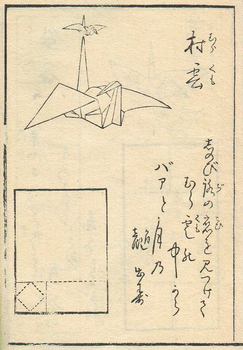
The folding of two origami cranes linked together from the first known book on origami Hiden senbazuru orikata published in Japan in 1797.
The history of origami followed after the invention of paper and was a result of paper's use in society. Independent paper folding traditions exist in East Asia and Europe, and it is unclear whether these evolved separately or had a common source.
ORIGINS AND TRADITIONAL DESIGNS
The Japanese word "Origami" itself is a compound of two smaller Japanese words: "ori", meaning to fold, and "kami", meaning paper. Until recently, all forms of paper folding were not grouped under the word origami, namely "tsutsumi", a kind of wrapper used for formal occasions. Before that, paperfolding for play was known by a variety of names, including "orikata", "orisue", "orimono", "tatamigami" and others. Exactly why "origami" became the common name is not known; it has been suggested that the word was adopted in the kindergartens because the written characters were easier for young children to write. Another theory is that the word "origami" was a direct translation of the German word "Papierfalten", brought into Japan with the Kindergarten Movement around 1880.
Japanese origami began sometime after Buddhist monks carried paper to Japan during the 6th century. The first Japanese origami is dated from this period and was used for religious ceremonial purposes only, due to the high price of paper.
A reference in a poem by Ihara Saikaku from 1680, which describes the origami butterflies used during Shinto weddings to represent the bride and groom, indicates that origami had become a significant aspect of Japanese ceremony by the Heian period (794–1185).Samurai warriors are known to have exchanged gifts adorned with noshi, a sort of good luck token made of folded strips of paper.
In 1797 the first known origami book was published in Japan: Senbazuru orikata. There are several origami stories in Japanese culture, such as a story of Abe no Seimei making a paper bird and turning it into a real one.
SADAKO AND THE THOUSAND CRANES
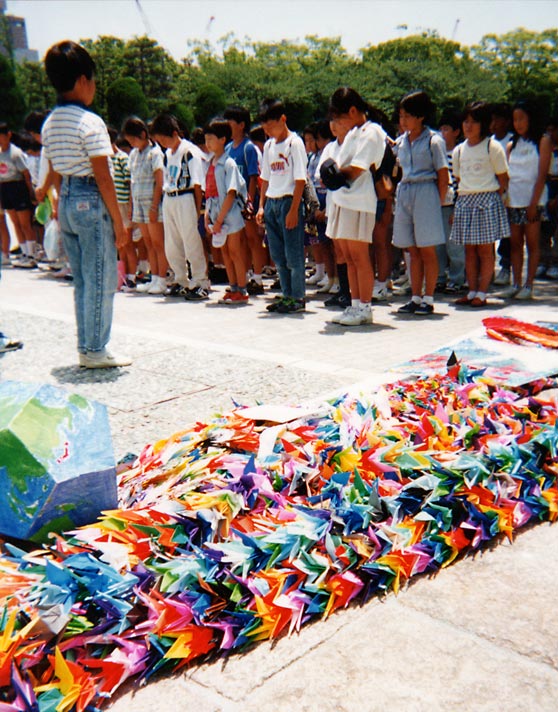
One of the most famous origami designs is the Japanese crane. The crane is auspicious in Japanese culture. Legend says that anyone who folds one thousand paper cranes will have their heart's desire come true. The origami crane (折鶴 orizuru in Japanese) has become a symbol of peace because of this belief and because of a young Japanese girl named Sadako Sasaki. Sadako was exposed to the radiation of the atomic bombing of Hiroshima as an infant, and it took its inevitable toll on her health. She was then a hibakusha — an atom bomb survivor. By the time she was twelve in 1955, she was dying of leukemia. Hearing the legend, she decided to fold one thousand origami cranes so that she could live. However, when she saw that the other children in her ward were dying, she realized that she would not survive and wished instead for world peace and an end to suffering.
A popular version of the tale is that Sadako folded 644 cranes before she died; her classmates then continued folding cranes in honor of their friend. She was buried with a wreath of 1,000 cranes to honor her dream. While her effort could not extend her life, it moved her friends to make a granite statue of Sadako in the Hiroshima Peace Park: a girl standing with her hands outstretched, a paper crane flying from her fingertips. Every year the statue is adorned with thousands of wreaths of a thousand origami cranes. A group of one thousand paper cranes is called senbazuru in Japanese (千羽鶴).
The tale of Sadako has been dramatized in many books and movies. In one version, Sadako wrote a haiku that translates into English as:
' shall write peace upon your wings, and you shall fly around the world so that children will no longer have to die this way.[citation needed]"
CHINESE PAPER FOLDING
Chinese Paper Folding, or zhezhi (Chinese: 摺紙; pinyin: zhézhǐ), is the art of paper folding that originated in China.
The work of Akira Yoshizawa widely popularized the Japanese name "origami"; however, in China and other Chinese speaking places, the art is referred to by the Chinese name, zhezhi. Traditional Chinese paper folding concentrates mainly on objects like boats or hats rather than the animals and flowers of Japanese origami. A recent innovation is Golden Venture where large representational objects are made from modular forms.
Paper was first invented by Cai Lun in the Eastern Han Dynasty in China. In the 6th century, Buddhist monks carried paper to Japan. The earliest document showing paper folding is a picture of a small paper boat in an edition of Tractatus de sphaera mundi from 1490 by Johannes de Sacrobosco. However it is very likely that paper folding originated much earlier than that in China and Japan for ceremonial purposes. In China, traditional funerals include burning folded paper, most often representations of gold nuggets (yuanbao). This practice probably started when papers gradually become popular and cheaper in China,and it seems to have become quite common during the Sung Dynasty (905-1125 CE). In Japan origami butterflies were used during the celebration of Shinto weddings to represent the bride and groom, so ceremonial paperfolding had probably already become a significant aspect of Japanese ceremony by the Heian period (794–1185) of Japanese history.
It is possible that paper folding came to Japan from China when paper was introduced but there is no evidence for this. The paper folding of China has typically been of objects like dishes, hats or boats rather than animals or flowers of Japan. The Japanese treasure ship model is probably derived from the Chinese model which uses an unusual fold that may have been inspired by the folded sychee, however in general the models of the two countries are quite different.
Like Origami ?Tell your friends!