
The whole trip will last around a month and a half.
We will start off in Kathmandu (1300m), before driving through the precipitous mountain roads into Tibet at Zhangmu, and on to Tingri and finally on to Base Camp at 4700m. From Base Camp it will, all being well, take around 25 days to reach the summit, mainly because of the repeated climbing and descent necessary to properly acclimitise.
The main principle is to always sleep at a lower altitude than the maximum altitude achieved during the day. We need to carry food and equipment to camps 1, 2 and 3, and will climb as high as 7400m before descending to Advanced Base Camp at 5100m to recover ahead of the actual summit attempt.
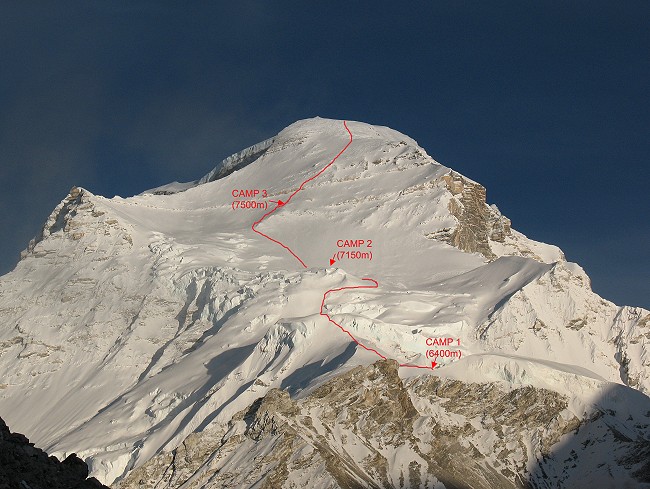
Only around 40% of climbers successfully reach the summit. Some climbers may get illnesses or simply find themselves physically unable to complete the climb. Altitude sickness is also a significant risk, and if this occurs an immediate descent is essential. Finally the weather is a major unknown - if a huge storm blows up around the time of the summit attempt and lasts for several days then it will be impossible to reach the top.
35 people have died trying to climb Cho Oyu, which is equivalent to around 1% of people who have attempted the climb and 2.5% of people who have summited.
Whilst this is not insignificant, it is the lowest amongst 8000m peaks. Everest has seen 179 fatalaties, although death rate in the 'modern' era is around 2.3% of those who attempt the climb. The most lethal peak has been Annapurna, with 53 deaths compared with only 130 summits achieved.
But, hey, if we only did things that carry no risk at all we'd never be able to do anything fun!
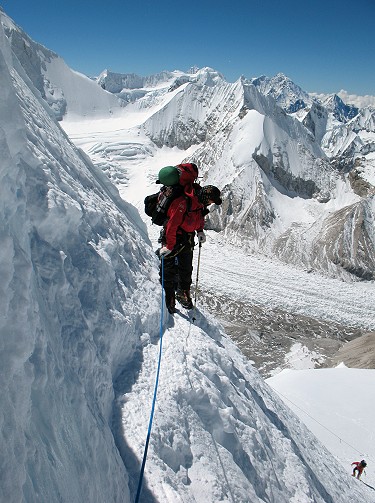
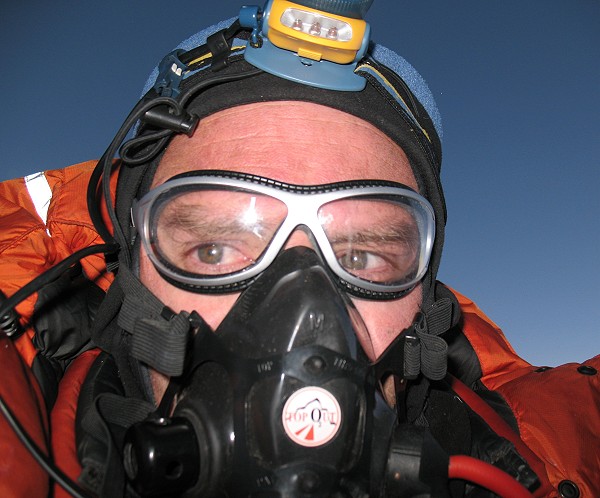
Yes, oxygen will be used above 7500m. The oxygen cylinders weigh approximately 7kg each. All 8000m peaks have been climbed without oxygen, but use of oxygen is normal on all of them. The oxygen takes the edge off the thinness in the air, but the effects of altitude will be only slightly moderated.
Um, well that's a tricky one! There is a plan to ski down, which seemed like a good idea at the time...then I found out that only around 10 people have ever done it before (only one Brit, and he's climbed up Everest 6 times!). Clearly the extra weight will be tough, and the altitude makes skiing incredibly difficult. So, I'll play it by ear and be ready to drop the skiing, but if I'm strong enough I'd love to give it a go!