The Ill-Fated
Mission: WARNING: There is some graphic detail within this document which may not be suitable for younger readers
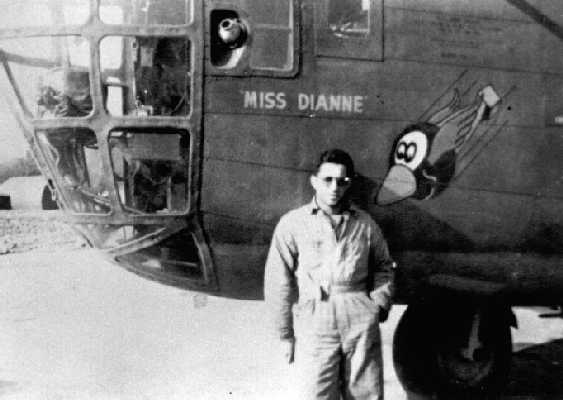
Copy of only photo
left in existence of Miss Dianne and her Ground Crew Chief,
|
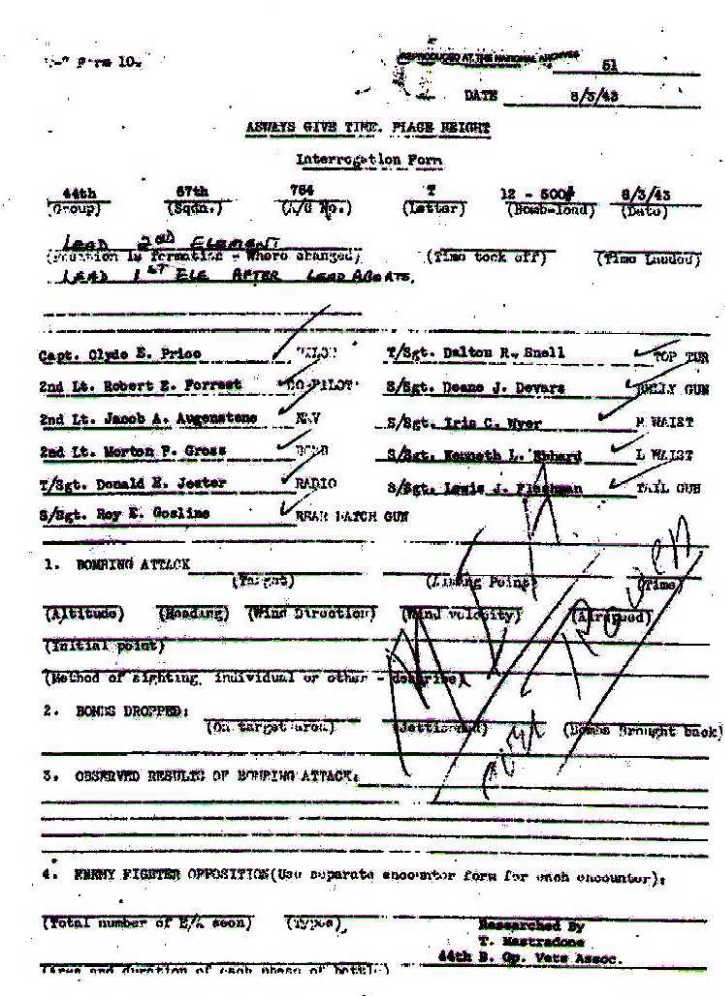
On March 8 1943, at 12h 03, 9 bombers B24 "Liberator" of the 44th Bomber Group, (67th squadron) of the 8th Air Force, took off from their base of Shipdham, very near Norwich. There were to meet 7 other B24's coming from the 93rd Bomber Group (329th Squadron) at Beachy-Head, on the southern coast of England near Eastbourne. The objective assigned to them was the switchyard of Sotteville les Rouen. This mission, important because of the switchyard's strategic position, consisted of a manoeuvre of diversion which was supposed to allow 54 other American bombers, B17 Fly Fortress, to simultaneously attack another switchyard, that of Rennes. The captain, James O'Brien, of the 93rd Bomber Group with Major Posey aboard, who was commanding the whole of the American formation, were constrained to interrupt their mission. John Husselton, one of the members of their team, had passed out because of a lack of oxygen. They left the formation, notified their base by radio in order to obtain the help of an ambulance and landed. John Husselton was taken off the plane. They took off again immediately with the number of crew members reduced and caught up with the formation just above the English Channel. When Captain O'Brien was forced to land, Captain Clyde Price of the 44th Bomber Group took the place of the leader of the formation, Lieutenant Robert Blaine moved up to the second plane. The crew members of Lieutenant Blaine, having had two wounded during a previous mission, was not supposed to take part in the mission, but after the briefing, they succeeded to put together a complete crew and received authorization to participate. Sergeant Kenneth L. Erhart, of the weaponry section, and Roy E. Gosline, of the mechanics section, volunteered willingly. They occupied, one and the other, a machine gun position aboard the B24 number 41-23784 to which the crew members had given the name of "Miss Dianne". It was one of the 9 first B24 "Liberator" to arrive in England on October 10, 1942. Will Lundy was responsible for the maintenance of the ground of this plane. Today (May 10, 1997) he has become the historian of the 44th Bomb Group Veterans Association. The 16 bombers crossed the coast of France at 13h 53 at St Valery en Caux. A few minutes later between Verville and Pavilly, the pilots were looking for their fighter planes; some P47 "Thunderbolt", expected to replace the 25 "Spitfire" of the R.A.F. were stopping their coverage. This was supposed to be the first participation of these American fighter planes on an escort mission since the beginning of the hostilities. However, delayed by the first attack of the objective at the north of France, they encountered severe opposition and were delayed too long by these combats, they were prevented from coming to ensure the protection of the "Liberators." The crew members of the bombers for whom the objective was to last no longer than a few minutes, were preparing themselves for the attack. It was at this moment that 30 FW 190, of the JG 26 "Shlageter" of the Luftwaffe, were arriving at 14h. With the sun behind them, they made a surprise attack on the American pilots who thought they were seeing their own fighter planes arrive. Watz Galland, who was leading the patrol of the FW 190 German fighters, launched his attack on the bombers; from the front and on the right flanks of the formation with the help of Major Pips Priller. The "Oberlieutenant" Peter Crump fired a long round from his machine guns at one of the airplanes. he was able to see clearly a good number of impacts around the pilot's position. As he distanced himself in a long nose dive, he saw with horror that he was in line with the deballasting of the bombs of a "Liberator." He escaped by a very tight bend... The plane that he just hit crashed in the part of a wooded valley to the north of the Seine. Their attack was devastating, the leading B24 caught fire, followed by the second bomber. The other crews were forced to break up the formation. The leader, Captain Price and the Lieutenant Blaine, his second man, were hit by the shot of numerous German fighter planes. These planes who were commanding the mission, now out of combat, left the other crews without information needed for the planned attack. Without the protection of Allied fighters, the crews had to resolve to set out for the North and rejoin the fixed rallying point at Neufchatel en Bray, then set themselves out towards the point of passage on the coast, chosen for the return to Biville Sur Mer in between Le Treport and Dieppe. The plane number 2, piloted by Lieutenant Robert W. Blaine, crashed into French ground at Sierville. The sole survivor, Lieutenant Leo O. Frazier, succeeded in jumping from the plane with a parachute. A prisoner of the German troops, he had the chance, a few days later, to return to the crash site. The plane had not exploded, the bombs were still on board. Leo Frazier finished the war at the Stalag Luft III. He was the victim of a heart attack in 1995 which left him in fragile health and he decided not to participate in the trip of the 44th Bomber Group Veterans Association organized to go to Europe from May 27 to June 7 1997... It is only on February 2 1997 that the point of impact of this was able to be confirmed thanks to the help of M. Yves Loisel, Mayor of Sierville who, responding to the request of the author of the present note, addressed to him a death certificate, which reads thus: "The 12 Mars 1943, at 18h, Monsieur Gustave Nemery, farmer at Sierville, discovered on the plain, hamlet of Plix, the body of a male individual of which the particulars are the following: decapitated body, dressed in a khaki military uniform, possibility wounded by a bullet just about the ankle. The collar of the jacket had this inscription: Kressig - M c Ator - Mac - Dili - Field. An identity plate belonged to the deceased and turned over to the Mayor march 20 1943 by a member of the occupation army at the moment of the burial. the plate carried the following information - Oscar F. Kreissig 110 105 44... According to every probability, the deceased belonged to the crew of a bomber fallen at Sierville, 400 meters from the place where the body was found at the time of an aerial combat taking place march 8 1943..." The plane of the leader, "Miss Dianne" that Captain Clyde E. Price was flying, was hit by the enemy fighter planes and by the Flak; seriously hit at the front and at the fuselage center, the oxygen and hydraulic circuits destroyed... The plane having immediately caught fire, the signal to escape was given... It is Sergeant Kenneth L. Erhart, one of the two replacement machine gunners who gave this information in the report that he made to the military authorities after his return to the United States. Because of the frontal attack, the personnel at the piloting position could not evacuate. Kenneth Erhart helped Sergeants Iris Wyer and Deane Devars to jump from the machine gun posts of the right flank. He observed that Sergeant Fleshman was already dead, after which, he was also able, he himself, to get out from the right flank. Upon touching the ground, he saw Lieutenant Gross arrive. His abdomen was gashed open. He died in the arms of Kenneth Erhart under the regard of the Germans. "He has asked me to take his watch and to give it to his mother, but the Germans seized it..." he declared. Deane Devars and Iris Wyer, wounded by the Flak and burned, were captured one or two days later, not having succeeded in getting themselves away from the occupants who were looking for them. As for Kenneth Erhart, once that he become a prisoner and that Lieutenant Gross was dead, the German soldiers turned them over to the troops of the Luftwaffe and he was taken to a hospital. He never learned of what kind of medicine they used to treat his burns, but the burns left no scars. He was taken care of by French doctors and watched over by German doctors, then he was taken by train to Stalag-Luft to be interrogated and taken to Stalag VII in Mooseberg in Baviere. Kenneth Erhart died two years after the end of the hostilities. He and Roy Gosline would often meet with Will Lundy after their return to the United States. Lundy, who was responsible for the maintenance of the ground of the B24 "Miss Dianne" during the war, later became the historian of the 44th Bomb Group Veterans Association. The most part of this report succeeded in being established with his very helpful collaboration. [Webmaster's
Note: Kenneth Erhart (Erhard) obviously did not die "Miss Dianne" had exploded above Barentin, a section of the plane in flames fell upon the housing development of the Badin Establishments and destroyed some houses. The greatest portion of the plane and the bodies of the 8 victims ended their fall at Villers Ecalles where a stele was erected in remembrance of the Allied aviators of whom the identity was only able to be established by the confirmation of the points of impact that each of the two B24 of the 44th Bomber Group. This confirmation would only come February 2 1997. The stele was inaugurated August 22 1948 by Maitre Andre Marie, president of the Council (First Minister) and the Mayor of Barentin, in the presence of Monsieur the Consul of the United States of America. A formal speech was given by Monsieur Richard, author and the one who brought the monument to fruition, adjunct of the Mayor of Villers Ecalles, then a moving exaltation of the spirit of sacrifice by M. Andre Marie preceded the deposit of a wreath of flowers while a plane of the Aeroclub of Normandy dropped flowers over the crowd. Monsieur LeBlond, the Mayor then received the honored guests at the Town Hall. Among the spectators, a young boy of 11 years who dreamed of becoming an aviator... he became one... and since May 8 1983, a group of non-commissioned officers of the reserve, members of their national association (l'ansoraa) participate each year, at the outskirts of the municipality, of the former combatants and of the inhabitants of Villers Ecalles at the commemoration of the remembrance of the Allied aviators whose names appear ever since on the monument.
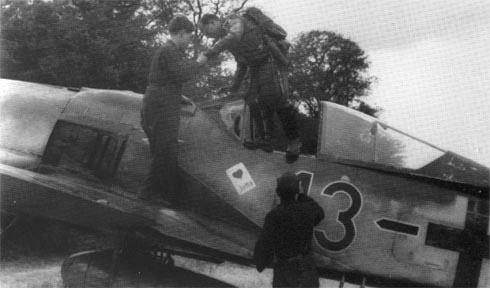
So who was it that shot down the Miss Dianne and her crew?
Josef "Pips" Priller, the German Flying Ace
|