


Final Act:
Operation
Ring (2)
The final offensive over Stalingrad was very cost for the Red Army; maybe it could have being done of another way. Although, Stalin knew that this victorious moment was very important for the moral and the propaganda. He had waited too much time to see the German humiliated and that moment was arriving.
(pag 2 of 2)
The Operation Ring began on Sunday, the 9th of January of 1943, in the Southwest of the Kessel. The whole artillery under the order of Rokossovky, was an hour crushing the enemy, it was standing out the Katiusha with its shrieks that so much were scaring to the German troops. An hour later the Soviet armies 21st and 65th attacked the positions of the 44th, 29th motorize divisions, 3rd Motorized Infantry Division and 376th in Karpovka's projection; in the evening, the T-34 and the Soviet units of infantry had destroyed the German positions. On the same day, the 66th Army was attacking the positions of 16th Panzer Division and to 60th Motorized Infantry and but was repelled by the panzers. In the south, 64th Army attacked 297th Infantry Division, which got to hold the position (Map, situation b).
The resistance of the VI Army, given the situation, was amazing. The Soviet troops suffered 26.000 falls and the half of their tanks in the front of the Don, though the Soviet controls didn't strain in to minimize their own loss. On the 12th, the 65th and 21st armies came to the western side of Rossoshka River. In the north, 16th Panzer Division and 60th Motorized Infantry Division were moving back. In Stalingrad, 62nd Army was attacking 10th Hunters Division and to 305th Infantry Division (Map, situation c).
The 65th and 21st armies were thrown to the conquest of Pitomnik's airport that was falling down on 16th of January, only there was staying Gumrak and Stalingradski airports like only route of leak for a few people (Map, situation d). The 17th of January, the remains of the VI Army were folded in the east half of the Kessel. The general Hube received the order to go out of the Kessel and took with him to his officials of the Panzer Corp, who was been considered specialists of armoured vehicles, equal luck had many people when his corps were considered to be specialists and important.
The 20th of January, the 65th Army attacked in direction Gumrak, which was taken the 22nd (Map, situation e). Only there was staying Stalingradski's airport, which was not it sufficiently long for heavy planes. With Gumrak's capture "the Hitler's air bridge" was eliminating. Into Stalingrad were packed approximately 100.000 men, who were fleeing in front of the advance of Rokossovski's troops. The 26th of January, the tanks of 21st Army found the troops of the general Rodimtsev in the north of the Mamaev Kurgan; they had been fighting isolated for almost five months. The Stalingrad's Kessel was divided in two (Map, situation f).
The 30th of January was the anniversary of Hitler's raise to the power, and Goering, in a speech compared the VI Army with the Spartans who died in the battle of the Thermopiles, this allegory wasn't very well seen by the people that were closed in Stalingrad. The 31st, Paulus was promoted Field Marshall. Hitler was making to Paulus the last gift, but this one didn't understand the intentions.
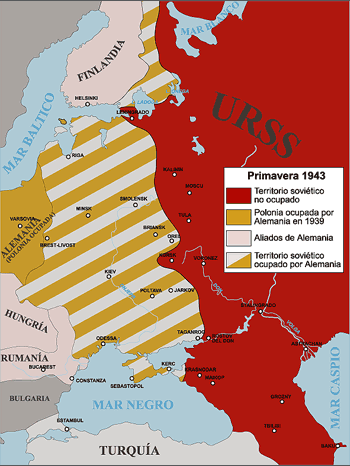
Situation in the spring of 1943 after the end of the Soviet winters offensives
The 31 of January, the 64th Army had assured the Stalingrad's devastated centre. The General Staff of the VI Army, who had stayed in the south pocket of the Kessel, was giving up itself while isolated groups of Germans continued fighting (Map, situation g). Hitler was communicated of Paulus's surrender at once; his reaction was of blind ire and indignation because Paulus hadn't committed suicide. The general Strecker was holding in the north pocket surrounded by four armies, who had received the order to squash the resistance. The 2 of February of 1943, the general Strecker was giving up himself and was finishing the fight in Stalingrad.
The survivors, as Soviet as Germans, went out of his hiding places to meet his destiny. For the Germans, a field of concentration and for the Soviets, food which they had lacked. Of Stalingrad's city only there were staying a few remains tortured by the bombs of both sides.
Result: For the Werhmacht the campaign was the most disastrous of the war and of the military German history. The Field Marshall Milch, calculated that there had got lost 488 planes of transport and 1.000 members of the crews during the "air bridge", without counting the losses of bombardier and fighters during the whole campaign. The VI Army and the 4th Panzer Army had been destroyed. From the beginning of the Operation Uranus, approximately 60.000 men had died and near 130.000 had been captured, without the falls counted before the Operation Uranus, the destruction of four armies allied (Rumanian and Italian), the defeat of the Operation Winter Storm and the fails for the Operation Small Saturn. In whole, the troops of axis lost half a million men.
The Red Army suffered 1.100.000 falls during the battle of which 485.751 were died. The losses in material were immense and it was impossible calculate it.

