


Second
Act:
Operation Uranus(1)
The key of triumph of an operation like the Uranus was the patience that Zhukov got to give to Stalin, and the thirst of revenge of this last one. The hasty attack in every front of the before winter had failed, and it had been the cause of the quick advance during the spring and summer in 1942.
The plan of Uranus was born to middle of September; the key was to hold Stalingrad while there was formed several armies in both wings of Germans. The city worked like a big ambush.
(pag 1 of 2)
In Stalingrad the lines was to very little distance one of other, like prescribed Chuikov. After having managed to resist the first month of siege in the middle of the rubbles, the Soviets discovered that his force was precisely in the combat to short distance, in where "land of nobody" doesn't allow any more than the throwing grenade, and it made useless to the attack of artillery or air, in where the Germans have advantage.
In another shore of the Volga was Zhukov, which was limiting to the minimum the sending of supplies: from the beginning of September until the first of November, only five divisions crossed the Volga, "only the sufficient to compensate the losses". This, which was driving to despair Chuikov that saw since his troops was been annihilated, it was actually strategist's calculation; but the Germans interpreted it as the proof that the enemy was finished. Actually, Zhukov, in the secret maximum (Chuikov wasn't knowing the plan), was preparing the counter-offensive: in the steppes of the left shore of the Volga it was organizing 27 new divisions of infantry and 17 armoured brigades.
Between October and November, the Germans generals who were under the order of Paulus began to put of manifest his doubts about the offensive in the city. The general was emphasizing in his critiques was von Schwedler, who had noticed of the danger of concentrating all the forces armoured in a point; because the flanks of the German front were forming a straight angle of 90 degrees defended by minor troops, to the bottom of which was Stalingrad. Nevertheless, since on July 20 Hitler had said that "the Russians are ended", von Schwedler was dismissed.
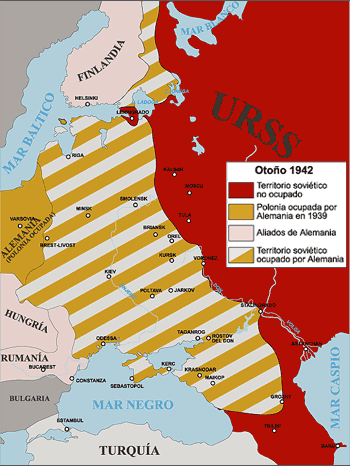
Soon after the Thursday's dawn 9th of November, the Russian soldiers who were hoping for the order to enter in Stalingrad were destined to establish suddenly a rhombus between the south and the north. With a time chosen well, among the first ices, which harden the soil and allow a great quick of movement, and the first big snowfalls that, nevertheless, prevent practically any possibility of manoeuvre, the Army groups of Rokossovsky, Vatutin and Eremenko put in march to close the pliers over the Volga. As a whole, the forces thrown by the Russians came to 1.500.000 soldiers, 900 tanks, 13.000 cannons and 1.100 planes. Though there was no many difference in relation with the adversary (the same men's number, 700 panzer, 10.000 cannons and 1.200 planes), in this moment the Soviets had improved notably the quality of his armoured means, as well as his "Stormovik", fighters, the most dangerous adversaries for the armoured cars and the concentrations of troops.
The plan was simple though very ambitious and it was fulfilling all the dreads of von Schwedler. The first one hit would be given to the west of Stalingrad, a section of 65 km to the south of the Don where 3rd Rumanian Army hadn't could to recover a head of bridge (Serafimovich) gained in one of the counter-offensives of the previous months by the Soviets. This point was far enough of Stalingrad, like to prevent to the troops become mobile of Paulus coming to the rescue. Another assault would come from another head of bridge to the south of the Don (Kletskaia). And from Stalingrad's south, an armoured group would attack looking for Kalach, where it should coincide with the troops that were coming from the north.
The key of this offensive, were the Rumanian armies who had to protect Paulus's flanks. They would pay with his lives the expansive pretensions of the Rumanian dictator Antonescu.

