|
Motor Vehicle Emission Modeler and Analyzer (Lines 1.0)
|
||||
|
Multiple Source
Air Quality Modeler/Analyzer
Single Chimney Emission Analyzer
River Self-Purification Modeler(1D)
Quasi-3D Refined Flow/ Contaminant Transport Modeling(CFD)
Digital Visualization Technology
|
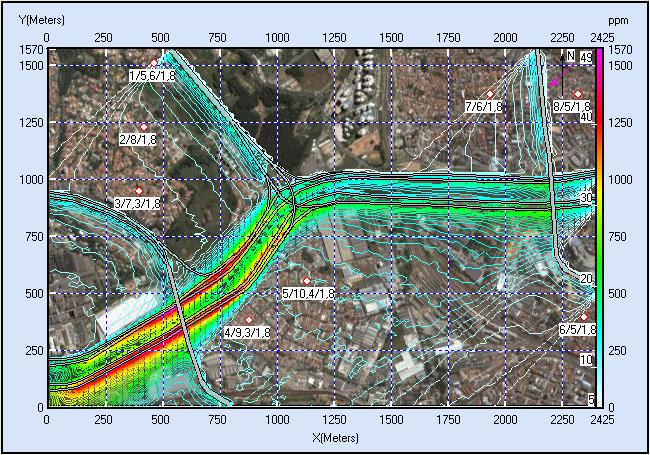
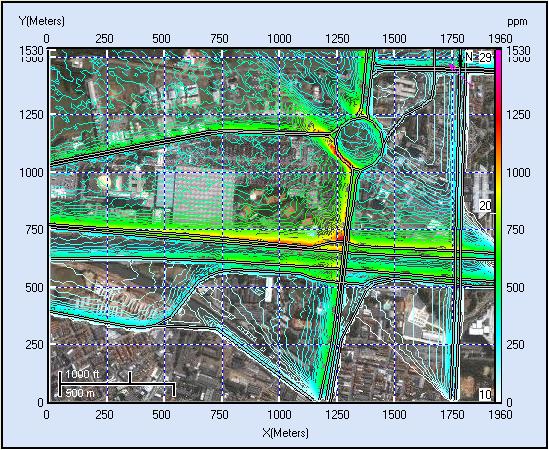
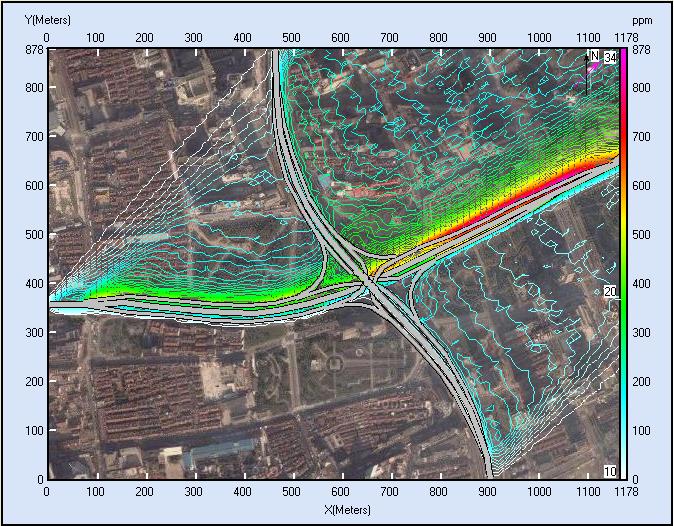
Motor Vehicle Emission Modeler and Analyzer (Lines 1.0, Lines 2.0) are versatile dispersion models with the support of Graphical User Interface (GUI) and Map Information Tool for simulating and predicting the concentrations of inert pollutants produced by traffic transportation, such as carbon monoxide(CO), particulates, and so on, in urban and rural zones as well as small-scale regions near highways and arterial streets. The Models, bases on the Gaussian diffusion equation, were originally developed by CALINE3 (Office of Transportation Laboratory, California Department of Transportation, USA) and CAL3QHC (U.S. EPA), respectively. The developed software, operated on various Windows Platforms, are able to provide for the user a series of up-to-date display functions, such as 2-D homochromy and color contour lines as well as color filled image map, and also can display the values of X- and Y-coordinates and model-calculated concentrations at given points by mouse move and characteristic concentrations in specified local regions by drawing tools. The Map Support Tool can help the user easily to enter geometrical data, such as the road position and location of receptors from various electric maps, including satellite map, except for figuratively demonstrating and quickly analyzing calculated results. Following figures present a part of results, given by the engineering examples for modeling CO concentration fields (in ppm, receptors’ height = 1.8 m). ● Ex-1. Connections of Marginal Tietê with two highways (Rodovia dos Bandeirantes and Rodovia Anhanguera) in São Paulo, Brazil (background map: Google Earth satellite map, see more figures under different wind directions click Albums);
Color contour lines (Wind Angle =45o) ● Ex-2. Marginal Tietê and Avenida Santos Dumont in São Paulo, Brazil (background map: Google Earth satellite map, see more figures under different wind directions click Albums);
Color contour lines (Wind Angle =135o) ● Ex-3. Two highways' intersection at the center of Shang Hai (Yan-An Road and Cheng-Du Road), China (background map: Google Earth satellite map, see more figures under different wind directions click Albums);
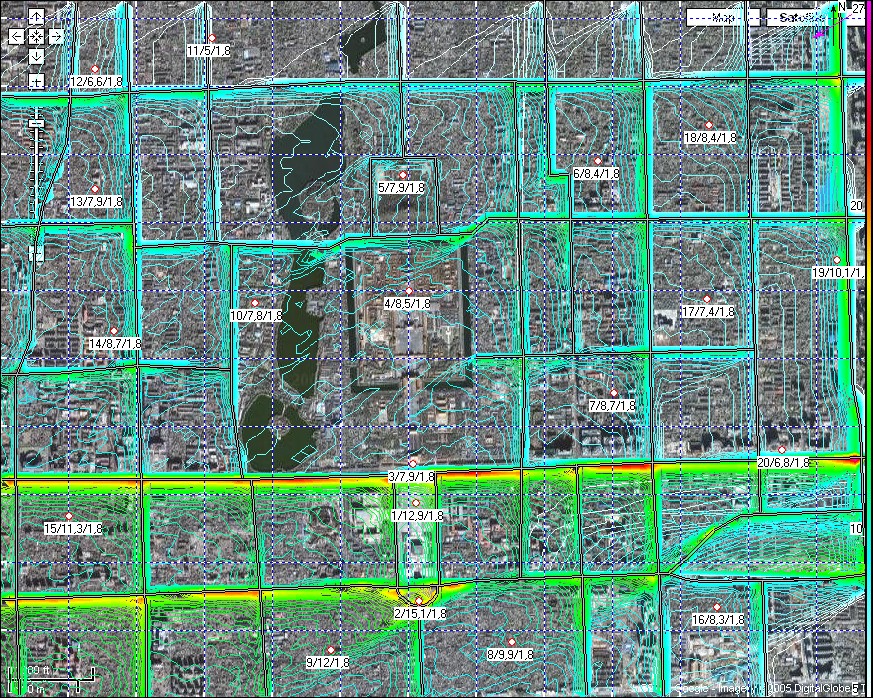
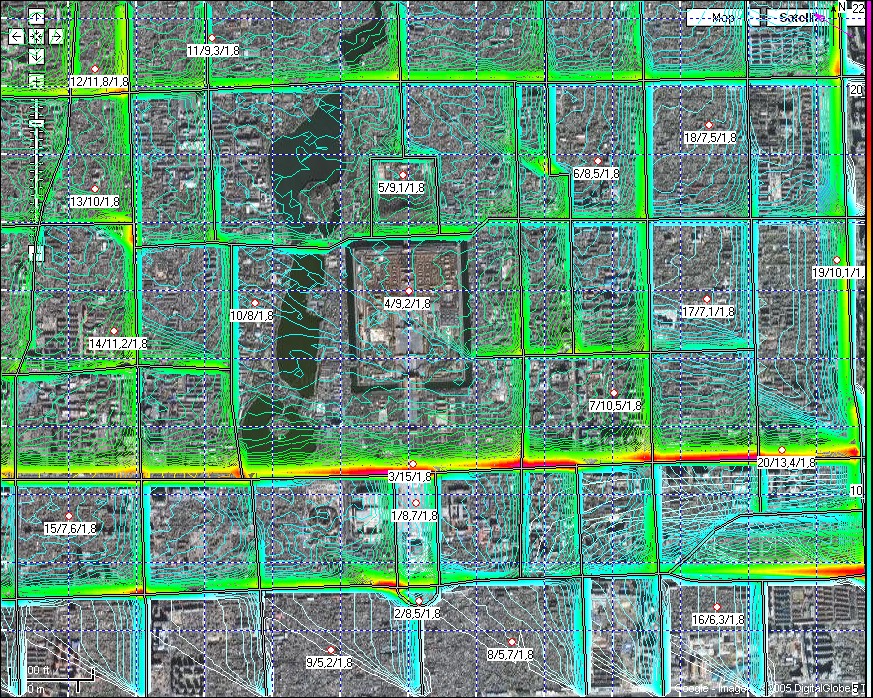
Color contour lines (Wind Angle = 225o) ● Ex-4. Arterial streets of local Bei Jing city zone, China (background map: Google Earth satellite map, see more figures under different wind directions click Albums);
Color contour lines (Wind Angle =60o)
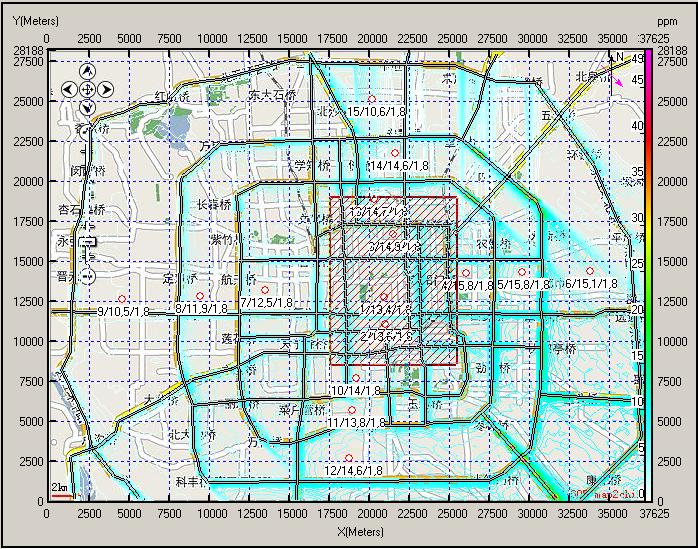
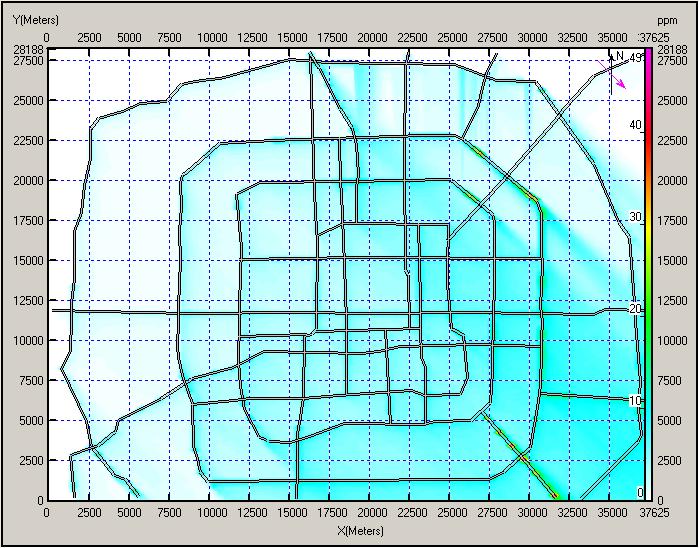
Color contour lines (120o) ● Ex-5. Highways and arterial streets of Bei Jing city zone, China (background map: Yahoo-China map, see more figures under different wind directions click Albums);
Color contour lines (Wind Angle =315o) with a rectangle (brown ), specified by the user through the drawing tool provided by software. The position of this region and corresponding characteristic concentrations (maximum, minimum and mean) can be instantly displayed on table.
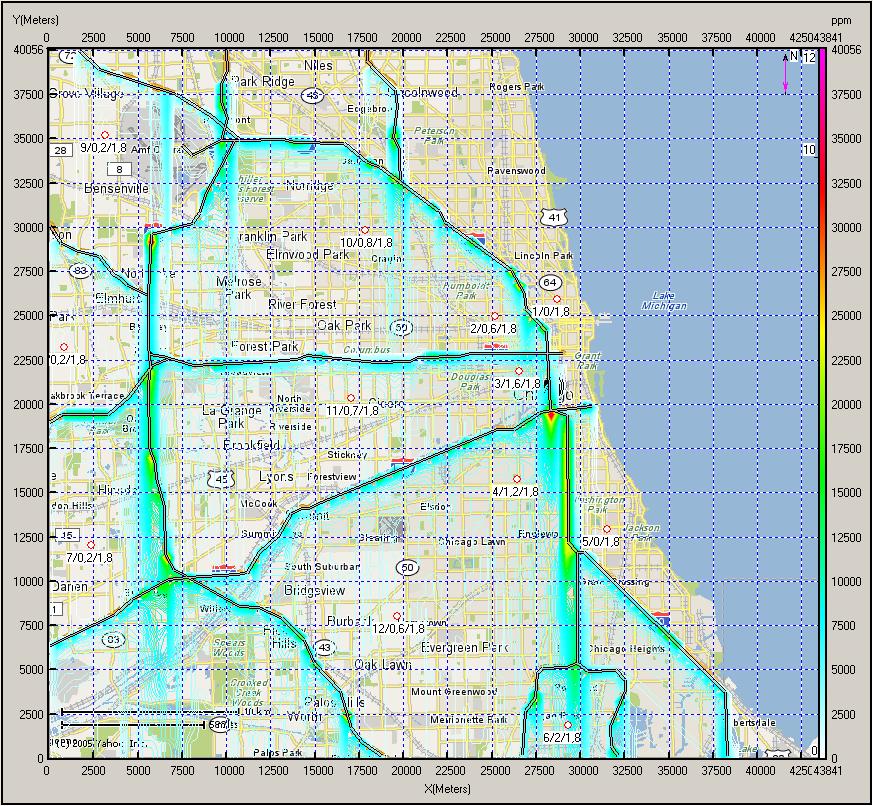
Color filled image (Wind Angle =315o) ● Ex-6. Highways in Chicago city zone, USA (background map: Yahoo map, see more figures under different wind directions click Albums);
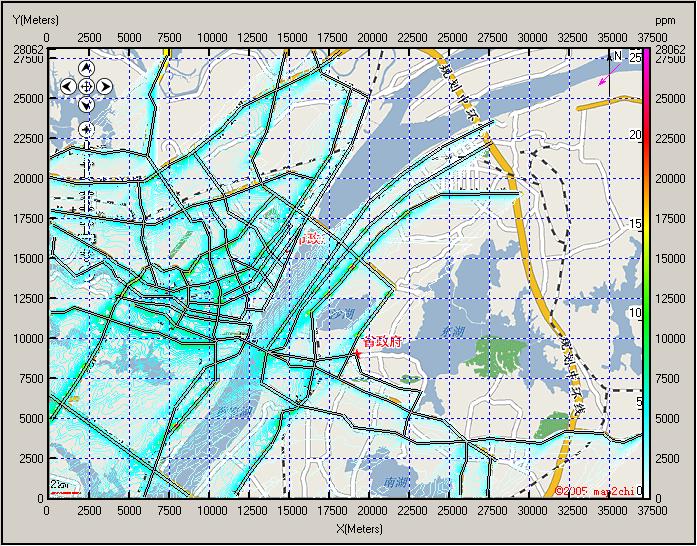
Color contour lines (Wind Angle =0o) ● Ex-7. Highways and arterial streets of Wu Han city zone, China (background map: Yahoo-China map, see more figures under different wind directions click Albums)
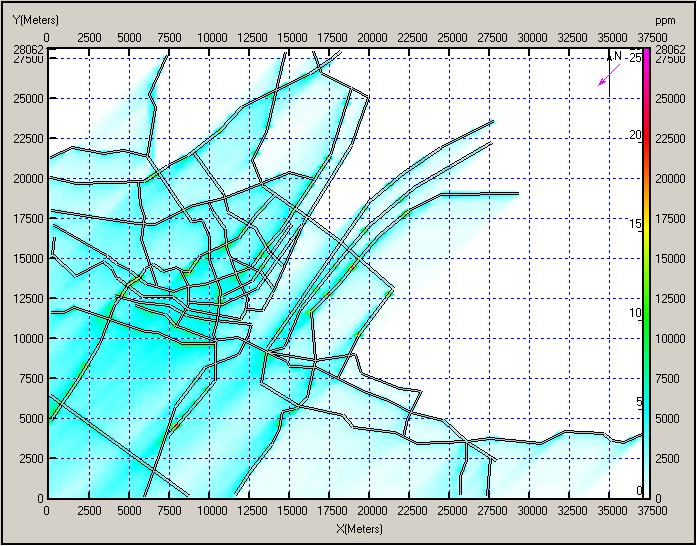
Color contour lines (Wind Angle =45o)
Color filled image (Wind Angle=45o)
|
|||