
|
| HOME | FRANCE | CHINA | KOREA |
FRANCE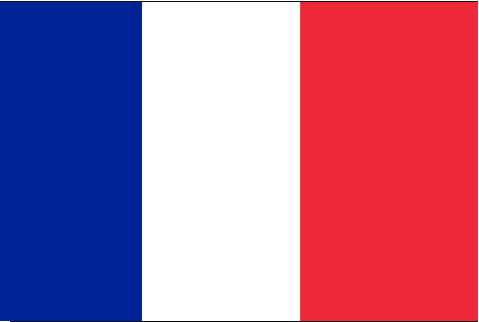 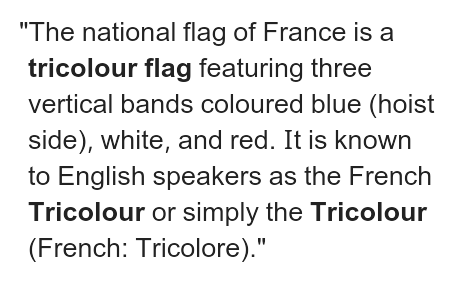 |
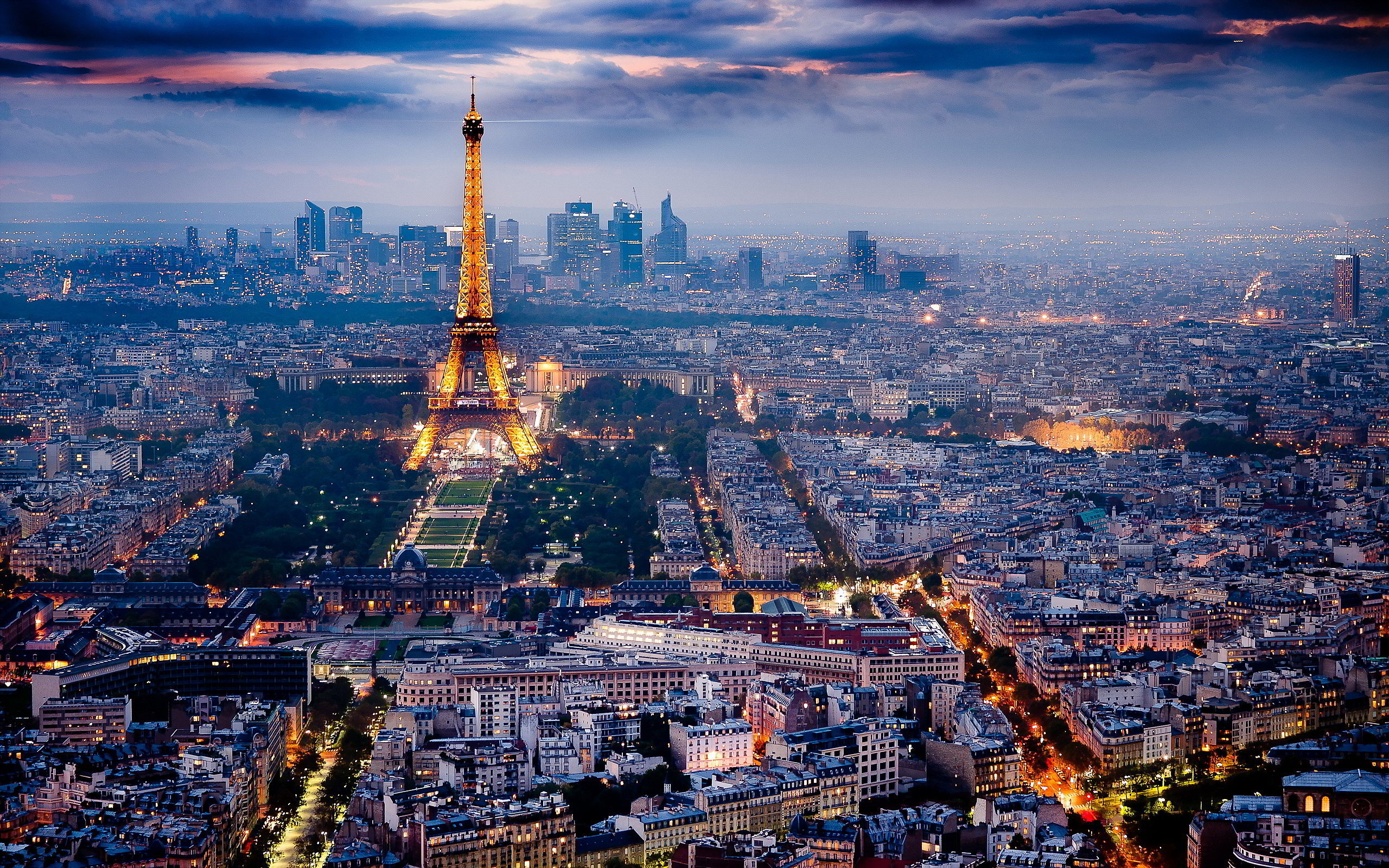 French is the capital and most populous city of France. Situated on the
Seine River, in the north of the country, it is in the centre of the
Île-de-France region, also known as the région parisienne, "Paris
Region". The City of Paris has an area of 105 km² (41 mi²) and a
population of 2,241,346 (2014 estimate) within its administrative borders
essentially unchanged since 1860. Since the 19th century, the built-up area
of Paris has grown far beyond its administrative borders; together with its
suburbs, the whole agglomeration has a population of 10,550,350 (Jan. 2012
census). Paris' metropolitan area spans most of the Paris region and has a
population of 12,341,418 (Jan. 2012 census), or one-fifth of the population
of France. The administrative region covers 12,012 km² (4,638 mi²), with
approximately 12 million inhabitants as of 2014, and has its own rA love lock or love padlock is a padlock which sweethearts lock to a bridge, fence, gate, or similar public fixture to symbolize their love.[1] Typically
the sweethearts' names or initials are inscribed on the padlock, and
its key is thrown away to symbolize unbreakable love. Since the 2000s,
love locks have proliferated at an increasing number of locations
worldwide. They are now mostly treated by municipal authorities as
litter or vandalism, and there is some cost to their removal. However,
there are authorities who embrace them, and who use them as fundraising
projects or tourism attractions.egional
council and president. |
PARIS Paris was founded in the 3rd century BC by a Celtic people called the Parisii, who gave the city its name. By the 12th century, Paris was the largest city in the western world, a prosperous trading centre, and the home of the University of Paris, one of the first in Europe. In the 18th century, it was the centre stage for the French Revolution, and became an important centre of finance, commerce, fashion, science, and the arts, a position it still retains today. The Paris Region had a GDP of €624 billion (US $687 billion) in 2012, accounting for 30.0 percent of the GDP of France, and ranking it as one of the wealthiest five regions in Europe; it is the banking and financial centre of France, and contains the headquarters of 29 of the 31 companies in France ranked in the 2015 Fortune Global 500. |
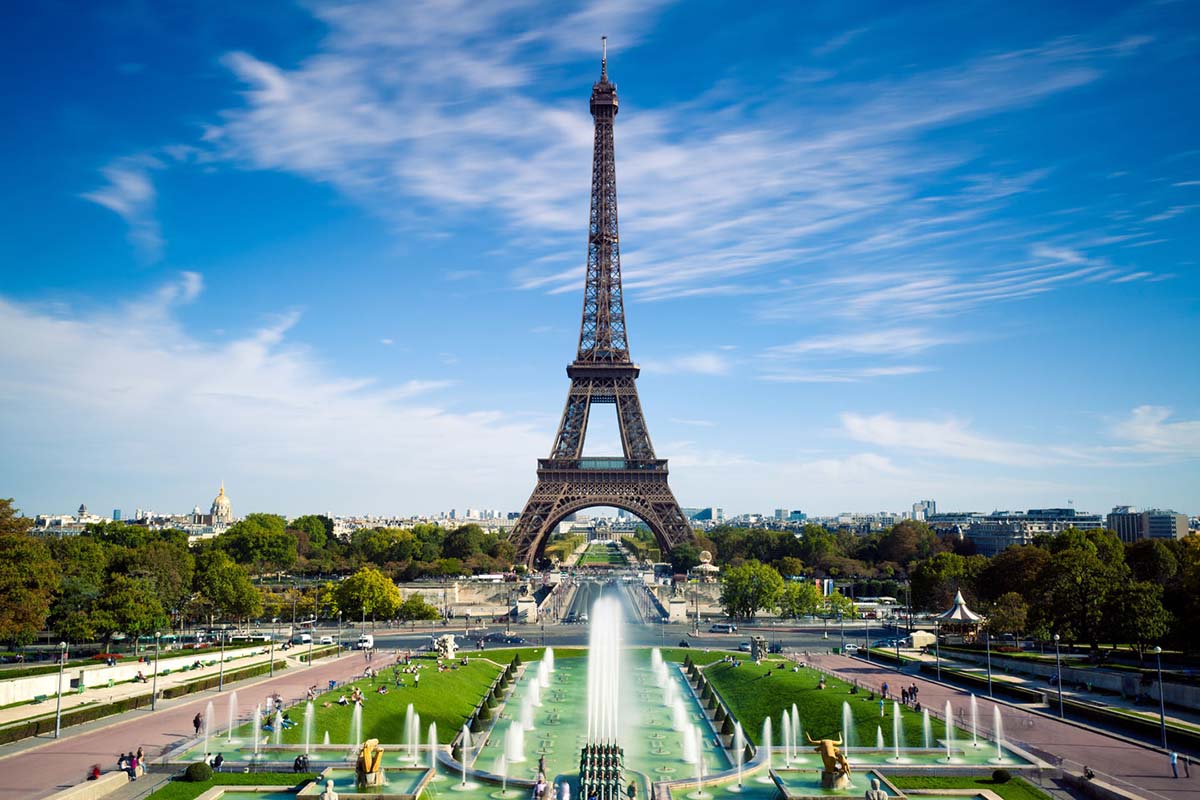
THE EIFFEL TOWER 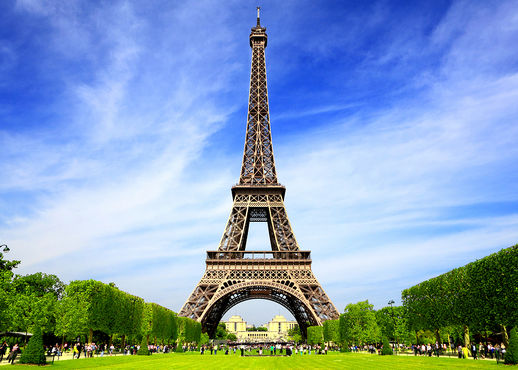 The Eiffel Tower is a wrought iron lattice tower on
the Champ de Mars in Paris, France. It is named after the engineer Gustave Eiffel, whose company designed and built the tower. |
HISTORY First drawing of the Eiffel Tower by
Maurice Koechlin including size comparison with other Parisian landmarks such
as Notre Dame de Paris, the Statue of Liberty and the Vendôme Column.
The new version gained Eiffel's support: he
bought the rights to the patent on the design which Koechlin, Nougier, and
Sauvestre had taken out, and the design was exhibited at the Exhibition of
Decorative Arts in the autumn of 1884 under the company name. On 30 March 1885,
Eiffel presented his plans to the Société des Ingénieurs Civils; after discussing
the technical problems and emphasising the practical uses of the tower, he
finished his talk by saying the tower would symbolise.
"Not only the art of the modern
engineer, but also the century of Industry and Science in which we are living,
and for which the way was prepared by the great scientific movement of the
eighteenth century and by the Revolution of 1789, to which this monument will
be built as an expression of France's gratitude."Little progress was made until 1886, when
Jules Grévy was re-elected as president of France and Édouard Lockroy was
appointed as minister for trade. A budget for the exposition was passed and, on
1 May, Lockroy announced an alteration to the terms of the open competition
being held for a centerpiece to the exposition, which effectively made the
selection of Eiffel's design a foregone conclusion, as entries had to include a
study for a 300 m (980 ft) four-sided metal tower on the Champ de Mars. On
12 May, a commission was set up to examine Eiffel's scheme and its rivals,
which, a month later, decided that all the proposals except Eiffel's were
either impractical or lacking in details.
After some debate about the exact location
of the tower, a contract was signed on 8 January 1887. This was signed by
Eiffel acting in his own capacity rather than as the representative of his
company, and granted him 1.5 million francs toward the construction costs: less
than a quarter of the estimated 6.5 million francs. Eiffel was to receive all
income from the commercial exploitation of the tower during the exhibition and
for the next 20 years. He later established a separate company to manage the
tower, putting up half the necessary capital himself. |
| THE CONSTRUCTION OF EIFFEL TOWER |
7 DECEMBER 1887 : Construction of the legs with scaffolding.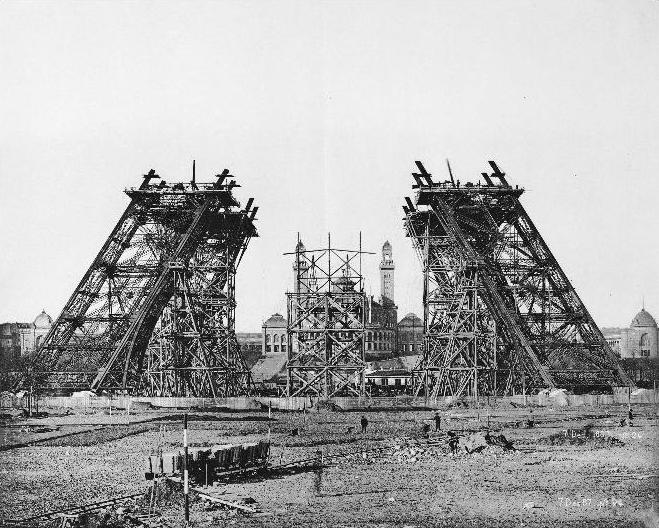 | 20 MARCH 1888 : Completion of the first level. 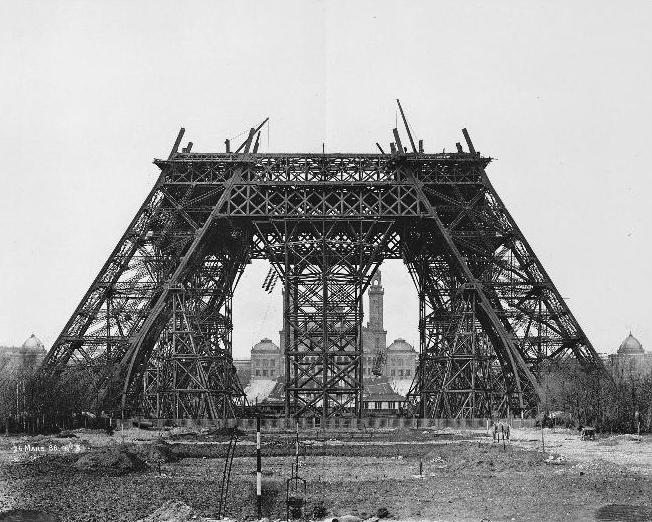 | 15 MAY 1888 : Start of construction on the second stage. 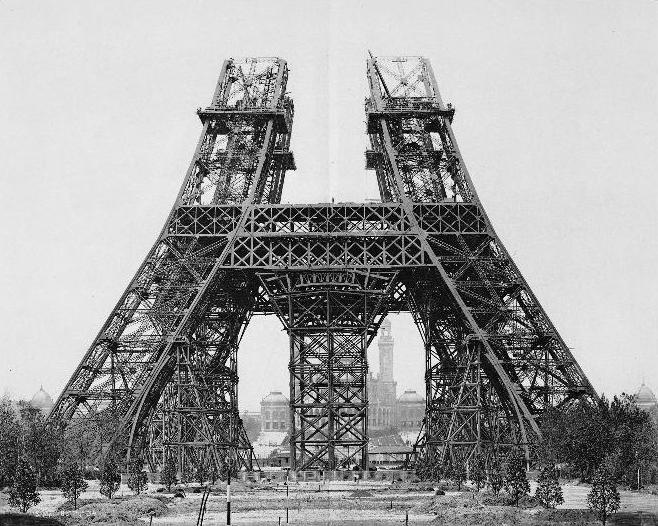 |
21 AUGUST 1888 : Completion of the second level.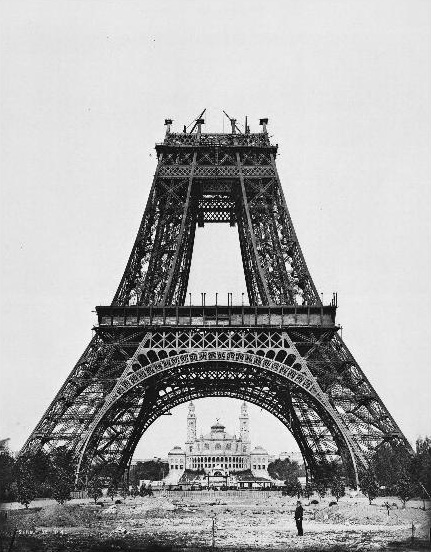 | 26 DECEMBER 1888 : Construction of the upper stage.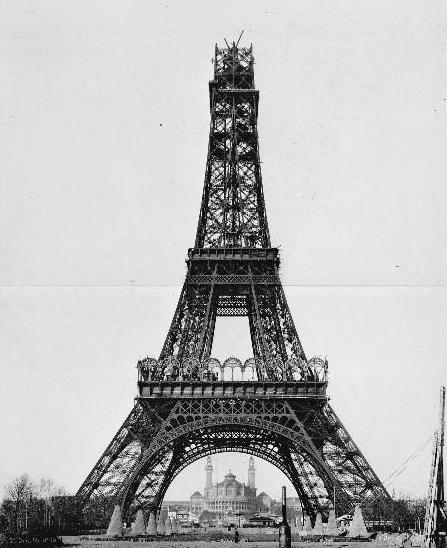 | 15 MARCH 1889 : Construction of the cupola.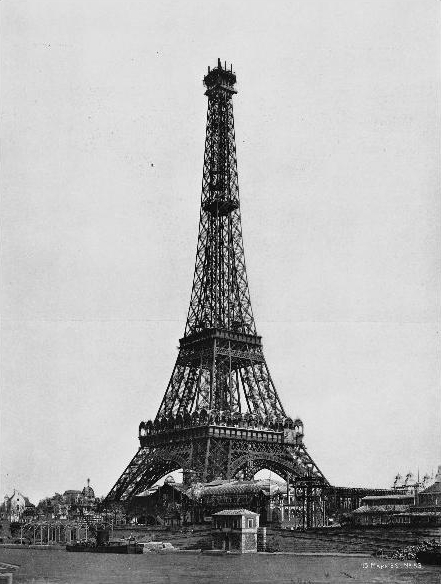 |
 | FOUNDATION OF THE EIFFEL TOWER The start of the erection of the metalwork Work on the foundations started on 28
January 1887. Those for the east and south legs were straightforward, with
each leg resting on four 2 m (6.6 ft) concrete slabs, one for each of the
principal girders of each leg. The west and north legs, being closer to the
river Seine, were more complicated: each slab needed two piles installed by
using compressed-air caissons 15 m (49 ft) long and 6 m (20 ft) in diameter
driven to a depth of 22 m (72 ft) to support the concrete slabs, which were
6 m (20 ft) thick. Each of these slabs supported a block of limestone with an
inclined top to bear a supporting shoe for the ironwork. Each shoe was anchored to the stonework by
a pair of bolts 10 cm (4 in) in diameter and 7.5 m (25 ft) long. The foundations
were completed on 30 June, and the erection of the ironwork began. The visible
work on-site was complemented by the enormous amount of exacting preparatory
work that took place behind the scenes: the drawing office produced 1,700
general drawings and 3,629 detailed drawings of the 18,038 different parts
needed. The task of drawing the components was complicated by the complex
angles involved in the design and the degree of precision required: the
position of rivet holes was specified to within 0.1 mm (0.004 in) and angles
worked out to one second of arc. The finished components, some already riveted
together into sub-assemblies, arrived on horse-drawn carts from a factory in
the nearby Parisian suburb of Levallois-Perret and were first bolted together,
with the bolts being replaced with rivets as construction progressed. No
drilling or shaping was done on site: if any part did not fit, it was sent back
to the factory for alteration. In all, 18,038 pieces were joined together using
2.5 million rivets.
At first the legs
were constructed as cantilevers, but about halfway to the first level,
construction was paused in order to create a substantial timber scaffold. This
renewed concerns about the structural integrity of the tower, and sensational
headlines such as "Eiffel Suicide!" and "Gustave Eiffel Has Gone
Mad: He Has Been Confined in an Asylum" appeared in the tabloid press.
At this stage, a small "creeper" crane designed to move up the tower
was installed in each leg. They made use of the guides for the lifts which were
to be fitted in the four legs. The critical stage of joining the legs at the
first level was completed by the end of March 1888. Although the metalwork
had been prepared with the utmost attention to detail, provision had been made
to carry out small adjustments in order to precisely align the legs; hydraulic
jacks were fitted to the shoes at the base of each leg, capable of exerting a
force of 800 tonnes, and the legs were intentionally constructed at a slightly
steeper angle than necessary, being supported by sandboxes on the scaffold.
Although construction involved 300 on-site employees, only one person died
thanks to Eiffel's stringent safety precautions and the use of movable
gangways, guardrails and screens |
 |  |