|
Mark's
Nonviolence Page Search
Here is the original link to Mark´s internet page.
Mahatma
Gandhi and his Myth
Contact Mahatma Gandhi
and His Myths By Mark Shepard For more resources, visit Mark Shepard's
Nonviolence Page at www.markshep.com/nonviolence Reprinted in full from
the book published by Shepard Publications, Los Angeles, 2002. Copyright
© 1990, 1996, 2001, 2002 Mark Shepard. May be freely copied and shared
for any educational, noncommercial purpose as long as no text is altered
or omitted.
This is the text of
the 1990 Annual Gandhi Lecture for the International Association of Gandhian
Studies, delivered at the University of Virginia at Charlottesville on
October 2.
There are many myths
about Gandhi. I'd like to point out a few of them and hopefully get
rid of them for you.
First, a quick one:
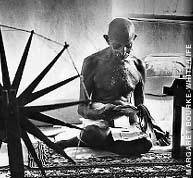
Gandhi was not a scrawny little man. Yes, his legs were scrawny-and
bowed-but he had a barrel chest, and a deep, booming voice to match
it. In pictures, you just don't notice his chest, because he usually had
a cloth draped around it. That was an easy one.
Let's try another.
One of the most common and most dangerous myths about Gandhi is that he
was a saint. The name-or rather, the title-Mahatma itself means "Great
Soul." That's somewhere between a saint and a Messiah. Gandhi tried to
avoid the title, but the people of India ignored his protests. Now I see
that even the Library of Congress has begun to classify him under "Gandhi,
Mahatma," so I guess he's lost that battle.
I've heard it argued
that Gandhi indeed was a saint, since he was a master of meditation. Well,
I must tell you that in all my readings of and about Gandhi, I've never
come across anything to say that Gandhi was a master of meditation,
or that he meditated at all-aside from observing a minute of silence at
the beginning of his prayer meetings, a practice he said he borrowed from
the Quakers.
Gandhi objected when
people called him "a saint trying to be a politician." He said he was
instead "a politician trying to be a saint." Personally, I go along with
Gandhi's judgment on this. Not that Gandhi's spiritual efforts and achievements
shouldn't be honored. They've certainly inspired me. But if we label
Gandhi a perfected being, we lose our chance to view his life and career
critically and to learn from his mistakes. Besides, if people see Gandhi
as a saint, they'll think he's "too good for the world," and they won't
take his example seriously as a model for concrete social change. I'm
constantly annoyed at finding books on Gandhi in bookstore sections marked
"Religious," or even "Occult." If his books are stashed away like that,
how will the hard-boiled political scientists ever run across him?
Another myth about
Gandhi is the idea that India's political leaders, beginning with Nehru,
are the inheritors of his tradition and have carried it on. I wish
they had. But really, India's leaders have rejected much more of
Gandhi than they've adopted. They abandoned nonviolent action as
soon as they attained power. India now sports the world's fourth
largest armed force, and the leaders haven't seemed at all reluctant
to use it to settle conflicts, either inside or outside the country. No
thought is given to possible Gandhi-style alternatives. Maybe even worse,
India's leaders have done their best to imitate Western countries by building
an economy based on large-scale industry and large-scale agriculture.
Gandhi fought this kind of development. He warned that it would economically
ruin India's villages, where 80% of India's people lived and still live.
And Gandhi has proved correct. Yes, India is now overall a much richer
country-but it has more desperately poor people than ever. As many as
half of its people can't afford enough food to sustain health.
India prides itself now on growing enough grain so it doesn't need
to import any-but the surplus rots in storage while people starve who
can't afford to buy it!
Gandhi promoted a
different kind of development. He stressed efforts based right in the
villages, building on the villagers' own strengths and resources.
Not many people here realize it, but Gandhi may be this century's greatest
advocate of decentralism-basing economic and political power at
the local level. You may remember in the movie Gandhi seeing Gandhi spin
cotton yarn on a compact spinning wheel. Gandhi and his colleagues
were the ones who developed this wheel and introduced it into the villages.
It's the first case of what's now called "appropriate technology"
or "intermediate technology."
Of course, E. F. Schumacher,
the author of Small is Beautiful, later introduced the terms themselves.
Schumacher was strongly influenced by Gandhi, calling him "the most important
economic teacher today." Gandhi set up a number of organizations to help
carry out village development. He sent many workers to live in and among
the villages. Since his death, thousands have carried on this work.
Now, though, the workers often combine development with campaigns against
local injustice. Probably the closest thing in the United States to what
they are doing is what we call "community organizing." The people carrying
on this work in India are among the true successors of Gandhi.
Other modern-day Gandhians are in programs like the Chipko-"Hug the Trees"-Movement,
which blocks irresponsible logging in the Himalayas; or Shanti
Sena, the "Peace Army," which intervenes nonviolently in urban riots.
My book Gandhi Today describes a number of the Gandhians' programs.
By the way, here's
a quick bust of another myth concerning Gandhi and India's leaders: Indira
Gandhi and her son Rajiv, the current prime minister, are no relation
to the Mahatma. Indira Gandhi was the daughter of Nehru. The name "Gandhi"
is common in India, and came to her by marriage. The name means "grocer."
I suspect, though,
that most of the myths and misconceptions surrounding Gandhi have to do
with nonviolence. For instance, it's surprising how many people
still have the idea that nonviolent action is passive. It's important
for us to be clear about this: There is nothing passive about Gandhian
nonviolent action. I'm afraid Gandhi himself helped create this confusion
by referring to his method at first as "passive resistance," because
it was in some ways like techniques bearing that label. But he soon changed
his mind and rejected the term. Gandhi's nonviolent action was
not an evasive strategy nor a defensive one. Gandhi was
always on the offensive. He believed in confronting his opponents
aggressively, in such a way that they could not avoid dealing with
him.
But wasn't Gandhi's
nonviolent action designed to avoid violence? Yes and no. Gandhi steadfastly
avoided violence toward his opponents. He did not avoid violence
toward himself or his followers. Gandhi said that the nonviolent activist,
like any soldier, had to be ready to die for the cause. And in
fact, during India's struggle for independence, hundreds of Indians were
killed by the British. The difference was that the nonviolent activist,
while willing to die, was never willing to kill.
Gandhi pointed out
three possible responses to oppression and injustice. One
he described as the coward's way: to accept the wrong or run away
from it. The second option was to stand and fight by force of arms. Gandhi
said this was better than acceptance or running away. But the third way,
he said, was best of all and required the most courage: to stand
and fight solely by nonviolent means.
Another of the biggest
myths about nonviolent action is the idea that Gandhi invented it. Gandhi
is often called "the father of nonviolence." Well, he did raise nonviolent
action to a level never before achieved. Still, it wasn't at all his invention.
Gene Sharp of Harvard University, in his book Gandhi as a Political Strategist,
shows that Gandhi and his Indian colleagues in South Africa were well
aware of other nonviolent struggles before they adopted such methods themselves.
That was in 1906. In the couple of years before that, they'd been impressed
by mass nonviolent actions in India, China, Russia, and among blacks in
South Africa itself. In another of his books, The Politics of Nonviolent
Action, Gene Sharp cites over 200 cases of mass nonviolent struggle
throughout history. And he assures us that many more will be found if
historians take the trouble to look. Curiously, some of the best earlier
examples come from right here in the United States, in the years leading
up to the American Revolution. To oppose British rule, the colonists used
many tactics amazingly like Gandhi's-and according to Sharp, they used
these techniques with more skill and sophistication than anyone else before
the time of Gandhi. For instance, to resist the British Stamp Act, the
colonists widely refused to pay for the official stamp required to appear
on publications and legal documents-a case of civil disobedience
and tax refusal, both used later by Gandhi. Boycotts of
British imports were organized to protest the Stamp Act, the Townshend
Acts, and the so-called Intolerable Acts. The campaign against the latter
was organized by the First Continental Congress, which was really a nonviolent
action organization. Almost two centuries later, a boycott of British
imports played a pivotal role in Gandhi's own struggle against
colonial rule. The colonists used another strategy later adopted by Gandhi-setting
up parallel institutions to take over functions of government-and had
far greater success with it than Gandhi ever did. In fact, according to
Sharp, colonial organizations had largely taken over control from the
British in most of the colonies before a shot was fired.
Why aren't we more
aware of such cases-including those in our own history? I think it's because
of something we could call "filtering." Probably most of you who've worked
with cameras know about the kind of filter I mean. The filter fits over
the camera lens and blocks out portions of the light-usually certain colors-and
lets the remainder pass through to the lens. In effect, the filter selects
the portion of light that the camera will "see." Each of us too sees the
world through our own "filter"-a filter made up of our assumptions, our
motivations, and the categories we use to sort out and organize our experience.
This filter determines how we see the world. When we come across something
that doesn't match our assumptions, motivations, and categories, our filter
blocks it out. It's not that we choose to reject it. Consciously, we don't
even perceive it. Or else we perceive it in a partial, distorted form.
It seems that nonviolence has a particularly hard time passing through
many people's filters. To know about current and past events, we depend
a great deal on journalists and historians. Now, one thing that journalists
and historians understand is military power. They know what comes from
many people being shot or imprisoned. It's obvious when such power is
being used, and a journalist or historian can feel professionally safe
in describing and analyzing it. But most of them do not deal so well with
subtle, nonviolent forms of power. They don't understand how such power
operates; or even how it could operate; or even that such a form of power
could exist. So, as often as not, they don't notice it at all. Or if they
do notice it, they don't grasp what they've seen. Or they don't connect
it with its effects. For example, say that a Third World country undergoes
a spontaneous, country-wide, mass noncooperation campaign against its
dictator, lasting weeks or even months. Tens of thousands march in the
streets, newspapers and radio stations defy the censors, whole cities
are shut down for days at a time as people go on strike. Noted citizens
call for the dictator's resignation, no one follows his orders, he has
completely lost control. Finally, four or five military officers, carrying
out the obvious will of the people, march nearly unopposed into the presidential
palace, arrest the dictator, and escort him out of office. Chances are
that our news media and history books will thereafter attribute the dictator's
downfall, purely and simply, to "a military coup." Watch the media closely,
and you will find this is not at all an uncommon pattern. One classic
example is in regard to the 1963 overthrow of South Vietnamese President
Ngo Dinh Diem. An almost anti-climactic military coup followed a half
year of intensive public actions led by Buddhist monks, in a campaign
that destroyed Diem's base of support. Yet all three of the almanacs on
my shelves ascribe Diem's downfall to the coup, and only one even mentions
the popular campaign as a factor. (By the way, for details on that popular
movement, I refer you to what is probably the best overview of the worldwide
nonviolence movement, The Struggle for Humanity, by Marjorie Hope and
James Young.) The fact is, even in revolutions that are primarily violent,
the successful ones usually include nonviolent civilian actions not so
different from the ones Gandhi used. And nearly every time, you will find
these actions curiously downplayed or ignored by most journalists and
historians. As Indira Gandhi put it, "The meek may one day inherit the
earth, but not the headlines."
So, Gandhi was definitely
not "the father of nonviolence" in the sense of having invented it. But
we might still grant him the title in something of the sense in which
we say Isaac Newton "discovered" gravity. Isaac Newton, of course,
was not the first person to see an apple fall out of a tree. But Newton
was the first person to notice that fall and grasp its significance,
and provide us with a general concept so that we could do the same.
Newton, in other words, altered our filters so we could perceive the working
of gravity. The same with Gandhi. He seems to have been the first person
to have the general concept of nonviolent action, to declare it, and then
to consciously apply it on a large scale. In this way, he
gave us all a way to perceive what he was up to. Of course, some people
still didn't get the point, because even when Gandhi laid it out for them,
the concept of nonviolent action couldn't begin to pass through their
clouded filters. It's fun to read what's been written about Gandhi by
his political opponents in England, or by Marxists in India and elsewhere,
or by recent slanderers nipping at the heels of the movie Gandhi. What
they've written doesn't reveal much about Gandhi, but it reveals a good
deal about the writers. Gandhi's most bitter critics have called him a
charlatan-a deceiving, malicious fraud. After all, who could say the things
Gandhi said and really mean them? Well, surely these critics couldn't!
Other, "kinder" critics have felt Gandhi was simply an idealistic fool,
with no conception of how power works in the real world. Translated, this
means that these critics can't understand how Gandhi's methods worked.
Let's look at these methods of Gandhi's and see if we can spot where their
power might come from. And maybe we can clear up some other myths along
the way.
Gandhi called his
overall method of nonviolent action Satyagraha. This translates
roughly as "Truth-force." A fuller rendering, though, would be
"the force that is generated through adherence to Truth." Nowadays,
it's usually called nonviolence. But for Gandhi, nonviolence was the word
for a different, broader concept-namely, "a way of life based on love
and compassion." In Gandhi's terminology, Satyagraha-Truth-force-was an
outgrowth of nonviolence. It may also help to keep in mind that the terms
Satyagraha and nonviolent action, though often used one for the other,
don't actually refer to the exact same thing. Satyagraha is really one
special form of nonviolent action-Gandhi's own version of it. Much of
what's called nonviolent action wouldn't qualify as Satyagraha. But we'll
come back to that later.
Gandhi practiced two
types of Satyagraha in his mass campaigns. The first was civil disobedience,
which entailed breaking a law and courting arrest. When we today
hear this term, our minds tend to stress the "disobedience" part of it.
But for Gandhi, "civil" was just as important. He used "civil" here not
just in its meaning of "relating to citizenship and government" but also
in its meaning of "civilized" or "polite." And that's exactly what Gandhi
strove for. We also tend to lay stress differently than Gandhi
on the phases of civil disobedience. We tend to think breaking the law
is the core of it. But to Gandhi, the core of it was going to prison.
Breaking the law was mostly just a way to get there.
Now, why was that?
Was Gandhi trying to fill the jails? Overwhelm and embarrass
his captors? Make them "give in" through force of numbers?
Not at all. He just wanted to make a statement. He wanted to say, "I care
so deeply about this matter that I'm willing to take on the legal penalties,
to sit in this prison cell, to sacrifice my freedom, in order to
show you how deeply I care. Because when you see the depth of my concern,
and how 'civil' I am in going about this, you're bound to change
your mind about me, to abandon your rigid, unjust position, and
to let me help you see the truth of my cause." In other words, Gandhi's
method aimed to win not by overwhelming but by converting his opponent-or
as the Gandhians say, by bringing about a "change of heart." Now, to many
people, that sounds pretty naive. Well, I'll let you in on a secret. It
was naive.
The belief that civil
disobedience succeeded by converting the opponent happened to be a myth
held by Gandhi himself. And it's shared by most of his admirers, who take
his word for it without bothering to check it out. As far as I can tell,
no civil disobedience campaign of Gandhi's ever succeeded chiefly through
a change of heart in his opponents. But this doesn't mean civil disobedience
didn't work. As a matter of fact, it did work. The only thing off-kilter
was Gandhi's explanation of how and why it worked. Let me give a general
description of what seems really to have happened when Gandhi and his
followers committed civil disobedience: Gandhi and followers break a law-politely.
Public leader has them arrested, tried, put in prison. Gandhi and
followers cheerfully accept it all. Members of the public are impressed
by the protest, public sympathy is aroused for the protesters and
their cause. Members of the public put pressure on public leader to
negotiate with Gandhi. As cycles of civil disobedience recur, public
pressure grows stronger. Finally, public leader gives in to pressure from
his constituency, negotiates with Gandhi. That's the general outline.
Notice that there is a "change of heart," but it's more in the public
than in the opponent. And notice too that there's an element of coercion,
though it's indirect, coming from the public, rather than directly from
Gandhi's camp. Some campaigns of Gandhi's show a variation on this model.
Sometimes Gandhi's opponents had superiors who wound up pressuring them
or even ordering them to negotiate with Gandhi. These superiors might
have been influenced by Gandhi's campaign, or by pressure from their own
public-for instance, when British citizens pressured government leaders
in Britain to intervene in affairs of their colonial government in India.
But the basic principle was the same: Gandhi's most decisive influence
on his opponents was more indirect than direct. Gandhi set out a number
of rules for the practice of civil disobedience. These rules often baffle
his critics, and often even his admirers set them aside as nonessential.
But once you understand that civil disobedience, for Gandhi, was aimed
at working a change of heart-whether in the opponent or the public-then
it's easy to make sense of them.
One rule was that
only specific, unjust laws were to be broken. Civil disobedience didn't
mean flouting all law. In fact, Gandhi said that only people with a high
regard for the law were qualified for civil disobedience. Only action
by such people could convey the depth of their concern and win respect.
No one thinks much of it when the law is broken by those who care nothing
for it anyway.
Other rules: Gandhi
ruled out direct coercion, such as trying to physically block someone.
Hostile language was banned. Destroying property was forbidden.
Not even secrecy was allowed. All these were ruled out because
any of them would undercut the empathy and trust Gandhi was trying
to build, and would hinder that "change of heart."
The second form of
mass Satyagraha was noncooperation. This is just what it sounds
like. Noncooperation meant refusing to cooperate with the opponent, refusing
to submit to the injustice being fought. It took such forms as strikes,
economic boycotts, and tax refusals. Of course, noncooperation and civil
disobedience overlapped. Noncooperation too was to be carried out in a
"civil" manner. Here too, Gandhi's followers had to cheerfully face beating,
imprisonment, confiscation of their property-and it was hoped that this
willing suffering would cause a "change of heart." But noncooperation
also had a dynamic of its own, a dynamic that didn't at all depend on
converting the opponent or even molding public opinion. It was a dynamic
based not on appeals but on the power of the people themselves. Gandhi
saw that the power of any tyrant depends entirely on people being willing
to obey. The tyrant may get people to obey by threatening to throw them
in prison, or by holding guns to their heads. But the power still resides
in the obedience, not in the prison or the guns. Now, what happens if
those people begin to say, "We're not afraid of prison. We're even willing
to die. But we're not willing to obey you any longer." It's very simple.
The tyrant has no power. He may rant and scream and hurt and destroy-but
if the people hold to it, he's finished. Gandhi said, "I believe that
no government can exist for a single moment without the cooperation of
the people, willing or forced, and if people suddenly withdraw
their cooperation in every detail, the government will come to a standstill."
That was Gandhi's concept of power-the one he's accused of not having.
It's a hard one to grasp, for those used to seeing power in the barrel
of a gun. Their filters do not pass it. And so they call Gandhi idealistic,
impractical.
Then there are the
critics who say nonviolent action worked fine in India, but they don't
think it would make sense to use it elsewhere. These critics believe that
Indians are particularly suited to nonviolent action, because of
the ethic of nonviolence built into their religion. This is a very interesting
myth, and those who believe in it certainly possess a very selective filter.
Personally, I don't think you can follow the news from India for long
and still believe Indians are less violent than other people. Besides,
Gandhi's philosophy of nonviolence seems to have been consciously inspired
first by the New Testament-the Sermon on the Mount. Only later,
it seems, did he find similar ideas in Hindu scriptures. It's surprising
how easy it is to forget that we too have an ethic of nonviolence built
into our society's chief religion. We just don't happen to follow it.
Just as the Indians don't normally follow theirs. But really, the easiest
way to see that nonviolent action is suitable outside India is simply
to look at all the cases of nonviolent action outside India. Unless your
filter is pretty murky, you can hardly miss them. It certainly can't be
easy to ignore the example of Martin Luther King, Jr., or to forget the
Solidarity movement in Poland, or to overlook the overthrow of Ferdinand
Marcos in the Philippines. Then there's the cousin of the "only-in-India"
argument. This one says that nonviolent action can work only against "easy"
enemies like the British, and not against, say, the Soviets, or Central
American dictators, or those villains of last resort, the Nazis. Here
again, filters are in place, because nonviolent action has been used with
some success against all these. In 1968, Czechoslovakian civilians nonviolently
held Soviet armed forces at bay for a full week and stopped the Soviet
leaders from ever subjugating that country to the degree they had intended.
In 1944, military dictators were ousted nonviolently in both El Salvador
and Guatemala. And during World War II, Norway nonviolently and successfully
resisted Nazi attempts to reorganize its society along fascist lines.
(In case you missed any of these, you can find details, again, in Gene
Sharp's The Politics of Nonviolent Action, among other sources.) One of
the interesting things about the many instances of nonviolent struggle
around the world is that, even today, it is often by people who know nothing
or next to nothing about Gandhi. After you look at a number of these,
you have to conclude that people in many situations just naturally turn
to such methods. On the other hand, if you look closely at so-called popular
liberation movements, you'll find that they're seldom started by the peasants
or workers they're supposed to benefit. These armed struggles may gradually
build wider support-but in almost every case, they're launched by students
or other intellectuals in the name of the people.
Still another group
of Gandhi's critics says: Maybe nonviolent action does work-but it's just
too slow. People are suffering injustice, slavery, starvation, murder.
How can you ask them to be patient and work nonviolently? Somehow people
have developed the myth that nonviolent action is slow, while violence
is quick. But I don't believe you can find evidence for this in history.
Now, I'm not going to try to prove my point by comparing cases of violent
and nonviolent struggles. There are so many variables that comparisons
from one situation to another really don't mean anything. But we can still
rid ourselves of the idea that violence is necessarily quick.
If we look at the
Chinese Revolution, for instance, we find that Mao Tse-Tung and his Communist
forces were engaged in combat over a period of 22 years. Vietnam was embattled
for an even longer period: 35 years. These are not swift victories. We
can also dispel the notion that nonviolent action has to be slow. The
nonviolent overthrow of Marcos in the Philippines-measured from the assassination
of Benigno Aquino-took only three years. Where does the idea come from,
then, that violence is quick and nonviolence is slow? Well, violence feels
quicker, because time passes rapidly when you're dodging bullets.
Nonviolent action,
on the other hand, requires more patience because the action is less thrilling.
Theodore Roszak once commented on the impatience of some of these critics.
He said, "People try nonviolence for a week, and when it 'doesn't work,'
they go back to violence, which hasn't worked for centuries." Now, what
does Roszak mean, that violence "hasn't worked for centuries"? Is he ignoring
the success of so many violent revolutions? I think Roszak means that
violence, even when it succeeds, has major negative side-effects-side-effects
that nonviolent action mostly avoids.
First of all, a violent
struggle will tend to bring about much more destruction of life, property,
and environment. Of course, there can be destruction in nonviolent struggles,
too. Just because you're nonviolent doesn't mean your opponent will be.
As I said before, Gandhi's campaigns in India saw hundreds of Indians
killed by the British. Still, this doesn't compare with the tens or hundreds
of thousands, or even millions, killed in some violent revolutions. The
difference, by the way, doesn't arise because nonviolent struggles are
aimed at "nice" enemies. After all, the British aren't so much nicer than
the French, who killed 800,000 Algerians-that's one out of every thirteen-during
Algeria's war of independence. No, the difference arises because, in a
violent struggle, the violence of each side goads the other to greater
violence. Also, each side uses the violence of the other side to justify
its own violence.
A nonviolent struggle,
on the other hand, doesn't so much encourage the violence of the
opponent. Other negative side-effects of violence come into view once
the struggle comes to an end. For instance, violence generally leaves
the two sides as long-standing enemies. Maybe the most amazing thing about
Gandhi's nonviolent revolution is, not that the British left, but that
they left as friends, and that Britain and India became partners in the
British Commonwealth. Gandhi noted also that violent revolutions almost
always end in repressive dictatorships. Once the rebel troops gain control,
they naturally keep acting as they're used to-in other words, they start
running the country like a military camp. And of course, there are lots
of bitter enemies within the country who still need to be put down and
kept down. Gandhi hoped that a nonviolent revolution, led by civilians,
would avoid all this. Now, India today is not a paradise. It is afflicted
by widespread injustice, civil violence, and authoritarian trends. Still,
it is one of the few Third World countries where democracy in any form
has survived continuously. There has never been a military coup in India.
When you look at the side-effects of violent struggle, you really have
to ask yourself, just who is being practical here, and who is not.
Now, maybe you think
from all I've said that I believe nonviolent action would work anywhere,
if people just gave it a try. Actually, I don't. I believe there are cases
in which nonviolent action wouldn't stand a chance, and where any attempt
at it is futile. In some of these cases, violence might succeed-in its
own fashion. On the other hand, the cases in which nonviolent action wouldn't
work are often just the cases in which violence as well would prove pointless
or worse. The belief that violence will work wherever nonviolent action
wouldn't is a very puzzling myth. The opposite case is likely more common:
Where violent efforts would be easily contained or instantly crushed,
nonviolent action may be the only realistic choice. Then there are other
cases, I believe, in which violence would work, but so would nonviolent
action-with much less harm. If exponents of armed struggle were less concerned
with proving their manliness and more concerned with the welfare of the
people they claim to stand up for, they might discover that nonviolent
forms of struggle, everything considered, work better.
I'd like to bust one
more myth about Gandhi's nonviolent action. This one is held both by many
of Gandhi's critics and by many of his admirers. In fact, the misunderstanding
is so common and so basic that I have to say that many-maybe most-admirers
of Gandhi's methods really miss the point. Just as I did when I began
my study of Gandhi. Prior to that study, most of my experience with political
activism had been with Marxists, and I had pretty well absorbed their
worldview. But later, after exploring several spiritual traditions, I
felt I could no longer endorse the Marxists' methods. How then to oppose
injustice and reform society? I hoped that Gandhi held the answer. It
seemed to me he had meant to work out just what I was looking for: a way
of defeating and overthrowing the oppressors of the world, but by moral
means.
That was my myth about
Gandhi; that was my filter. I had to read an entire book and a half about
Gandhi before it struck me-and it struck me hard-that Gandhi was not talking
about defeating or overthrowing anyone. Satyagraha-Gandhi's nonviolent
action-was not a way for one group to seize what it wanted from another.
It was not a weapon of class struggle, or of any other kind of division.
Satyagraha was instead an instrument of unity. It was a way to remove
injustice and restore social harmony, to the benefit of both sides. Satyagraha,
strange as it seems, was for the opponent's sake as well. When Satyagraha
worked, both sides won. That concept did not pass at all easily through
my filter, and I understand why so many others miss it entirely. But it
is, really, the essential difference between Gandhi's Satyagraha and so
much of the nonviolent action practiced by others. You may wonder, how
did Gandhi himself come to this amazing attitude? He said it this way:
"All my actions have their source in my inalienable love of humankind."
You see, love for the victim demanded struggle, while love for
the opponent ruled out doing harm. But in fact, love for the opponent
likewise demanded struggle. Why? Because by hurting others, the oppressor
also hurts himself. Of course, the oppressor isn't likely to be aware
of that. He may be thoroughly enjoying his power and wealth. But beneath
all that, his injustice is cutting him off from his fellow humans and
from his own deeper self. And when that happens, his spirit can only wither
and deform. Now, that's not obvious, and if you don't believe it, I don't
know any way I might convince you. But if that does pass through your
filter, you may be well on your way to understanding Gandhi.
Bibliography Mohandas
K. Gandhi, Nonviolent Resistance, Schocken, New York, 1967. A collection
of writings on nonviolence. Marjorie Hope and James Young, The Struggle
for Humanity: Agents of Nonviolent Change in a Violent World, Orbis, Maryknoll,
New York, 1977. Portraits of important leaders and groups in the worldwide
nonviolence movement. Mark Shepard, Gandhi Today, Simple Productions,
Arcata, California, and Seven Locks Press, Washington, D.C., 1987. On
successors of Gandhi in India and around the world. Gene Sharp, Gandhi
as a Political Strategist, Porter Sargent, Boston, 1979. A collection
of Sharp's articles on Gandhi and nonviolence. ---,
The Politics of Nonviolent
Action, Porter Sargent, Boston, 1973. An extensive look at methods and
historical examples of nonviolence. The paperback edition is in three
volumes. Also available as a paperback or an ebook! Mark's Nonviolence
Page
Download the whole
text as PDF file
DOWNLOAD
|