|
West
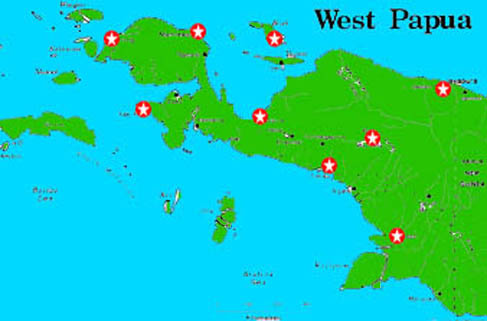
Papua Map

Background to the United Nations
Involvement
in West Papua (Irian Jaya)
Until October 1962, West Papua
(Irian Jaya) was a non-self governing territory that was
being prepared for eventual independence by the Netherlands.
However, Dutch policy in West
Papua was strongly opposed by Indonesia's President Sukarno
who claimed that, as a former part of the Dutch East Indies,
the territory was Indonesian.
When diplomatic appeals to the
UN General Assembly failed to win him sufficient support,
Sukarno embarked upon a massive arms build up and threatened
to take West Papua by force.
In September 1961, the Dutch
presented a plan (the Luns Plan) to the UN General Assembly
to resolve the dispute peacefully. They proposed to hand the
territory over to a UN administration that would remain
until the population was considered ready to exercise their
right to self-determination. Although it won majority
support, it fell short of the required two-thirds of votes
to be passed.
With no solution agreed at the
UNGA, the threat of an Indonesian attack on the territory
grew. To avoid this the US put pressure on the Dutch to give
in to most of Jakarta's demands and come to some form of
UN-brokered agreement with them.
The result was the signing on 15
August 1962 of the New York Agreement between the
Netherlands and Indonesia.
In confidential communications,
the Kennedy administration made clear the motivation behind
its coercion of the Dutch. As one senior official advised
the President on the day the Agreement was signed:
we ought to capitalise on
the WNG settlement by moving fast toward the 'future
fruitful cooperation' of which you spoke to Sukarno. Capital
of the sort we've gained is a transitory asset to be used
while it's still good. Moreover, Indonesia is one of the
truly big areas of East-West competition; having invested so
much in maneuvering a WNG settlement for the express purpose
of giving us leverage in this competition, we'd be foolish
not to follow through. [Komer. Memorandum to President
Kennedy, 15 August 1962. In US Foreign Relations 1961-63,
Vol XXIII Southeast Asia, (Department of State Printing
Office, 1994), p. 626 - Enclosure 1] More>>>
 Sources;
indymedia.org Sources;
indymedia.org
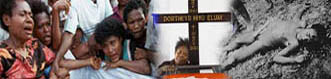
Separatist Leader Found Dead; Papuans Suggest
Indonesian Military Played Role
The mysterious death of popular West Papuan
separatist leader Theys Eluay has sparked substantial
unrest in the Indonesian-ruled land over the last several days. On Sunday,
November 11, Eluay was found, suffocated,
inside his car at the bottom of a ravine, after being missing
for almost a day. Eluay's supporters have declared that the Indonesian
military is to blame; Indonesian leaders have strongly denied involvement.
Eluay, leader of the Papuan
Presidium Council, a West Papuan separatist group, had been on trial along
with three other presidium members, on charges of "subversion." West
Papuan separatists are preparing for a difficult week in anticipation of
December 1, the day they have chosen as their 'independence
day."
Next month the Indonesian government will grant greater autonomy, though not
independence, to West Papua, which occupies the western part of New Guinean
Island. Many in the province, currently called Irian Jaya, have been struggling
for independence from Indonesia for 40 years. U.S.-based Freeport-McMoran
Copper & Gold Inc., has owned
mines in the province since Indonesia took control in 1969; the controversial
corporation operates the
world's largest gold mine and one
of the world's largest copper mines there; West Papuan separatists have
accused Freeport-McMoran of bolstering
the Indonesian military's often brutal rule.
***
|