
The READER picks and chooses which books to expose him/herself to. One can willy-nilly choose or be steered by the Best Seller List or a college course. With a million books to choose from, some framework, sketching out a limit, would seem useful. Here I present one idea I used in organizing a series of books. I group the content of books here mentioned according to the author's focus, whether this focus was on either the READER, the LANGUAGE or the MILIEU. The author may discuss the READER'S brain and how it processes words; the author may focus on LANGUAGE itself and the various approaches to verbal or non-verbal communication; or the author may find the MILIEU or environment crucial to the viewer's ability to interpret communications of all sort -- verbal, graphic and photographic.
To me the reader's understanding of the words (including my words) stems from his/her POINT OF VIEW. For example, one reader may consider the words to be divinely inspired and number two reader interprets the same words to be pure fiction. Interpretation of a work is a joint endeavor between READER and AUTHOR. The author, by picking the words understands his/her own circle of meaning and likely readership. The writer's fondest hope is that his/her written words will excite some reader to further develop the story or idea in his/her own life or writing. In other words to make an impact. The author has spent many hours separating the wheat from the chaff. The author has populated one of what I call a WORLDREEL. If the reader can make use of his work in any fashion, the time spent was not wasted.
One of my favorite
authors is JERZY KOSINSKI. He wrote in his final book of
essays, PASSING BY (1962-1991), "since the only true
measure of literature's effectiveness is the extent to which the
reader's awareness is expanded, the writer's ultimate success
or failure can never be entirely known."
Jerzy felt that the author was only half the writing -- the other
half was the reader's ability to decipher the words. My
intent here on the WORLDREELS SITE -- as Kosinski wrote
is to "present a framework of ideas, words and images
in order to trigger the reader's imagination, but that framework
itself is not the final goal."
To me, words are but mental pictures of the language. Kept
imprisoned in the mind, language will wilt like a flower.. Let
loose, words can grow and bloom.

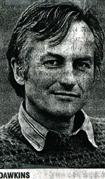
Richard Dawkins, (THE SELFISH GENE, THE EXTENDED PHENOTYPE) depicts the brain as composed of replicating brain-legos, very tiny worms with built in designs. He terms this genetic material as "selfish genes" but only as a device of grabbing the reader's attention. When he describes the genes as "survival machines" it is clear that machines do not posses intent. He goes on to say that genes "don't care about anything." "The universe that we observe has precisely the properties we should expect if there is, at bottom, no design, no purpose, no evil and no good, nothing but pitiless indifference."
Of
course his chosen language brings forth a fire storm from readers
who try to super-impose their own points of view on top his. I
don't think Dawkins had any notion that his idea would be interpreted
to mean man is a puppet being jerked around by the strings of
DNA in his brain. Nothing can stop the reader from adding his
own load of personal baggage and junk language to the author's
words. Had Dawkins been studying some man-made organism, an android
or skin-covered-robot, and described the biochips and computer
chips as controlling the automaton species, there would be little
outcry. All Dawkins was saying is that the creature, man, must
accept that there is a blueprint used in his or her construction.
This genetic blueprint is a controlling factor in man's path to
self realization.
Dawkins did not confine his words to descriptions of flesh and
blood. He also ventured into the realm of LANGUAGE . Dawkins came
up with the 'meme," (an idea-virus that spreads
in man's mind like a virus might in a computer). After SUSAN
BLACKMORE wrote THE MEME MACHINE (1999), further
extending Dawkins metaphor to include ideas, myths and art, another
crop of writers took her to task. She was making a self fulfilling
prophecy when she copied Dawkins ideas for genes and extended
them to "memes". What upsets some readers is that these
ideas,both Blackmore's and Dawkins', are seen to diminish free
will and seen to support some form of determinism. What scares
the shit out of most is to discover that they are themselves works-of-art
in progress. That control of one's ideas and control of one's
own personality growth might be directed without free will seems
to make a mockery of one's religion and one's ego. Neither religion
nor ego rarely give up turf without a fight.
RETURN LINKS: WELCOME; PHILOSOPHY; REMODEL;GENEALOGY; COSMOLOGY1; COSMOLOGY2;COSMOLOGY3: COSMOLOGY4; UNIVERSAL CONSCIOUSNESS;

ANOTHER BOOK where the author focuses on the READER is ROGER PENROSE'S THE EMPEROR'S NEW MIND: Concerning computers, Minds, and the Laws of Physics. Penrose attempts to set the human mind apart from artificial intelligence. Penrose is not the first nor the last to maintain the sanctity of "thinking" as a function of man -- a function not possible for a computer -- chess winner Big Blue or not.
What I found interesting in this book is Penrose's attempt to
bolster his unique mind thesis by quoting renowned scientists.
The thesis posits a human consciousness that goes beyond the symbolic
manipulations that a computer can perform. I ask -- what are words
within the mind? There is, of course, no 2+2=4 answer. Penrose
quotes EINSTEIN: "...elements of thought ...are,
in my case, of visual and some musculature type. Conventional
words ...had to be sought for laboriously only in a second stage."
In this case Penrose can not even say that thought is composed
of words.
Penrose spends a lot of time defending the nonverbal nature of
thought. Quoting JACQUES HADAMARD (THE PSYCHOLOGY OF INVENTION
IN THE MATH FIELD):"even after reading or hearing
a question, every word disappears the very moment that I am beginning
to think it over; and I fully agree with Schopenhauer
when he writes, 'thoughts die the moment they are embodied
in words."
And geneticist FRANCIS GALLON who wrote: "It
is a serious drawback to me in writing, and still more in explaining
myself, that I do not think as easily in words as otherwise...I
have to translate my thoughts into a language that does not run
very evenly with them."
It may turn out that it is the brain's ability to translate pictures and non-verbal symbols into words that will distinguish the brain from super computers. As shown in the writing of poetry it is a struggle to find words that convey feelings along with meaning. The easiest form of thinking and the easiest to replicate with computing power may be numerical and mathematical thought. Penrose's focus on mathematics blinded him to the harder problems. Penrose felt that his mathematics gave him direct contact and a direct route to truth. As so many philosophers before him all the way back to Plato, Penrose resorted to discovering an absolute truth much as one would discover the north pole. There is nothing absolute about man's use of language. Penrose's point of view makes him stray from the obvious -- truth is a mental construction which given limiting parameters any machine could arrive at.
I don't read anything in Penrose's THE EMPEROR'S NEW MIND about emotional IQ. He fails to discus the feelings in man and the lack of feelings in the computer? Yet feelings and emotions are very much centered in the mind. To clarify the important differences between man and machine I must turn to another type of writer who took the hard questions head on -- the writer I select is PHILIP K. DICK.
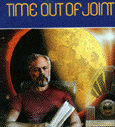
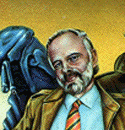

BEYOND ANY OTHER
WRITER, PHILIP K. DICK
opened the Pandoras' box of the READER'S relationship to the author
and vice versa. When the reader picks up the book he/she doesn't
realize they are downloading a portion of the author's mind into
their own. The download of words has no identifying label of FICTION
OR FACT. Here is what Dick wrote (SHIFTING REALITIES OF PHILIP
K. DICK, edited by Lawrence Sutin): "And -- I say this
as a professional fiction writer -- the producers, scriptwriters
and directors who create these video/audio worlds do not know
how much of their content is true....Speaking for myself, I do
not know how much of my writing is true, or which parts (if any)
are true. This is a potentially lethal situation. We have
fiction mimicking truth and truth mimicking fiction."
Read Dick's 20 page essay, HOW TO BUILD A UNIVERSE THAT DOESN'T FALL APART TWO DAYS LATER. His topic is reality, the topic he was obsessed with. Dick was asked for a one sentence definition of reality. He replied: "REALITY IS THAT WHICH, WHEN YOU STOP BELIEVING IN IT, DOESN'T GO AWAY."
Some of Dicks most
memorable characters were not human, rather they were androids,
replicants or robots. They all looked human and had the feelings
of humans. Dick often surrounded his android characters with dysfunctional
humans who lacked any spontaneity and had lost their human souls.
Humans became the dying bird of authentic humanness. Man's soul
was squeezed out when his/her goal became the instruments of manipulators
and accepted the cloak of what Dick called an "android personality
"-- one with mechanical and reflex qualities.
The best example of Dick's attitude toward his android characters
is shown in his 1969 story THE ELECTRIC ANT. Dick
discussed the laser scanner and punch-hole tape that projected
pictures of reality into the android character, Garson Poole.
When Poole discovered he was an android with limits dictated by
the tape his emotions prompted him to fiddle with the punch-hole
tape, splice it in backwards and cover up punch holes. Poole tried
to explain to his secretary why he was experimenting with himself:
"Here I have an opportunity to experience everything.
-- Simultaneously. To know the universe and its entirety. ...Something
no human can do." In contrast, Dick
saw the human as brainwashed and manipulated by the powerful corporations
who control the media and man's livelihood. He saw the human as
a mechanized man and tried to portray the android characters as
struggling to break out of their man-made limits -- in contrast
to humans who refused to break out of their social bondage.


NEXT are books and authors who focus on language or attempt to clarify words. I don't think it useful to discuss semantics. The most helpful writer I have encountered is LUDWIG WITTGENSTEIN. He taught me to see words as pictures. A word is a picture of language as a portrait on a book cover is a picture of the author. As you see above (Ludwig, who died in 1951) the picture is not alive. Wittgenstein did not attempt to twist and torture words back to life to suit his biases. He sorted out phrases which he could comprehend and trashed those he could not. Here I will list some of his sage advice:
1. "But if we had to name anything which is the life
of the sign(word), we should have to say that it was its use."
2. "Understanding a word may mean: knowing how it is used;
being able to apply it."
3. "...understanding a description means making oneself a
picture of what is described."
Thus, words in a book lie dormant until transferred into the reader's mind. The reading brings the word alive. Spoken words must accept the listener as he/she is --brilliant, stupid or non-caring. One can always speak to oneself in a mirror. Here is what Wittgenstein made of such private language: "Why can't my right hand give my left hand money?...When the left hand has taken the money from the right, we shall ask, 'Well, and what of it?' And the same could be asked if a person had given himself a private definition of a word...." Readers of Wittgenstein soon get over the notion that words have neatly packaged meanings like so many shades of lipstick -- all ready to apply and each eliciting a definite response. A dictionary is a cemetery for words. WORLDREELS philosophy could also be called the study of POINTS OF VIEW.
Out of six billion people we get six billion points of view and six billion different languages. The fact that two people might both understand English does not insure any accurate verbal communication. One would be safer to assume the listener knows only a foreign tongue. In fact, few people have much need or desire to communicate with words. Most meaningful exchanges beyond business are non verbal. Both the spoken word and books then, merely give either entertainment or a chance to contrast our own point of view with another's point of view.
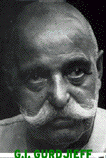
ALTHOUGH G. GURDJIEFF (ALL and EVERYTHING)
had a very low opinion of his reader: "Speaking
frankly, contemporary man ...is nothing more than a clockwork
mechanism, though of a very complex construction."(P.
1108), he spent over 1100 pages trying to convert them to his
views. Gurdjieff would try to make his reader plow through eleven
hundred pages but the smart reader will start with the final fifty
pages called FROM THE AUTHOR, CHAPTER 48.
Unlike Wittgenstein Gurdjieff wasn't able to clarify the language
but G did fully understand the problem: "The words
that make up our contemporary language, owing to the arbitrary
meaning people put into them, convey only indefinite and relative
notions, and are thus taken by ordinary people 'elastically'.
" Most of my reading life is spent discarding ideas. Sifting
through the mountains of phrases and ideas one hopes to find a
couple per author that are USEFUL. OTHERS, of course, reading
the same book will find different ideas useful than mine. That
follows from the different viewpoint the other will approach the
book with. So called truth lies in the eye of the reader. That
is the CATCH 22 -- nothing written on a page is either alive or
true. The words must be lifted off the page to come alive and
put to a limited use in order to be "true."
Moving down the Gurdjieff path you will run into this description
of education: "which consists simply and solely in
drumming into pupils, by means of constant repetition to the point
of stupification, numerous almost empty words and expressions,
and in training them to recognize merely by the difference in
their sounds the reality these words and expressions are supposed
to signify." Time and time again the READER finds
him/herself devouring a book which almost urges one not to read
it. The sad fact is, perhaps, that there is no other game in town.
The AUTHOR seeks readers who can use the words and thereby establish
a verbal rapport.
Gurdjieff knew he would find few. When he wrote that he wanted
to prove, "the absurdity of all their inherent ideas
concerning the supposed existence of a certain 'other world' with
its famous and so beautiful a paradise and its so repugnant a
hell," he knew he couldn't prove this. He
also couldn't prove "...that Hell and Paradise do indeed
exist, only not in 'another world' but here beside us on Earth."
But he did locate many readers who agreed with his grand, tedious
thesis.

A SERIES OF BOOKS THAT discuss the
impact of a SOCIAL MILIEU on the READER are of great
interest here. These authors write with grandiose viewpoints.
They seem to say, "Hey, look, here is what you've been overlooking!"
They expose the silent effects of all pervasive factors such as
MEDIA, BUSINESS, or COMPUTER REVOLUTIONS on the hapless readers.
ERIC HOFFER, the San Francisco longshoreman, gave us THE
TRUE BELIEVER: Thoughts on the Nature of Mass Movements (1951).
What Eric tried to tell his reader is that written and spoken
words do not always flush automatically down the toilet. When
these words ricochet off people without power, without purpose
and possessing a guilt ridden existence they can produce mass
movements. Although the model for Hoffer's views was Nazi leaders
and the German people, his ideas still fit into the 21st Century.
In short, his thesis is the true believer is a person deeply empty
inside who will USE words to fill that emptiness.
The pages of his books leap out at the READER:"The
True Believer is, then, a plastic human type thrown up by a century
of ceaseless change. ...In other words, drastic change creates
an estrangement from the self, and generates a need for a new
birth and a new identity."
Eric
Hoffer cited as raw material for a mass movement like communism
or Nazism the misfits, the inordinately selfish,the minorities,
the bored and the sinners. To take just one of these categories:
"There is perhaps no more reliable indicator of a society's
ripeness for a mass movement than the prevalence of unrelieved
boredom. ...When people are bored, it is primarily with their
own selves that they are bored. The consciousness of a barren,
meaningless existence is the main fountainhead of boredom."
Later writers such as HERBERT MARCUSE, MARSHALL McLUHAN,
and NEAL GABLER would present new WORLDREELS,
different social and technological factors as key ingredients
in the READER's understanding of whatever he/she reads. Keep in
mind the common point of view expressed in all these writers --
ideas cannot be understood in a vacuum -- it is the social framework
that shapes the words which sit there silently and dead on the
paper or glass page until USED by the READER. My reader here should
place each writer's ideas in a separate frame to be used when
the occasion arises.

HERBERT MARCUSE wrote ONE DIMENSIONAL MAN: Studies in Ideology of Advanced Industrial Society (1968). Marcuse helped me to see the READER as the center to the bullseye of verbal communication. Enclosed within his/her circle of LANGUAGE, and further, enclosed within the MILIEU or media circle -- are those corporate commercial powers who tell the reader what to attend to and what to ignore. These are the corporate powers who have one goal -- eliminate the opposition or the opposing view. Marcuse included in this opposition most of what he thought had brought progress in art and human values. To Marcuse only what could be focused on was real. What Marcuse launched was a deep consideration of the diminishing criterion for REALITY. Reality without opposition is static and would not bring advances.
Many of Marcuse's ideas were presented in obtuse, overly academic
style:----------------"If mass communications blend
together harmoniously and often unnoticeably -- art, politics,
religion and philosophy -- with commercials, they (mass media)
bring these realms of culture to their common denominator -- the
commodity form. The music of the soul is also the music
of salesmanship. Exchange value, not truth value counts."
(P.57). Translating this to idiom, he saw Microsoft gobbling up
the pop singer's songs to sell Windows '98. To continue: "As
the great words of freedom and fulfillment are pronounced by campaigning
leaders and politicians, on the screens, radios and stages, they
turn into meaningless sounds which obtain meaning only in the
context of propaganda, business, discipline and relaxation...Higher
culture becomes part of the material culture. In this transformation,
it loses the greater part of the truth."
To
sum up, the one dimensional man is created when business forces
invade the negative provinces of art, the alienation of art, which
formerly allowed a check and balance to the one dimensional goals
of business to sell its products unchecked. What bothered him
was the rise to power of multi-billionair Bill Gates, totally
unchecked to spoon feed his consumers whatever content Microsoft
chose. Throughout history Marcuse saw the antagonistic thinker
as a long term plus for society. Marcuse saw the alien idea as
the means used to test the rationality of the status
quo. Oddly enough, he saw the triumph of positive thinking as
a real threat to social progress and to the competition of differing
ideas which fertilized growth and progress. He ends his book with
"nothing indicates that it will be a good end."
And then he quotes Walter Benjamin, "It is only for
the sake of those without hope that hope is given to us."

MARSHALL McLUHAN wrote UNDERSTANDING MEDIA (1964) and the global village has never been the same. Since the author first thrust "THE MEDIUM IS THE MESSAGE" down his reader's throats dozens of authors have added exposes of the MEDIA to the bookshelf. To McLuhan the message was the content --the message was the "instant sensory awareness of the whole, ..the message, it seemed, was the 'content,' as people used to ask what a painting was about." In my view the message is whatever the reader finds USEFUL. McLuhan understood that the READER and AUTHOR stand in the center of concentric circles called LANGUAGE and MILIEU.
Few readers understood the clip phrase, "the medium is
the message." McLuhan tried to clarify but his language
only became more obtuse. In his examples he counted trains, airplanes,
electric lights, TV , telephones and radio as mediums of change.
McLuhan pointed out how each of these transporting devices changed
the scale, pace and pattern of human activity. This proved confusing.
Prior to McLuhan many readers thought of a medium as print, pictures,TV,
radio and photos. New ideas always require more effort on the
readers part. Some said McLuhan's ideas were 90% new material.
It is a difficult task to wind one's way out of McLuhan's maze
of language. If you have taken what is useful and dumped the rest
you will find the exit. AUTHORS always distort to make a point.
McLuhan's big contribution was to expand the READER's view of
LANGUAGE. Clothing became man's extended skin. Housing, money,
clocks, autos, airplanes,books, photographs, movies, TV, telephones
and computers all became extensions of man's senses. Naturally
this complicated the reader's view of his world. By adding all
the electronic information input to man's nervous system, the
reader had to pick and choose more carefully what to expose him/herself
to prevent information overload. Language was now interpreted
as a link between viewer and milieu (including gadgets, vehicles,
computers or moving pictures). To me McLuhan's ideas became but
one more frame on the film of WORLDREELS.
This leads us to my last bookreel, LIFE THE MOVIE: How Entertainment
Conquered Reality, by NEAL GABLER(1998). This author saw the graphics
media (first tabloids, then movies, and TV) as totally changing
the reality of the viewer. Gabler's two dimensions of existence
were the one outside the camera's sight line and the one recorded
with the camera. The viewer, he claimed lost interest in the outside
life. Moving pictures were so addictive and entertaining that
man began to model all his/her life experiences after those in
celebrity film land.
NEAL GABLER foresaw the web-cam, where people now try to charge
a monthly fee to let the world watch their exciting lives through
the lenses of 21 cam corders installed in their homes. Getting
beyond the celebrity scene, however, was beyond Gabler's point
of view. No matter that amateurs can sell their photos and films
(adult and otherwise) as quickly as the professionals. The reason
I include LIFE THE MOVIE is because his viewpoints shows
how futile it is to confine one's world view to language. What
was surprising to me was his LIFE THE MOVIE , although proclaiming
how entertaining the graphic reels were , was without a single
picture -- contradicting his own thesis -- he decided words could
say it all.. This shows the mind does not need a camera or projector
to see pictures .WHEN ALL IS SAID, reality will remain imprisoned
in the mind of the reader and contrary to Neal Gabler, entertainment
can never conquer reality. If one wants reality it will not help
to live in a movie theater. Reality will not fit into Richard
Dawkins selfish gene nor his extended phenotype. Reality for the
READER cannot be established with the thesis of Roger Penrose's
THE EMPEROR'S NEW MIND -- that the human mind is unique
and cannot be replicated by the output of a computer.
What may be derived from reading this site is a warning not to
let a book, another's language, fill the emptiness of your mind.
Pick up the metaphor, WORLDREELS, and view a book merely
as one more point of view -- one out of six billion. Your own
book, written or unwritten, drawn or not, will comprise your reality.
All these other views, Philip K. Dick's, Ludwig Wittgenstein's,
G. Gurdjieff's, Eric Hoffer's, Herbert Marcuse's can assist in
focusing your reality, appreciating your reality, and enriching
your reality. There is only one person per WORLDREEL --
the contents of each worldreel can be hung on a gallery wall,
placed in a museum's glass case, published by Random House, shown
on the Hollywood big screen, but none of this will change your
unique reality which will remain encased within your mind. All
attempts to share your reality with another are futile. As StarTrek
Shatner told his Captain Kirk groupies: "GET A LIFE!"
The handwriting on the cave wall reads: ONE LIFE AND ONE
REALITY PER CUSTOMER.
LINK TO READ MY AMAZON.COM REVIEWS
http://www.amazon.com/exec/obidos/tg/cm/member-reviews/-/A1U20CUTG6I28X/104-4374202-9212419