|
Home
Sri Lanka News alert Articles
India World
Economy Reports
Documents Global
Issues Peoples
Struggle R.Readings Posters
Tasks
Home
Last Updated :
October 01, 2006
RULE OF THE GAME
is,
DIVISION OF THE WORLD AMONG THE
GREAT POWERS
Italy says French merger is act of war
Ambrose Evans-Pritchard (Filed: 27/02/2006)
Daily Telegraph
Italian leaders from across the political spectrum yesterday slammed moves by Paris to merge the utilities Suez and Gaz de France, calling it a naked attempt to exclude Italy's Enel from the French energy sector.
"This is 1914 all over again," said Italy's economy minister, Giulio
Tremonti.
"Nobody wanted war, but war happened. Somebody launches an ultimatum, another responds, and the effect is a waterfall," he said. "We still have time to stop this race by the European states to build protective barriers."
Silvio Berlusconi, Italy's outspoken premier, called for retaliatory action to avenge an act of economic hostility. "If they're going to protect their strategic sectors like that, we should do the same back to them," he was reported as telling colleagues. Rome is mulling plans to impose a 2pc cap on foreign ownership of energy companies.
The furore erupted as French leaders said they would rush through legal changes to allow the €72bn (£49bn) merger, which would create Europe's biggest power utility. It comes days after Spain took steps to block a €29bn bid by Germany's E.on for Madrid power company
Endesa.
The moves have fuelled fears of a rising wave of protectionism across Europe, threatening to halt the boom in cross-border mergers and acquisitions.
Thierry Breton, the French finance minister, said a new law was needed to allow the French state holding in GdF to drop below 70pc. "It is too early to determine the final stake of the government in the new entity but it will in no case be lower than a blocking minority, or 34pc," he said. "It will be completely anchored in French national territory."
The boards of both Suez and GdF were meeting last night to thrash out terms of the paper deal. Suez, though bigger, is likely to be the one acquired to shield the government from attacks by left-wing unions that it is giving up a state entity.
The pair have been eyeing a merger for years, citing synergies between GdF's gas network and Suez's needs as a gas consumer. Combined, the two believe they would have the clout to push further into the EU electricity market.
The idea of a merger had been stymied until now by the French state but this policy was dropped as soon as Enel put out feelers for Suez.
French premier Dominique de Villepin said the move was needed to secure French energy supplies. He said: "It will give France a second big player in the energy sector besides EDF and boost the global industrial vocation of our country."
Fulvio Conti, Enel's chief executive, said the gambit amounted to renationalising Suez, a step backward for free-market reform in Europe. "It's as if the Italian government took over Fiat to defend it from a takeover bid by Renault. It's the funeral of the European market," he said.
One Suez shareholder, Knight Vinke Asset Management in New York, said the merger was "clearly a protectionist move" even if it had some industrial logic.
"We fully support the view that Enel should be permitted to make an offer or a counter-offer for Suez without hindrance from political authorities," it said.
(emphasizes added)
......Nine-tenths of Africa had been seized (by 1900)........
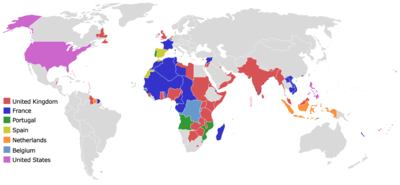
Wikipedia: Colonization and imperialism in World War II (1945)
Fourthly, monopoly has grown out of colonial policy. To the numerous “old” motives of colonial policy, finance capital has added the struggle for the sources of raw materials, for the export of capital, for spheres of influence, i.e., for spheres for profitable deals, concessions, monopoly profits and so on, economic territory in general. When the colonies of the European powers,for instance, comprised only one-tenth of the territory of Africa(as was the case in 1876), colonial policy was able to develop—by methods other than those of monopoly—by the “free grabbing” of territories, so to speak. But when nine-tenths of Africa had been seized (by 1900), when the whole world had been divided up,there was inevitably ushered in the era of monopoly possession of colonies and, consequently, of particularly intense struggle for the division and the redivision of the world.
V.I.Lenin: Imperialism, the Highest Stage of Capitalism - X.THE PLACE OF
IMPERIALISM IN HISTORY
Japan PM heads to Central Asia, eyes on resources
Sat Aug 26, 2006 10:18pm ET
TOKYO (Reuters) - Japanese Prime Minister Junichiro Koizumi begins a trip to Kazakhstan and Uzebekistan from Monday, in a bid to secure rich energy resources in the region, where China and Russia are increasing their influence.
Japanese officials said the three-day tour, the first to Central Asia by a Japanese prime minister, reflects the strategic importance of the region for resource-poor Japan, that depends on the Middle East for almost all of its oil imports.
"They're not OPEC, not Middle East, but are producers of oil and gas -- that means a lot to Japan," a senior foreign ministry official said.
Along with crude oil and natural gas, Kazakhstan has the world's second-largest reserves of uranium. That's also vital to Japan, which needs the nuclear fuel because atomic energy produces about 30 percent of the electricity used in the country.
Koizumi is expected to bring up Japanese participation in uranium mine projects in his talks with Kazakhstan President Nursultan
Nazarbayev, the Japanese official said.
While some Japanese firms already have uranium deals in Kazakhstan, they hope that Koizumi's visit would lead to more.
"For those of us involved in the energy resources business, this is welcome news," said Eiichiro
Otsuka, deputy general manager at Sumitomo Corp's nuclear energy department.
Sumitomo Corp., Japan's third-largest trading firm, and Kansai Electric Power Co. agreed in January with Kazakhstan's state-run KazAtomProm to jointly develop a uranium deposit in the country. Another trading firm, Itochu Corp., also has a deal with KazAtomProm to buy uranium.
CONSOLATION PRIZE
But some in the Japanese business community in Kazakhstan say the uranium deals are a consolation prize for being left out in the competition with China for Kazakh oil.
Late last year, Kazakhstan began sending oil to China along a new pipeline and Chinese firms have been busy securing rights for oil reserves in the Central Asian country.
Kazakhstan's oil output is expected to nearly triple to 3.5 million barrels per day by 2015, putting it in the same ranks as Mexico and Iran as a major oil producer.
Koizumi's trip is also part of Tokyo's diplomatic drive to show its commitment to the region, Japanese officials said, as China and Russia strengthen their ties through a forum that brings them together with Kazakhstan, Uzbekistan, Kyrgyzstan and Tajikistan.
In June, Japan invited foreign ministers from the Central Asian countries to Tokyo for a one-day meeting just as the forum, the Shanghai Cooperation Organization
(SCO), was preparing to hold a leaders summit in Shanghai.
Japanese officials say that Tokyo does not see the SCO as a threat to its interests in Central Asia, but the United States, Japan's closest security ally, has expressed displeasure at the forum for lobbying to push U.S. forces out of the region.
U.S. relations with Uzbekistan, formerly a close ally in the "war on terror", soured after Washington condemned excessive use of force when troops fired on crowds in Andizhan last year during an uprising. Uzbekistan subsequently expelled U.S. troops from a military airbase there.
Japanese officials said Koizumi will raise human rights issues when he meets Uzbek President Islam
Karimov, who argues that he is fighting extremists who want to overthrow him.
Analysts said given the region's historical ties with Russia and also its proximity to China, Japan should seek to cooperate, rather than compete, with the rivals over Central Asia.
"From Central Asia's standpoint, Japan is no match to Russia," said Natsuko
Oka, an expert on the region at the Institute of Developing Economies.
She added that since the Central Asian countries were landlocked, Japan would need the cooperation of China or Russia to import oil from the region via pipelines.
(Additional reporting by Maria Golovnina in Almaty)
Eelam News Bulletin-
ENB! Eelam Web 1917!!
VOICE OF THE OPPRESSED PEOPLE AROUND THE GLOBE,
FOR THEIR FREEDOM AND LIBERATION, SO DO THE REVOLUTION.
Join FREE.


|