|
A "Brief" History on Kendo
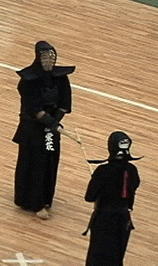 The history of kendo features no specific
date or founder, but rather evolved out of the
samurai’s study of kenjutsu to the modern
form practiced today. The study of sword
technique in feudal Japan took a pronounced
leap forward around the 12th century, when a
military class arose under the rule of the
Shogunate. During the late Muromachi
Period (1336-1568) and stretching on into
the Tokugawa Period (1600-1868), the
study of the sword was institutionalized in
around 200 different schools of kenjutsu.
Itto-ryu, the “one-sword school,” is credited as having the most
influence on modern kendo. The history of kendo features no specific
date or founder, but rather evolved out of the
samurai’s study of kenjutsu to the modern
form practiced today. The study of sword
technique in feudal Japan took a pronounced
leap forward around the 12th century, when a
military class arose under the rule of the
Shogunate. During the late Muromachi
Period (1336-1568) and stretching on into
the Tokugawa Period (1600-1868), the
study of the sword was institutionalized in
around 200 different schools of kenjutsu.
Itto-ryu, the “one-sword school,” is credited as having the most
influence on modern kendo.
The late 18th century saw the development of kendo
protective equipment and shinai, which greatly reduced the risk
of injury while practicing with bokuto and live blades. Kendo
suffered a temporary decline with the Meiji Restoration (1868)
as the wearing of swords in public was outlawed and the samurai
class abolished. Civil unrest in 1887 saw kendo return in the
form of police training, and interest continued to increase with
the Sino-Japanese War (1894-95) and the Russo-Japanese War
(1904-1905). 1895 saw the founding of the Butokukai, an
organization dedicated to the study of martial arts, and kendo
was officially introduced into middle school physical education
curriculum in 1911. Kendo became a required course for all
boys in 1939 as Japan prepared for war.
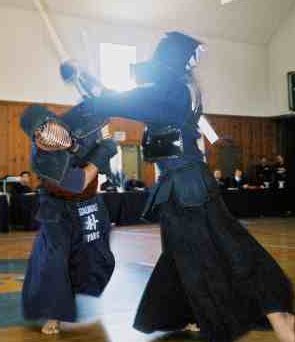 Because of its militaristic and nationalistic associations,
kendo was outlawed for
several years in post-WWII
Japan, and its adherents had
to hide their practice from
occupying military troops.
By 1952, however, a “pure
sport” form of kendo called
Shinai Kyogi was
reintroduced into the public
school system and kendo
was once again part of
Japanese police training.
Modern kendo continues to
grow under the leadership of
the All Japan Kendo
Federation, the International Kendo Federation, and national
federations all over the world. Because of its militaristic and nationalistic associations,
kendo was outlawed for
several years in post-WWII
Japan, and its adherents had
to hide their practice from
occupying military troops.
By 1952, however, a “pure
sport” form of kendo called
Shinai Kyogi was
reintroduced into the public
school system and kendo
was once again part of
Japanese police training.
Modern kendo continues to
grow under the leadership of
the All Japan Kendo
Federation, the International Kendo Federation, and national
federations all over the world.
Uh...so ok, what is Kendo then?
Kendo is the modern study of the Japanese sword. Using protective armor (bogu) and a shinai (bamboo practice sword), kenshii (Kendo practitioner) train their body and mind through rigorous practice. There are four attackable locations that students are trained in, the men (head), kote (wrist/forearm), do (stomach, and, the reserved for highly trained students, tsuki (throat). Using these attacks in combination with different techniques, students learn Japanese swordsmanship. Unlike European fencing where a simple tap would be considered a valid point, in Kendo simply striking the opponent is not enough. Several factors are considered before a point is award, such as proper form, striking location, follow through after the attack, and spirit.
The Kendo bogu consists of protection to the four valid points in kendo. There is a helmet that guards the head and throat, gloves that cover the forearms, a breastplate to cover the stomach, and a lower body protector. The shinai is a practice sword made up of four wooden staves that compress when someone is hit, reducing the force of the blow.
For a more detailed explanation of kendo/kenjutsu and other
Japanese sword arts, check Neil Gendzwill’s Japanese Sword
Arts FAQ at http://www.ii.uib.no/~kjartan/swordfaq/
|