
 Mexico
 | The
Maya culture The Classic Period of Maya development is the 600 years from 300 AD to 900 AD. The Maya refined the long-count calendar and developed a more advanced written language. The Maya had a tendency to tear down buildings and temples and rebuild new ones over the rubble of the old. Some buildings are built on several layers of previous buildings. All of the great Mayan cities as they appear today were built during the Classic Period, over the remains of previous construction. Architecture and culture blossomed during the Classic Period. The Maya began to accurately record important events on carved stelae. Excellent examples of Mayan stelae and art can be seen at Quirigua, an easy day-trip from Rio Dulce. Early in the Classic Period, around 400 AD, the Maya became heavily influenced by the civilization of Teotihuacan to the north. Teotihuacan was the most powerful culture in Central Mexico. Much about this relationship is unclear but it appears to have been beneficial to both civilizations because both prospered and developed at this time. Evidence also exists that there was interaction and trade between Central American cultures and European, African and Polynesian cultures -- well before the time of Columbus. For more about this see Trans-Oceanic Diffusion. Around the year 650 AD the civilization of Teotihuacan collapsed. This collapse triggered an upset in the Mayan civilization. Apparently there was a struggle to fill the power-vacuum left by the collapse of Teotihuacan. Now free of its relationship to Teotihuacan, the Maya reached their highest levels of sophistication. Art, astronomy and religion reached new heights. The population grew and cities expanded in this era of greatest Mayan prosperity. Astronomy and arithmetics advanced and the Mayans were able to measure the orbits of celestial bodies with unprecedented accuracy. The Maya predicted the motions of Venus to a degree of precision only equaled in recent times. The Maya traded with cultures as far away as South America and the southern US. Mayan cities were much larger and more populous than any city in Europe. The Mayas greatest artistic works in pottery and jade were made during this pinnacle of Mayan development. Looking at the grey ruins of Mayan architecture today, it is hard to imagine that they were originally painted in bright colors, red, white, yellow and green, inside and out. Certain internal chambers have been preserved and microscopic traces of paint on the outside have enabled archaeologists to reconstruct what Tikal and other sites looked like. However, this peak of Mayan development was to be short lived. By 750 AD problems arose and the collapse was underway. There are many theories about what happened. By this time, the climate was certainly changing from grassland and savannah into the tropical climate we now associate with Guatemala. Perhaps there were food shortages. In any event, the population dropped and the cities were gradually abandoned. By 830 AD construction and development had come to a halt. Some cities in Belize and Yucatan survived longer but in Guatemala the population abandoned the cities and redistributed itself into the farming villages of the highlands that we see today. |
||
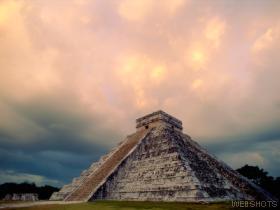 El Castillo, Chichen Itza, Mexico |
||
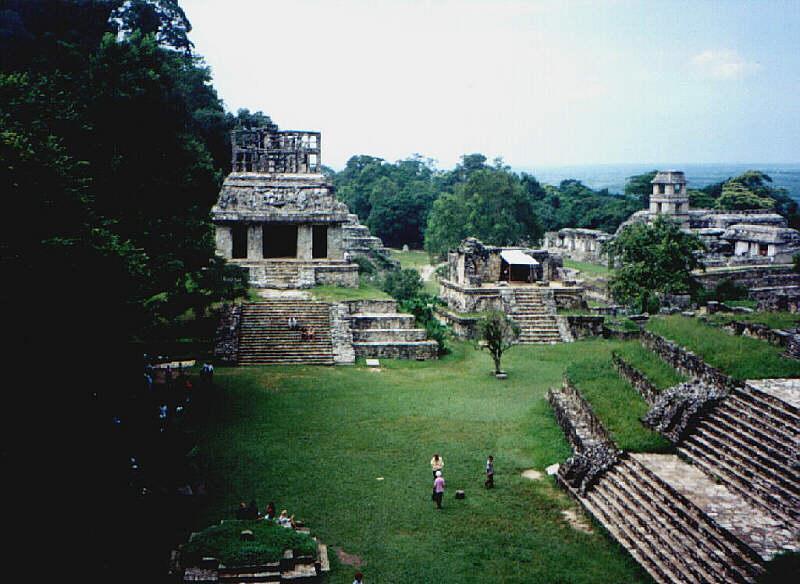 Ruins of Palanque, Mexico |
||
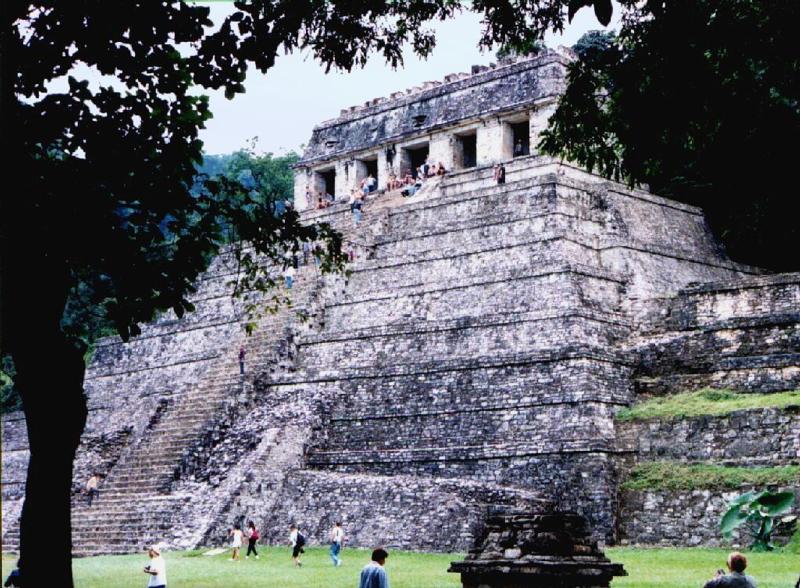 Palenque Mexico |
||