
 About
the DP
About
the DP| The
history of DP The history of the dynamic positioning The very first dynamic positioning system was used in 1957, on the American ship CUSS 1. It was a primitive system, with four propellers, but it was possible to keep the ship in position above the well at a depth of 948 meters off La Jolla,California . After this first well in 1961, the ship did 5 drillings at a depth of 3560 mts, while maintaining a position within a radius of 180 mts. The position in relation to the seabed was found by lowering a transmitter down to the seabed that transmitted signals up to the vessel (the first form of hydro acoustic reference system). The idea of developing an automatic control unit to take care of the DP functions was born. Later in 1961 the American Shell Oil Company launched the drilling vessel EUREKA. In 1964 another vessel CALDRILL 1 was delivered to Caldrill Offshore Company, USA with a similar DP system on board. Both the Eureka and Caldrill worked very well, the first drilled at a depth of 1300 mts with 6 mts of waves and wind up to 40 knots, the second was able to drill at maximum depth of 2000 mts. In 1963 the first French DP vessels was delivered, SALVOR and TEREBEL were laying pipelines in the Mediterranean. A few years later started the oil adventure in the North Sea, Norway and UK became interested in the dynamic positioning. Today the DP has changed a lot since the CUSS1 in 1961, is now being used for many different operations, geological, military, cruise ship manoeuvring in lagoons, drilling, pipelaying, accommodation barge, shuttle tankers, diving , heavy lift and construction. |
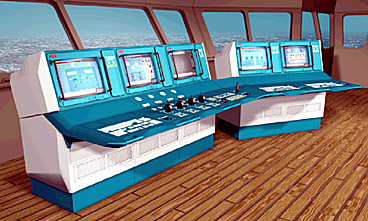 |
| The purpose of DP The main purpose of Dynamic Positioning is to keep a vessel in a specified position by control of the propulsion system. The D.P. is designed to perform this task within a certain range limit, using a minimum fuel and with minimum wear and tear of the propulsion equipment. The D.P. computer calculates the difference between the "wanted" position and the "present" position of the vessel, and then calculates the force that the propellers should produce in order to make the difference as small as possible. The system controls the vessel's position in three horizontal degrees of freedom, called surge (ahead and astern), sway (sideways) and yaw (turning of the bow). The computer use a mathematical model for calculate the force of reaction, that is based on a hydrodynamic description involving some of the ship's characteristics such as mass, drag etc. The purpose of the model is to describe, as much as possible, the vessel's motion and reaction to any external forces. The model is "driven" by the same forces as the vessel itself. These forces are wind and thrusters, and with algorithms the model is also able to calculate the sea current. The model of course is never 100% perfectly as the "real world", but by using the so-called Kalman-filter technique the model is able to correct itself continuously in the following way. The vessel heading and position are measured using gyro-compass along with one or more position reference system and sent to the computer. These data are compared to the predicted data produced by the model and the difference are "filtered" by the Kalman-filter and then finally used to "tune" the model to the actual situation How to get a
DP Operators certificate Discussion Forum Valerio de Rossi's homepage |
|