
|
Origins of the Symposium
Homeric society was based not on kinship but on the existence of a warrior elite. Support for the aristocracy was gained outside the family through a manipulation of agricultural surplus. Within Homeric society this surplus was utilized through feasting to establish or reinforce the associations between members of the aristocracy which maintained the warrior social system. Feasting was used to attract male companions or hetairoi outside the family who then formed ties with their leader or basileus. In this sense, commensality provided a means of structuring early Greek society. Feasting took place in the megaron hall in which entertainment was provided by a bard who was accompanied by a lyre. The feasting in this hall was central to upholding the aristocratic way of life in Homeric times. The overall function of this feasting is that it results incompetition between the nobility using generosity to accumulate increased influence. The relationships formed through the feasts serve to increase the status of the basileus in the community. The hetairoi are tied to their leader through their acceptance his generosity. The hetairoi are thus obliged to follow their basileus into battle.
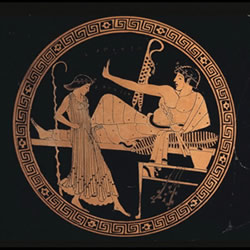
The feast remained central to aristocratic life but in a new form. Such a transformation was representative of the adjustments of the society to the new military approaches of the age. There was not only a shift to the promotion of a leisurely lifestyle, the aristocratic life was increasingly political. The symposium became the backdrop of the competition between the aristocratic families for political power in their own interests rather than in the military interests of the state. The symposium lost its wider social significance and increasingly became simply a means for the aristocracy to escape reality. A set of customs and norms emerged surrounding the symposium such as prayers and reclining on the kline which increased the exclusiveness of the gathering. Drinking and entertainment, rather than military defence or politics, became the central purpose of the symposium. Dayna Froude |
 However,
by the eighth century BC, due to the emergence of the new military
techniques of the hoplite army the Homeric way of life began to
disappear. The warrior symbolism of Homeric times was replaced by
that of the symposium. This signalled the move in society away from
a warrior elite to a leisured class.
However,
by the eighth century BC, due to the emergence of the new military
techniques of the hoplite army the Homeric way of life began to
disappear. The warrior symbolism of Homeric times was replaced by
that of the symposium. This signalled the move in society away from
a warrior elite to a leisured class.