|
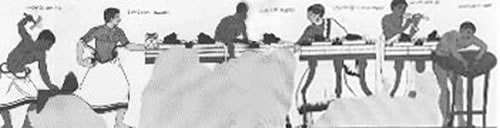
Who were the Etruscans? The Etruscans were the people who inhabited the Italian peninsula and are apparent in the archaeological record from around 700BC. The Etruscans were native to Italy and although there has been much debate on that topic, there is much evidence to suggest that they developed from the Iron Age villages of southern Etruria. Why are the Etruscans important to our study of the symposium? The inclusion of the Etruscan banquet in our study of the Greek symposium is important in providing a cultural comparison between two concurrent cultures in which commensality was an integral element in society. However the modes of commensality differed. Within Etruscan society the banquet, which included food and drink, was predominant whilst in Greek society the drinking party followed the banquet as a distinct feature. Features of the Etruscan banquet Theopompus encapsulated
the scandalized feelings of the Greeks that "Etruscan
women did Emma Belton, Sandy Blair and Dayna Froude |
 Etruscan
Developments
Etruscan
Developments recline
at dinner together with men" and that "they are also capable drinkers."
(Flower, 1994: p219. F204). The presence of women reclining at the
banquet can also be seen in the archaeological record in Etruscan
tomb paintings. Such images contrast sharply with the Greek ideal
of the respectable citizen female. At Greek symposia the only women
who participated
were the non-citizen hetairai and the slave girls who were brought
in to cater for the freeborn males needs as shown in sympotic iconography.
The setting for the Etruscan banquet could range from festival celebration
and funerals to everyday social gatherings. The symposium
in Greece, however, had a distinctive social function centred around
the elite male, the drinking of wine and the introduction
of young males into adult society. Despite the lack of evidence
and bias within it, the Etruscan banquet seems to be portrayed as
less exclusive, with the inclusion of women and children and seemed
to incorporate more of elite society as a whole.
recline
at dinner together with men" and that "they are also capable drinkers."
(Flower, 1994: p219. F204). The presence of women reclining at the
banquet can also be seen in the archaeological record in Etruscan
tomb paintings. Such images contrast sharply with the Greek ideal
of the respectable citizen female. At Greek symposia the only women
who participated
were the non-citizen hetairai and the slave girls who were brought
in to cater for the freeborn males needs as shown in sympotic iconography.
The setting for the Etruscan banquet could range from festival celebration
and funerals to everyday social gatherings. The symposium
in Greece, however, had a distinctive social function centred around
the elite male, the drinking of wine and the introduction
of young males into adult society. Despite the lack of evidence
and bias within it, the Etruscan banquet seems to be portrayed as
less exclusive, with the inclusion of women and children and seemed
to incorporate more of elite society as a whole.