[Home Page] [Dr Chetan Parikh] [Narayan eye hospital] [Cataract & Phaco Surgery] [Risk Of Cataract Surgery] [Glaucoma] [Diabetic retinopathy] [Macular degeneration] [Central serous retinopathy] [Retinal detachment] [Flashes and floaters] [Pterygium] [Ophthalmologist & Optician] [General examination schedule] [Guest Book]
Macular Degeneration Back to home page
What Is Macular Degeneration?
Age-related macular degeneration (AMD) is the most common cause of irreversible
vision loss in Americans over the age of 60. It is estimated that 10 million
Americans will experience this age-related visual impairment during their
retirement years.
Macular degeneration is a disorder of the retina, the light-sensitive inner lining of the back of the eye. The macula is a small, central portion of the retina which is necessary for sharp, "straight ahead" vision needed for reading, driving a car or recognizing faces.
There are a number of abnormalities associated with the term "age-related macular degeneration." They range from mild changes with no decrease in vision to abnormalities severe enough to result in the loss of all "straight ahead" vision. Macular degeneration does not cause total blindness because the remaining and undamaged parts of the retina around the macula continue to provide "side" vision.
There are two main types of macular degeneration, "dry" and "wet," which are discussed in the next section.
Signs and Symptoms
Aging causes the cells in the retina to become less efficient. Ultimately,
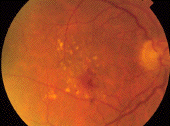
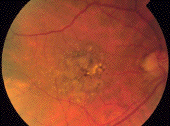
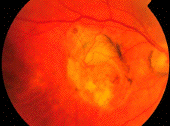
deposits called drusen appear under the retina and can be seen during an eye
examination and on photographs of the retina. A few small drusen may cause no
decrease in vision. However, if many large drusen develop, vision may be
decreased. Vision may be affected when there are pigment disturbances in the
layer of cells called the retinal pigment epithelium. These two types of changes
in the macula are known as "dry" macular degeneration, which is the
most common form. Currently, there is no known treatment for dry AMD.
Figure 1-3: These photographs show different degrees of dry macular degeneration. The macular degeneration increases in severity from left to right.
A few people experience the "wet" form of macular degeneration which can cause more severe visual loss. In this situation, abnormal blood vessels grow beneath the retina and result in bleeding and leakage of fluid. Vision may suddenly become distorted or blurred. In some cases of wet macular degeneration, laser treatment can be effective at destroying the abnormal vessels, thus preventing or slowing further visual loss. Wet macular degeneration cannot always be treated successfully by laser, however, some experimental drugs and surgical procedures are being tested.
A Self Test
The Amsler Grid (see figure below) is used to screen for macular degeneration.
In an effort to detect loss of vision associated with macular degeneration, eye
doctors across the country are recommending this test to their patients. The
test involves looking at a square grid with a dot in the center. The grid should
be held 12 inches away from the face. While wearing eye glasses normally worn
when reading, the individual covers one eye at a time. With the uncovered eye,
the individual stares at the dot in the center of the grid. All four corners of
the grid should be visible, and the lines of the grid should appear to be
straight and continuous from top to bottom and side to side. If there appear to
be any holes or blurry spots, or the lines look wavy, fuzzy, crooked, distorted
or broken, the individual should call their eye doctor immediately.

Figure 1: The Amsler Grid. A useful test of central vision. This grid may be printed and used for self screening.
Eye Examinations
Today's advances in medicine means that more and more older Americans will be
able to maintain good vision as they age. Since many serious eye conditions are
treatable when detected at an early age, it is important to have periodic eye
examinations, especially as one approaches the sixth decade of life.
How you can help to find a cure for Macular Degeneration
Unfortunately, not enough is known about macular degeneration at this time to
provide effective treatment in most cases. Research today may help find the
cures of tommorow.
[Home Page] [Dr Chetan Parikh] [Narayan eye hospital] [Cataract & Phaco Surgery] [Risk Of Cataract Surgery] [Glaucoma] [Diabetic retinopathy] [Macular degeneration] [Central serous retinopathy] [Retinal detachment] [Flashes and floaters] [Pterygium] [Ophthalmologist & Optician] [General examination schedule] [Guest Book]