[Home Page] [Dr Chetan Parikh] [Narayan eye hospital] [Cataract & Phaco Surgery] [Risk Of Cataract Surgery] [Glaucoma] [Diabetic retinopathy] [Macular degeneration] [Central serous retinopathy] [Retinal detachment] [Flashes and floaters] [Pterygium] [Ophthalmologist & Optician] [General examination schedule] [Guest Book]
Central Serous Chorioretinopathy Back to home page
What is central serous chorioretinopathy?
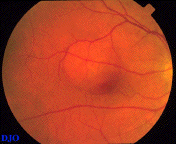
Central serous chorioretinopathy is a collection of fluid under the retina that
results in visual distortion. As the name suggests, the collection of fluid
affects central vision where it causes the most visual disturbance.
Figure 1: Photograph of an eye with central serous chorioretinopathy demonstrating the "blister" of fluid underneath the retina
What are the symptoms of central serous chorioretinopathy?
Patients often complain of a blind spot, decreased or blurry vision, and
distortion of shapes such that straight lines may appear bent or crooked. The
vision may be minimally to significantly affected with visual acuities ranging
from normal (20/20) to 20/200.
Who gets central serous chorioretinopathy?
The disease primarily affects young adults ages 20-45. Men are affected 10 times
more frequently than women. Many patients with central serous chorioretinopathy
are noted to live under a high level of stress.
Why does central serous chorioretinopathy occur?
The exact etiology of central serous chorioretinopathy is highly controversial.
However, there appears to be an imbalance in the amount of fluid which enters
the subretinal space and the ability to remove it, resulting in a net
accumulation of fluid beneath the retina. Some experimental evidence suggests
high blood levels of epinephrine and cortisol hormones may be responsible.
What is the prognosis for central serous chorioretinopathy?
Most patients with central serous chorioretinopathy will spontaneously recover
visual acuity in 6 months (average time to recovery 3-4 months). Many patients
will have some residual symptoms, such as distortion, decreased color and
contrast sensitivity, as well as visual difficulty at night. Despite an overall
good prognosis, 40-50% of patients experience one or more recurrences.
Is there any treatment available?
There is no medical therapy proven to be effective in treating central serous
chorioretinopathy. Laser photocoagulation treatment is effective in shortening
the duration of the disease; however, it does not appear to alter the final
visual acuity or the recurrence rate. Treatment with laser is controversial
because there are potential complications (as with any surgery) and there does
not appear to be any long term benefit to the treatment.
[Home Page] [Dr Chetan Parikh] [Narayan eye hospital] [Cataract & Phaco Surgery] [Risk Of Cataract Surgery] [Glaucoma] [Diabetic retinopathy] [Macular degeneration] [Central serous retinopathy] [Retinal detachment] [Flashes and floaters] [Pterygium] [Ophthalmologist & Optician] [General examination schedule] [Guest Book]