
Metal Mech
Metal Gear 2
Somari
Nintendo officially retired the NES in 1995.
|
|
|
|
|
|
|
|
|
|
|
|
|
|
|
|
|
|
The Nintendo Entertainment System | |||||||||||||||
| Reviews: Metal Mech Metal Gear 2 |
||||||||||||||||
| Mario Lottery Somari |
||||||||||||||||
| Now you're playing... With power! | ||||||||||||||||
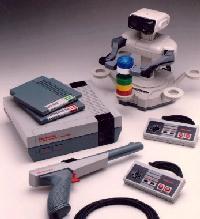
| The Nintendo Entertainment System was born in Japan as the Famicom (Family Computer) in 1983. It was a huge success in Japan, and Nintendo decided they wanted to venture into the American market. They struck a deal with Atari, but it later fell through, so Nintendo decided to distribute the console themselves. This was soon after the great video game crash of '84 (caused by too many poor games and consoles overflowing the market, similar to the more recent dot-com crash), so Nintendo was taking quite a gamble. Most retailers wouldn't take a video game system for fear of getting burned again. Nintendo made their system as far disassociated with the term "video game system" as possible. They made the NES look more like a VCR, as opposed to making it look like a conventional console, and it was dubbed the "Nintendo Entertainment System;" (note reluctance to use the term "video game system"). Retailers were still wary of taking a game console, so Nintendo said they would buy back any units the stores did not sell. In 1985, the NES was released to the public. It was a hit. Nintendo wasn't about to make the same mistake as its predecessors and allow the market to be overrun with half-assed games made in someone's basement - so they created the Nintendo Seal of Approval. The Nintendo Seal of Approval was put on all licensed NES games (in order to get a license, the company had to promise to produce games exclusively for the NES - these types of strong-arm tactics led to many an investigation of Nintendo), meaning that the company had a license to make Nintendo games, and that the game had nothing objectionable in it (a few games were able to slip by with some bad language or something - Bionic Commando, Castlevania II, Golgo 13, and a few others). Nintendo had an unreasonably strict censorship policy that reached its peak in the Super NES days (Nintendo removed all references to Nazis from Wolfenstein 3D, removed all blood from Mortal Kombat, pulled a John Ashcroft with some topless statues in Castlevania IV, etc), but was very much present in the NES days. | ||||||||||||||||
| In 1986, Nintendo released the Famicom Disk System in Japan, and this soon became the medium for all major Famicom titles for years to come (even immensely popular games like Casltevania and The Legend of Zelda were not released on cartridge format in Japan until the early 90s). Nintendo promised to bring the Disk System peripheral to America, but they never followed through (this was repeated later with the announced-yet-never-released 64DD - Nintendo 64 Disk Drive, which was never even released in Japan). | ||||||||||||||||
| In July 1988, Nintendo released the official NES magazine, Nintendo Power. Nintendo Power replaced the Nintendo Fun Club, a free monthly magazine. A subscription to Nintendo Power included 12 issues (1 per month) of the magazine and a free copy of Dragon Warrior. This is, I think, the chief factor of Nintendo Power's early success. Nintendo Power was more of an advertisement than anything - it had reviews and codes, but mostly it was one big Nintendo ad. Early issues of it are quite entertaining to read though. | ||||||||||||||||
| In 1993, Nintendo released the NES 2, a smaller version of the NES, in order to accomodate those who couldn't afford a Super NES. It wasn't too successful though, by that time the Super NES had fairly well taken off, and few people wanted an NES. Nintendo officially retired the NES in 1995. |
||||||||||||||||