Collapse of Rome (372-410)
|
Western Europe emerged as the site of a distinct civilization after the fall of the Western Roman Empire in the 5th century, as Germanic peoples conquered it, while the Eastern Roman Empire (also known as the Byzantine Empire ) survived for another millennium. The Roman Empire was already divided into Greek -speaking and Latin -speaking regions for centuries. In the 7th and 8th century the Arab expansion brought Islamic cultures to the southern Mediterranean shores (from Syria to Sicily and Spain ), further enlarging the differences between the various Mediterranean civilizations. Huge amounts of technology and learning were lost, trade languished and people returned to local agrarian communities. In the same century, Bulgarians created the first Slavic state in Europe - Bulgaria . Feudalism created a new order in a world without cities and replaced the centralized Roman administration which was based on cities and a highly organized army. The only institution surviving the collapse of the Western Roman Empire was the Roman Catholic Church , which preserved part of the Roman cultural inheritance and remained the primary source of learning in its domain at least until the 13th century; the bishop of Rome , known as the Pope , became the leader of the western church (in the east his supremacy was not accepted in the end). The Holy Roman Empire emerged around 800, as Charlemagne , king of the Franks , was crowned by the pope as emperor. His empire based in modern France , the Low Countries and Germany expanded into modern Hungary , Italy , Bohemia , Lower Saxony and Spain . He and his father received substantial help from an alliance with the Pope, who wanted help against the Lombards . The pope was officially a vasal of the Byzantine Empire , but the Byzantine emperor did (could do) nothing against the Lombards. In the late 9th century and 10th century, northern and western Europe felt the burgeoning power and influence of the Vikings who raided, traded, conquered and settled swiftly and efficiently with their advanced sea-going vessels such as the longships . The Hungarians pillaged mainland Europe and the Arabs the south. In the 10th century independent kingdoms were established in Central Europe, for example, Poland and Hungary . Hungary had stopped its pillaging campaigns; prominent nation states also included Bulgaria and Serbia , that have rivalled Byzantium in the Balkans . The subsequent period, ending around 1000, saw the further growth of feudalism , which weakened the Holy Roman Empire.
|
|
Collapse of Rome (372-410) |
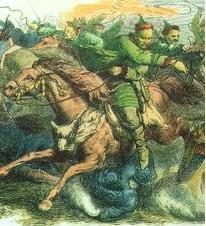
Starting in the second century, various indicators of Roman civilization began to decline, including urbanization, seaborne commerce, and population. Only 40 per cent as many Mediterranean shipwrecks have been found for the third century as for the first [17] . The population of the Roman Empire shrank from 65 million in 150 to 50 million in 400, a decline of more than 20 per cent. Some have connected this to the Dark Age Cold Period (100-700), when there was a decline in temperature globally which reduced agricultural harvests [18] . Migrating south from Scandinavia, the Germanic peoples reached the Black Sea early in the third century. They created confederations which proved more formidable opponents than the Sarmatians , whom the Romans had dealt with earlier. In Romania and the grassy steppes north of the Black Sea, the Goths , a Germanic people, created two kingdoms, one Visigothic , the other Ostrogothic . The arrival of the Huns in 372-375 ended the history of these kingdoms. The Huns were a confederation of central Asian tribes who founded an empire with a Turkic-speaking aristocracy. They had mastered the difficult art of shooting composite recurve bows from horseback and swept aside both the mounted lancers of the Ostrogoths and the infantry of the Visigoths. The Gothic people were forced to seek refuge in Roman territory (376). The Goths agreed to enter the Empire as unarmed settlers, but many bribed the Danube border guards into allowing them to bring their weapons with them. The discipline and organization of a Roman legion made it a superb fighting machine. The Romans preferred infantry to cavalry because infantry could be trained to retain formation in combat, while cavalry tended to flee when faced with danger. But unlike a barbarian army, the legions required constant training and salaries that made them a huge expense for the empire. As agriculture and economic activity declined, taxes grew harder to collect, and the system came under strain. In the Gothic War (377–382) , the Goths revolted and confronted the main Roman army in the Battle of Adrianople (378). Not wanting to share the glory, Eastern Emperor Valens ordered an attack on Visigothic infantry under Fritigern without waiting for Western Emperor Gratian , who was on the way with reinforcements. While the Romans were fully engaged, the Ostrogothic cavalry arrived. Vastly outnumbered, only one third of the Roman army managed to escape. It was the most shattering defeat that the Romans had suffered since Cannae , according to Roman military writer Ammianus Marcellinus . The core army of the eastern empire was destroyed, Valens killed, and the Goths free to lay waste to the Balkans, including the armories along the Danube. "The Romans, who so coolly and so concisely mention the acts of justice which were exercised by the legions, reserve their compassion and their eloquence for their own sufferings, when the provinces were invaded and desolated by the arms of the successful Barbarians," as Edward Gibbon comments in A History of the Decline and Fall of the Roman Empire (1776). The empire lacked the resources, and perhaps the will, to reconstruct the professional mobile army that had been destroyed at Adrianople, so it was forced to rely on barbarian armies to fight on its behalf. The Eastern Roman Empire was able to buy off the Goths with tribute. The Western Roman Empire was less fortunate. Stilicho , the western empire's half-Vandal military commander, stripped the Rhine frontier of troops to fend off invasions of Italy by the Visigoths in 402-03 and by the Ostrogoths in 406-07. Fleeing before the terrifying advance of the Huns , the Vandals , Suebi , and Alans launched an attack across the frozen Rhine near Mainz ; on December 31 , 406 , the frontier gave way and these tribes surged into Gaul . They were soon followed by the Burgundians and by bands of the Alemanni . In the fit of anti-barbarian hysteria which followed, Emperor Honorius had Stilicho summarily beheaded (408). "[W]ith a firmness not unworthy of the last of the Roman generals, [Stilicho] submitted his neck to the sword of Heraclian," writes Gibbon. Honorius was left with only incompetent courtiers to advise him. In 410, the Visigoths led by Alaric captured the city of Rome and for three days there was fire and slaughter as bodies filled the streets, palaces were stripped of their valuables, and those thought to have hidden wealth interrogated and tortured. As newly converted Christians, the Goths respected church property. But those who found sanctuary in the Vatican and in other churches were the fortunate few.
|
 |
Byzantine Empire |
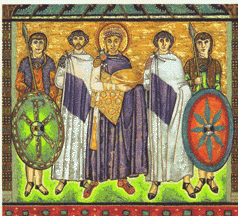
Byzantine Empire (native Greek name: ?as??e?a t?? ??µa??? - Basileia ton Romaion ) is the term conventionally used since the 19th century to describe the Greek-speaking Roman Empire of the Middle Ages , centered at its capital in Constantinople . In certain specific contexts, usually referring to the time before the fall of the Western Roman Empire , it is also often referred to as the Eastern Roman Empire . To its inhabitants the Empire was simply the Roman Empire and its emperors continued the unbroken succession of Roman emperors. During much of its history it was known to many of its Western contemporaries as " The Empire of the Greeks " due to the increasing dominance of its Greek population and distinct culture. Today most scholars acknowledge that the Byzantine Empire was the direct continuation of the Hellenistic World . There is no consensus on the starting date of the Byzantine period. Some place it during the reign of Diocletian (284–305) due to the administrative reforms he introduced, dividing the empire into a pars Orientis and a pars Occidentis . Some consider Constantine I its founder. Others place it during the reign of Theodosius I (379–395) and Christendom 's victory over pagan Roman religion , or, following his death in 395, with the division of the empire into western and eastern halves. Others place it yet further in 476, when the last western emperor, Romulus Augustus , was forced to abdicate, thus leaving sole imperial authority to the emperor in the Greek East . In any case, the changeover was gradual and by 330, when Constantine inaugurated his new capital, the process of further Hellenization and increasing Christianization was already under way.
|
 |
Viking Age |
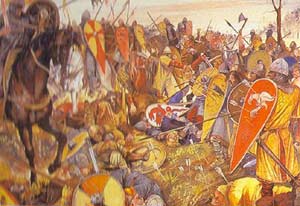
The Viking Age is the name of the period between 793 and 1066 AD in Scandinavia and Britain , following the Germanic Iron Age (and the Vendel Age in Sweden ). During this period, the Vikings , Scandinavian warriors and traders, raided and explored most parts of Europe , south-western Asia , northern Africa and north-eastern North America . Apart from exploring Europe by way of its oceans and rivers with the aid of their advanced navigational skills and extending their trading routes across vast parts of the continent, they also engaged in warfare and looted and enslaved numerous Christian communities of Medieval Europe for centuries, contributing to the development of feudal systems in Europe, which included castles and barons (which were a defense against Viking raids). Viking society was based on agriculture and trade with other peoples and placed great emphasis on the concept of honour both in combat and in the criminal justice system. It is unknown what triggered the Vikings' expansion and conquests, but historians have suggested that technological innovations imported from Mediterranean civilizations along with a milder climate led to population growth due to a long period of good crops. Another factor was the destruction of the Frisian fleet by Charlemagne around 785 , which interrupted the flow of many trading goods from Central Europe to Scandinavia and led the Vikings to come looking for it themselves. A factor, particularly for the settlement and conquest period that followed the early raids is the internal strife in Scandinavia, which resulted in the progressive centralisation of power in fewer hands. It may be argued that all of the factors above had contributed to the advent of the Viking Age.
|
 |