Britain
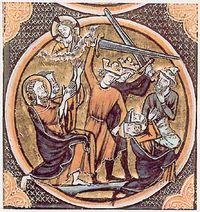
The High Middle Ages was the period of European history in the 11th , 12th , and 13th centuries (AD 1000–1300). The High Middle Ages were preceded by the Early Middle Ages and followed by the Late Middle Ages , which by convention ends around 1500 . The key historical trend of the High Middle Ages was the rapidly increasing population of Europe, which brought about great social and political change from the preceding era. By 1250, some scholars say, the continent became overpopulated, reaching levels it would not see again in some areas until the 19th century . This trend was checked in the Late Middle Ages by a series of calamities, notably the Black Death but also including numerous wars and economic stagnation. From about the year 1000 onwards, Western Europe saw the last of the barbarian invasions and became more politically organized. The Vikings had settled in the British Isles , France and elsewhere, whilst Norse Christian kingdoms were developing in their Scandinavian homelands. The Magyars had ceased their expansion in the 10th century, and by the year 1000, a Christian Kingdom of Hungary was recognized in central Europe. With the brief exception of the Mongol incursions, major barbarian invasions ceased. In the 11th century, populations north of the Alps began to settle new lands, some of which had reverted to wilderness after the end of the Roman Empire . In what is known as the "great clearances," vast forests and marshes of Europe were cleared and cultivated. At the same time settlements moved beyond the traditional boundaries of the Frankish Empire to new frontiers in eastern Europe, beyond the Elbe River , tripling the size of Germany in the process. Crusaders founded European colonies in the Levant , Spain conquered from the Moors, and the Normans colonized southern Italy, all part of the major population increase and resettlement pattern. The High Middle Ages produced many different forms of intellectual, spiritual and artistic works . This age saw the rise of modern nation-states in Western Europe and the ascent of the great Italian city-states . The still-powerful Roman Church called armies from across Europe to a series of Crusades against the Seljuk Turks , who occupied the Holy Land . The rediscovery of the works of Aristotle led Thomas Aquinas and other thinkers to develop the philosophy of Scholasticism . In architecture, many of the most notable Gothic cathedrals were built or completed during this era.
|
| |
Britain |
|
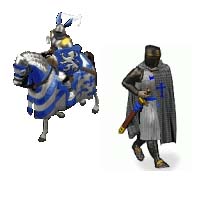
In England , the Norman Conquest of 1066 resulted in a kingdom ruled by a French -speaking nobility. The Normans invaded Ireland in force in 1169 and soon established themselves throughout most of the country, though their stronghold was the southeast. Likewise, Scotland and Wales were subdued to vassalage at about the same time, though Scotland later regained her independence. The Exchequer was founded in the 12th century under King Henry I , and the first parliaments were convened. In 1215 , after the loss of Normandy , King John signed the Magna Carta into law, which limited the power of English monarchs
|
 |
France and Germany |
France in the Middle Ages roughly corresponds to modern day France from the death of Charlemagne in 814 to the middle of the 15th century . The Middle Ages in France were marked by (1) the Viking invasions and the piecemeal dismantling of the Carolingian Empire by local powers, (2) the elaboration of the seigneurial economic system and the feudal system of rights and obligations between lords and vassals, (3) the growth of the Capetian dynasty and their struggles with the expanding Norman and Angevin regions, (4) a period of artistic and literary outpouring from the 12th to the early 14th centuries, (5) the rise of the Valois dynasty, the protracted dynastic crisis of the Hundred Years' War with the Kingdom of England and the catastrophic Black Death epidemic, and (6) the expansion of the French nation in the 15th century and the creation of a sense of French identity.
This article gives an overview of the History of Germany . It begins with the birth of the nation from Ancient Roman times from the 8th century, and then continues into the Holy Roman Empire dating from the 9th century until 1806 . At its largest extent, the territory of this empire included what today is Germany , Austria , Slovenia , the Czech Republic , western Poland , the Low Countries , eastern France , Switzerland and all of northern Italy . After the mid 15th century, it was known as the "Holy Roman Empire of the German Nation". This was followed by the German Confederation of 1806 – 1870 , the German Empire of 1871 – 1918 and the Weimar Republic of 1919 – 1933 , then by Adolf Hitler 's Nazi Germany (or " Third Reich ", his proclaimed successor of the large medieval Empire or "Reich") of 1933 – 1945 and the devastations of World War II . The article concludes with the history of the post-war Federal Republic of Germany (West Germany) and the history of the German Democratic Republic (East Germany) from 1945 to 1990
By the time of the High Middle Ages, the Carolingian Empire had been divided and replaced by separate successor kingdoms east and west of the Vosges called France and Germany , although not with their modern boundaries. Germany was under the banner of the Holy Roman Empire , which reached its high-water mark of unity and political power.
|
 |
The Crusades |
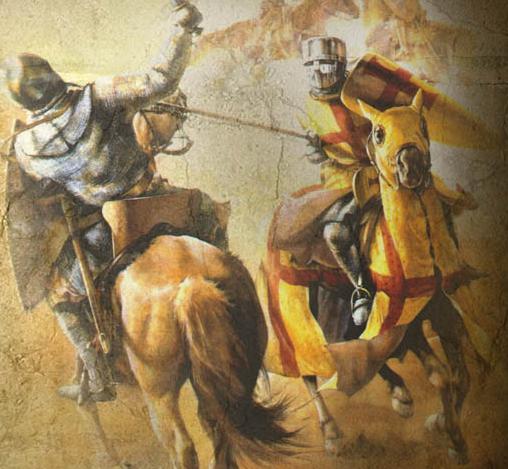
One of the most important events of the period was the series of religious Crusades, in which Christians fought to retake Palestine from the Seljuk Turks . The Crusades impacted all levels of society in the High Middle Ages, from the kings and emperors who themselves led the Crusades, to the lowest peasants whose lords were often absent in the east. The height of the Crusades was the 12th century, following the First Crusade and the foundation of the Crusader states ; in the 13th century and beyond, Crusades were also directed against fellow Christians, and in eastern and northern Europe, non-Muslim pagans. Expanded contact with the east, especially among the city-states of Italy, would eventually help spark the Italian Renaissance , that then spread throughout the whole of western Christendom .
|
|