Early signs of the rebirth of civilization in western Europe began to appear in the 11th century as trade started again in Italy , leading to the economic and cultural growth of independent city states such as Venice and Florence ; at the same time, nation-states began to take form in places such as France , England , Spain , and Portugal , although the process of their formation (usually marked by rivalry between the monarchy, the aristocratic feudal lords and the church) actually took several centuries. (See Reconquista for the latter two countries.) On the other hand, the Holy Roman Empire , essentially based in Germany and Italy , further fragmented into a myriad of feudal principalities or small city states, whose subjection to the emperor was only formal. One of the largest catastrophes to have hit Europe was the bubonic plague , also known as the Black Death . There were numerous outbreaks, but the most severe was in the mid-1300s and is estimated to have killed a third of Europe's population. Since many Jews worked as money-lenders ( usury was not allowed for Christians) and were generally more protected from disease through adherence to their kosher laws concerning hygiene), the Jews were often disliked by Europeans, so it was popular to blame them for the epidemic. This led to increased persecution of Jews in some areas. Thousands of Jews fled to Poland which, ironically, was spared by the first plague, but black death came back time after time. Beginning in the 14th century, the Baltic Sea became one of the most important trade routes . The Hanseatic League , an alliance of trading cities, facilitated the absorption of vast areas of Poland , Lithuania and other Baltic countries into the economy of Europe . The conventional end of the Middle Ages is usually associated with the fall of the city Constantinople and of the Byzantine Empire to the Ottoman Turks in 1453. The Turks made the city the capital of their Ottoman Empire , which lasted until 1919 and also included Egypt , Syria and most of the Balkans .
|
|
Western and Central Europe |
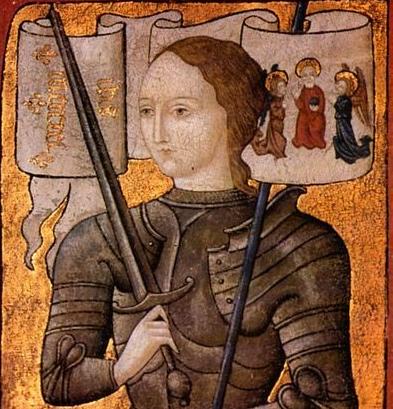
The French Valois Monarchy , that followed the Capetian Dynasty in 1328 , was at its outset virtually marginalized in its own country, partly by the English invading forces of the Hundred Years' War, partly by the powerful Duchy of Burgundy . The appearance of Joan of Arc on the scene changed the course of war in favour of the French, and under Louis XI Burgundy was also subjugated. In Germany , the Holy Roman Empire passed to the Habsburgs in 1438 , where it remained until its dissolution in 1806 . The Empire, however, remained fragmented, and much real power and influence was held by financial institutions such as the Hanseatic League and the Fugger family.
|
 |
Martin Luther |
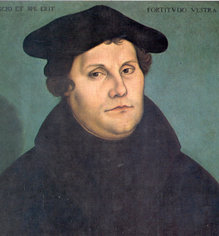
Martin Luther ( November 10 , 1483 – February 18 , 1546 ) was a German monk, priest and theologian , and a church reformer, whose teachings inspired the Reformation and deeply influenced the doctrines and culture of the Lutheran and Protestant traditions. Luther's call to the church to return to the teachings of the Bible led to the formation of new traditions within Christianity and to the Counter-Reformation , the Catholic reaction to these movements. His marriage on June 13 , 1525 , to Katharina von Bora began a movement to reintroduce the practice of clerical marriage within many Christian traditions, and his hymns, including his best-known " A Mighty Fortress is Our God ", inspired the development of congregational singing within Christianity. Today nearly seventy million Christians belong to Lutheran churches worldwide, with some four hundred million Protestant Christians, who trace their history back to Luther's reforming work. His contributions to Western civilization extend beyond the Christian Church. His translation of the Bible helped to develop a standard version of the German language , added several principles to the art of translation , and significantly influenced the translation of the Bible into English. (see Luther's Bible translation below). Due to the printing press , his pamphlets were well read throughout Germany, influencing many subsequent Protestant Reformers and thinkers, giving rise to diversifying Protestant traditions in Europe and elsewhere. Luther is also known for his writings about the Jews , in which he proposed that Jews' homes be destroyed, their synagogues and schools burned, their money confiscated, and their rights and liberties curtailed. These writings were given "full publicity" by the National Socialists in Germany in 1933-45. (See Luther and the Jews below.)
|
 |
Ottoman Empire |
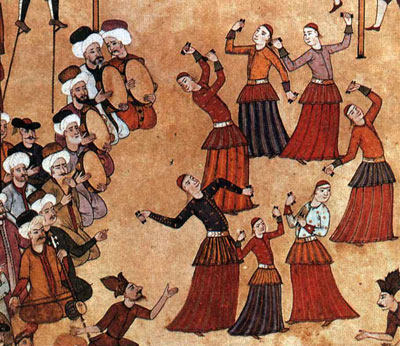
The Ottoman Empire ( Ottoman Turkish : ????? ????? ???????? Devlet-i Âliye-i Osmâniyye ; literally, "The Sublime Ottoman State", modern Turkish : Osmanli Imparatorlugu ), also sometimes known as the Turkish Empire , existed from 1299 to 1923. At the height of its power in the 16th and 17th centuries , its territory included Anatolia , the Middle East , parts of North Africa , and much of south-eastern Europe to the Caucasus . It comprised an area of about 5.6 million km² [1] , though it controlled a much larger area, if adjoining areas dominated mainly by nomadic tribes, where the empire's suzerainty was recognized, are included. The empire interacted with both Eastern and Western cultures throughout its 624-year history. In the 16th and 17th centuries, the Ottoman Empire was among the world's most powerful political entities, with the powers of eastern Europe constantly threatened by its steady advance through the Balkans and the southern part of the Polish-Lithuanian Commonwealth . Its navy was also a powerful force in the Mediterranean. On several occasions, the Ottoman army invaded central Europe, laying siege to Vienna in 1529 and again in 1683 in an attempt to conquer the Habsburg domain, and was only finally repulsed by great coalitions of European powers at sea and on land. It was the only non-European power to seriously challenge the rising power of the West between the 15th and 20th centuries , to such an extent that it became an integral part of European balance of power politics, hence blurring the distinctions. The dissolution of the empire was a direct consequence of World War I , when the Allied Powers defeated the Central Powers in Europe as well as the Ottoman forces in the Middle Eastern theatre . At the end of the war , the Ottoman government collapsed and the empire was conquered and divided among the victorious powers. Subsequent years saw the declaration of new states from the remnants of the Ottoman Empire, whose central lands became the Republic of Turkey . The members of the ruling Osmanli family were subsequently exiled from Turkey in 1923 - 1924 . In 1974 , after 50 years, the Turkish Parliament granted the right to re-acquire Turkish citizenship for the family descendants, which they all did in the following decades in a process completed by the citizenship of the head of the family, Ertugrul Osman V in 2004 .
|
|