
BYZANTINE ICONS
SHORT HISTORY OF THE BYZANTINE ICON
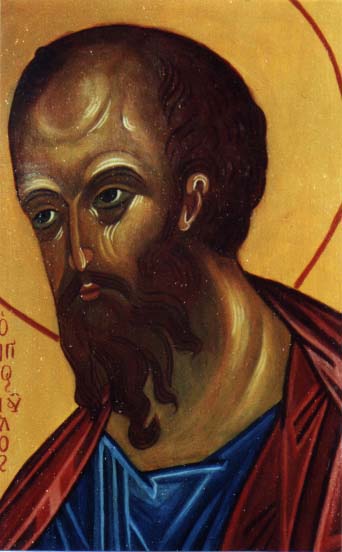
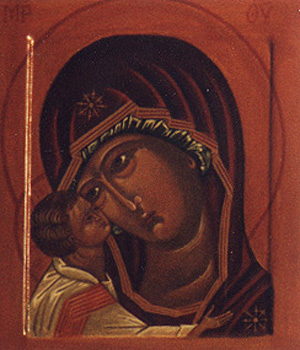
The Greek word eikon meant more than just a picture; it was a potent evocation of the world beyond - a link with Christ, the Virgin Mary or one of the saints. The earliest icons were reputed to have been painted "by no human hand" and to have miraculous powers. Christians prayed to them in their homes and churches and princes carried them into battles.
Yet in the first centuries after Christ, the Christian fathers forbade any religious art. They believed that since man could only portray the appearance, and not the essence, of God's creation, art was a deceit. However, it soon became clear that simple people could not deal with abstract concepts; they needed visual
6 1/2 X 8 3/4 tempera on wood
tempera on wood
3 1/2 x 9 1/2
With the division of the Roman Empire into two, Byzantium, renamed Constantinople, became the capital of the eastern empire and the cultural metropolis for an area that included Asia Minor, Syria, Egypt and the Holy Land, as well as the Caucasus, Russia, Romania, Greece, and the Balkans. Yet the great dispute over icons continued, culminating in the Iconoclastic Controversy (726 - 843 A.D.) when icons were publicly burned. Eventually, however, icon-worship became a cornerstone of the Orthodox Church.
As the centuries passed, in western Europe sacred and secular art merged in painters such as Giotto, but in the east reverence for the icon as a sacred object remained as strong as ever. Techniques of portrayal and composition were highly stylized and Constantinople retained a strong influence over artists from Kiev and Moscow to Mount Athos, Crete and Serbia. In spite of this, painters of genius were able to assert their individuality and even innovate while remaining within the strict confines of sacred art.
THE CANONS OF ICONOGRAPHY
The canons and the methods used to create the icons shaped up throughout many centuries, even before the involvement of the antic Russia. The tradition of iconography arrived in the antic Russia brought by Christianity penetrating from Byzantine Empire at the end of the X century.
The Byzantine art during that time had a strong religious character and submitted to very strict canons. The regulation of the iconography was the result of long discussions and fights, linked to the iconoclast. One of the most important issues of the iconoclast was the ideological and military pressure of the Muslims under the Byzantine Empire. Under Islam the interdiction to venerate the idols, to which the Muslims added the cross and the icons, became absolute. In 730 the Byzantine emperor Leone III prohibited the cult for icons. Before becoming emperor, he used to work a lot in the oriental provinces of the empire and found himself under the influence of the bishops from Minor Asia, at their turn influenced by Islam. He tried to purify the Christian religion of any material, sensitive or spiritual element. During that period of time a lot of icons, mosaics and frescos were destroyed. The veneration of icon didn't stop even if its followers continued to be cruelly persecuted.
The cult for icons was temporary reaccepted in 787 by the Ecumenical Council, and permanently starting with 843.
The icon - as image - was not a copy of the represented subject but rather the symbol, through which we could reach the concept of Divine. The icon played the part of the mystic mediator between the terrestrial world and the celestial one. This was how the meaning of the iconography was delimitated.
The VII Ecumenical Council demanded the icon painters to strictly follow the iconographic canons during the painting process. These iconographic canons regulated either the character or the way of representation of the religious scenes and saints. This can be explained by the fact that the icons were expressions and preservations of the ecclesiastic traditions. It was for this reason that the offence of the iconographic canons and the distortion of traditions led to heresy. The icon was a summarized representation of the Sacred Scripture. It remained unchangeable, the original iconography, the original models being created and transmitted from one author to an other, from one generation to an other. During the elaboration of these models, the faces of the saints - parts of canons - lost their particular forms and changed into symbols - liki as an expression of a supernatural spirituality.
The decisions of the VII Ecumenical Council addressed the whole Christian world. During Middle Age the French king Carl, the future emperor Carl The Greatest, conquered the Byzantine Empire, and didn't accept these decisions (this becoming a logical reason for the opposition between Occident and Orient).
As a response to the decisions of the VII Ecumenical Council, at Carl's initiative, in 790-794 the Carolingian Books have been compiled, in which it was stated that the object of cult could be only God, and in no case the icons. The icons could be used only to adorn the temples and for illustrative means. As a result, the iconographic canon for image wasn't accepted. This is why in the Occidental Church the iconographic models didn't exist and the painters in the Occidental Europe could show their own interpretation of the Christian terms. Little by little, the religious art of the Occidental Europe distanced more and more from the iconography, and created the concept of paintings of religious subjects
In Byzantium and other orthodox countries the situation of the representative art was different. The iconography regulated by canons and the orthodox faith dogmas created a system of coordinates, which showed people the right way on the sea of life. The Byzantine icon painter didn't need to search for new methods of representation - the principles of creating images adequate to the faith were already there. The instauration of iconographic canons played a double part: limited the creative freedom of the icon painter, and it was the incarnation of the rich iconographic experience, the fruit of intellectual and spiritual efforts of former generations. The iconography was a collective creative work, and each painter brought his own contribution to this great work.