
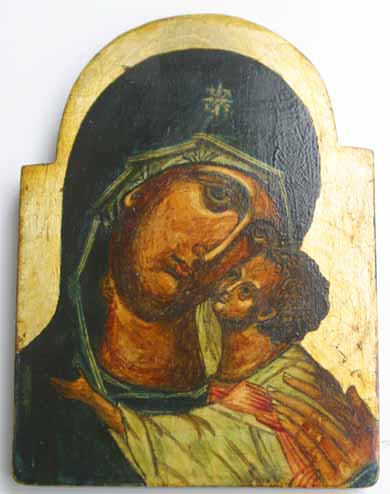
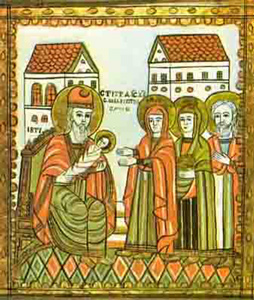
The peasant illustrated in the icons his own considerations about life and social justice, his own ethics and his idea of afterlife, the invisible world, inserting in this context, spontaneously, biblical stories or themes from The Old and New Testament in the only known reality, the Transylvanian village.
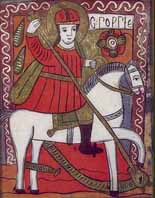
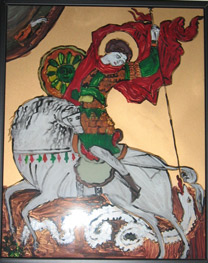
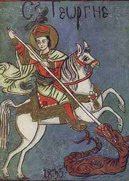
Nicula is situated at thirty miles northeast of Cluj, two and half miles from the small town of Gherla. In 1699, the Nicula church became famous because of an icon of the Blessed Virgin that was hanging in the small wooden church of the monastery. The gossip was that the icon was shedding tears.
How old are the Romanian icons painted on glass? There is specific mention of an icon on glass as early as 1703, but it was not until the late 1700�s that there was any substantial number of them catalogued. From about 1830 through 1900, the art flourished. Since 1900, fewer and fewer were painted and now the art of this type has nearly vanished.
The painting on glass as genre of folkloric creation and as artistic m�tier was considered to be characteristic to the oriental part of Central Europe, in particular to Bohemia, Austria, Silenzia, Moravia, Slovakia and Galizia, where the first centers of painting on glass appeared, favored also by presence of the first glass workshops in the region. Romania was the farthest eastern country where it was found. It appears, however, that Transylvania was the center of the art form. By contrast with other people that paint on glass, the Romanian painters adopted the orthodox Byzantine iconography.
The technique of the painting on glass developed in this region from a basic antic folkloric form of art without any urban influences. It was a folkloric art of a pure quality, which permitted the Romanian icons to be individual creations of the craftsman. At the beginning of the XVIIIth century, the Romanians from Transylvania replaced the expensive icons on wood with the ones on glass, much more affordable and made by local craftsmen. Transylvania, starting with the XVIII-th century until the beginning of the XX-th century, was under foreign domination and the Romanian well-educated and prosperous class was not strong enough to be able to finance a developing artistic life. The church was practically the only cultural center making all the efforts to maintain the continuity of Romanian traditions, supporting the local communities in the construction of churches and decorating them with icons on glass, paintings and frescoes.
Name: Doina Horodniceanu

