THE TECHNIQUE OF ICON PAINTING
The traditions touched not just the iconography, but also the choice of materials used to paint the icon on, the materials for the base (mestica), the techniques used for the preparation of the surface to be painted, the technology of colors preparation, the sequence of painting.
The process was strenuous and long. The previous examples, the "originals" were used as paradigm for the icon painting. They contained the indications of how to paint one or another image. By antic tradition the icon should be painted on a well-dried piece of wood. After a long and patient preparation (the wood was covered by a piece of canvas glued together, coated by several layers of plaster, sanded until the surface was smooth and silky), they drew the image. The outline of the drawing was engraved with a metallic pinch and a red tint (called bolo) was spread out, then it was covered with a golden foil.
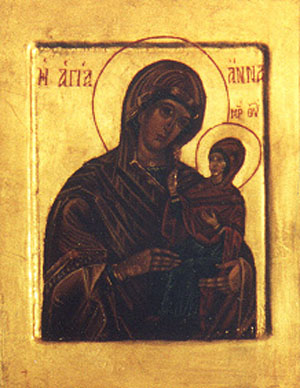
On the other hand, the process of painting was a secluded contact with God, and writing the own name wasn't necessary: God knew very well the one that through his prayers and humility tried to represent the Prototype. The authors of the majority of Russian icons are unknown. The icons, as well as the prayers, were the result of a collective creativity; were accurately created by many generations. The icon painter, during the process of painting, created only a new reproduction of the original, meaning the Prototype. Although a great maestro, with very delicate touches, could express himself too. This kind of icon-prayer was a direct and private way of readdressing God and for this reason it wasn't necessary to have the name of the person that created it. The best icons of the antic Russia had a profound spiritual significance, and despite the representation of an unchanged theme, the diversity - as diverse were those who painted them - was astonishing.
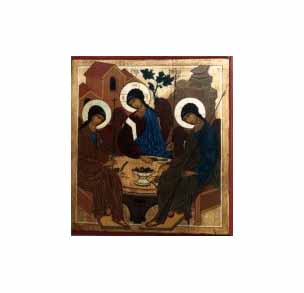
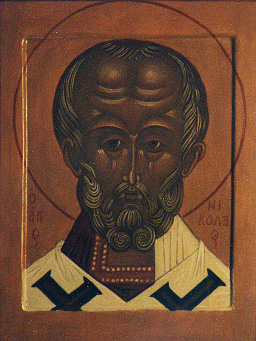
The icon, illustrating an evangelical episode, represented it beyond time and space, in all its aspects; in the same time presenting all the connected events and a transfigured vision of it. The characters represented in the icons, were painted in a nonrealistic way, but with a transfigured face, which revealed the fact that they belonged to a celestial world and they were only sheltered in an incorruptible body. The body outline didn't respect the anatomic canons. There was a certain sobriety of the characters' movements and gestures, represented in a fixed hieratic attitude and usually frontal in which the movement is almost absent.
The icons are authentic sacred objects. In the oriental churches it is an iconostas, a wall that separates the sanctuary and the rest of the church, which is covered with icons, and represents an angle of conjunction between the life after death world (it's the sanctuary where the divine mysteries happen) and the church central part that holds the praying believers.
The icons are also used in homes for the praying rituals of the family, placed in the oriental corner of the room and honored with candles and incenses, they create a small domestic sanctuary called by the Russians " the beautiful and precious corner." Long ago the icons were appreciated not just for their religious function, but also for their beauty and for their artistic and esthetic importance.
The Byzantine icons by authors are original works, entirely hand made using the same technique and the same materials as those used for the antic icons. They are unique works, where the effects of the colors are unrepeatable. They are painted in egg-tempera, natural pigments and golden foil on wood, following the canons of the Byzantine tradition and recreating a unique work of art.