Anna (Brueggemann) Tiedeken

                      |--------Peter BRÜGGEMANN ( - )
                      |
           |---------Conrad BRÜGGEMANN (1784 - 1856, Germany)
           |          |
           |          |--------Elisabeth WITTHOLM ( - )
           |
  |------Conrad Engelbertus BRÜGGEMANN (1821, Germany - 1899, Germany)
  |        |
  |        |          |--------
  |        |          |
  |        |---------Anna Maria Francisca SCHULTE (1790 - 1842, Germany)
  |                   |
  |                   |--------
  |
Anna Maria BRÜGGEMANN (1851, Germany - 1934, Iowa)
  |
  |                   |--------
  |                   |
  |        |---------Jürgen (Casjen) JANSSEN (1769 - 1830, Germany)
  |        |          |
  |        |          |--------
  |        |
  |------Friederika JANSSEN (1806, Germany - 1864, Germany)
           |
           |          |--------
           |          |
           |---------Anna RASTEDE(ROSTE) (1769 - 1844, Germany)
                      |
                      |--------
Anna immigrated to the US with her children in 1886, arriving in Baltimore October 13th. The family first settled near Parkersburg and Aplington, Iowa. Caspar died just four years after they arrived in the US so Anna and the children had to make their own way. They continued to farm in Butler County. Anna's grandson Fred Nicklaus stated ``They had no money and had a very hard life.''
In 1904, Anna and some of her children moved to the Madelia, Minnesota area. Anna farmed there with her sons until late in life. In 1920 Anna moved in with her daughter Elizabeth and Elizabeth's family back in Parkersburg, Iowa.
The Nicklaus family cookbook contained one long biography about Anna. These stories were written by Georgia (Nicklaus) Rewerts based on stories told by Margaret (Nicklaus) Hoffman. Since Georgia is who wrote these stories down, Anna is referred to as ``great-grandmother.'' I include spelling, dates, etc. as written by Georgia. Below is the biography;
My great-grandmother, Anna Marie Bruggaman, was born in Leer,
Germany, on December 2, 1851. Her father was a very wealthy
cabinet maker. She was an only child and pampered and spoiled.
She could have anything she wanted.
She said that as a very young girl she had a pair of golden
slippers. A girlfriend of hers wanted some, too, so she went to
the shoemaker and had a pair made. When she got them her father
was so angry that he chased her down the street beating her with
the slippers while the people watched and laughed.
Another story she told was -- Great-grandmother had an uncle
who was a sea captain and he gave her a parrot. She and ``Paulo''
were very good friends. Sailors were a superstitious lot and when
the ship's parrot died, the uncle sent a sailor for her parrot.
Great-grandmother was coming home from school when the sailor took
the parrot. All the way down the street the parrot kept crying
``Anno, Anno'' and Great-grandmother cried ``Paulo''. She never saw
her parrot again. The real reason her parents let the uncle have
the parrot was because he used bad words and insulted some
dignified old ladies.
Great-grandmother lived near the summer palace of the old,
blind king of Germany. Her playmates as a child were the Crown
Prince and his brothers and sisters. The Crown Prince later became
Kaiser Willhelm of Germany. She said he was a very kind and gentle
boy.
Great-grandmother's mother died when she was a young girl.
Later her father married a fiery tempered Prussian lady. She was
very strict. Great-grandmother felt very abused, but she said she
could never have lived through the hard years to follow if she had
not had this training.
One day her father took her to another town to have her
portrait made as a surprise gift for her stepmother. They walked
and on the way a tall young man caught up with them and walked with
them a way. He talked only to her father. After awhile, he left
them and Great-grandmother asked who he was. Her father said, ``He
is the man you are going to marry.'' That was how she met her
future husband, Casper Tiedeken. They married and had seven
children.
Her husband said there was no future for Germany and he wanted
to go and see what America was like. So, he came to America and
looked around and then returned to Germany. His brother was a
plantation owner in the Phillipines and wanted Great-grandfather
to try life out there, so Great-grandfather went out to visit him
but he couldn't stand the way the slaves were treated, so he went
back to Germany and said he was sure that America was the place to
go.
Great-grandmother being an only child, her parents offered
them anything they asked for if they would just stay in Germany,
but Great-grandfather's mind was made up and they came to America.
Everywhere Great-grandfather went he took his own tea cup and
deep saucer. The cup is handleless and looks like a small chinese
rice bowl. Margaret now has this teacup.
They had been in America only a couple years when Great-
grandfather died of typhoid fever, leaving Great-grandmother to
raise 7 young children. Life was very hard while they were young,
but in time, Great-grandmother made a fortune. Bad investments
caused her to lose most of it. Over the years, she made and lost
three fortunes and was well on her way to another when she died
March 11, 1934.
Great-grandfather was an artist. Not a painter, but a
musician and a dreamer. Great-grandmother was very practical. She
had a very good education. She attended the University of Berlin
when it was very rare for a girl to have a good education.
Great-grandmother was very fond of Margaret. She told
wonderful stories of her experiences to Margaret. When Margaret
was 18 years old, Great-grandmother gave her a German gold locket
that had been Great-grandfather's engagement present to great-
grandmother. Lisa got the locket so we will never know where it
is.
Though Great-grandmother was 83 years old when she died, she
was only slightly hard of hearing and had perfect eye sight.
Margaret said she was a remarkable lady.
I have attempted to verify some parts of this old story, to the extent possible (although this may make you think of me as somewhat of a killjoy).
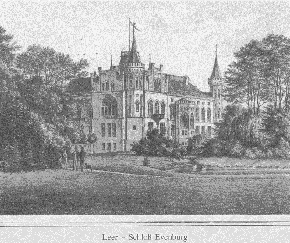
First, regarding having the Prince as a childhood playmate: There is (or was) no summer palace of the royal Prussian family in Ostfriesland, but in Loga there were/are two palaces. Here is the story of these palaces: The commander of the Netherlands garrison in Emden, Erhard Ehrentreiter Von Hofrieth, gave Graf Ulrich II 4000 Reichstaler. Ulrich was not able to give the money back. So Ulrich decided to give Ehrentreiter the villages Loga and Logabirum for rent (so called Lehen) in 1642. The palace which Ehrentreiter built was named Evenburg to honour his wife Eva Von Ungnad. The % Evenburg % was finished in 1650. In 1860 the palace was pulled down and rebuilt in newgothic style. In the second world war the roof of the Evenburg was damaged and not restored to the way it was. There is also a second palace in Loga: the Philippsburg. Philipp, son of Erhard Ehrentreiter, built it 1730. One of these, the Evenburg, I think, later belonged to the family ``von Wedel''. Botho Graf (count) von Wedel (born 1862, died 1943) was German ambassador in Austria-Hungary. His father may have had some relations with the German Kaiser, too. Therefore it is possible that Friedrich Wilhelm Victor Albert von Preussen (later Kaiser Wilhelm II) was in Loga as a child (provided that Kaiser Wilhelm I knew Graf von Wedel). I think it is more likely that Anna's playmate was a child of one the local counts.
Regarding Anna's attending the University of Berlin: There are actually three universities in Berlin now. The one that Anna would have been most likely to attend is now known as Humboldt University (formerly Friederich Wilhelm University and before that Berlin University). I wrote them to inquire if they had any records of Anna's enrollment. They responded that women did attend in the 1800s, but generally did not matriculate (pursue a degree). They didn't have any records for non-matriculated students.
Regarding Anna's parents: The facts about her mother dying young, etc. are proven true. Her father was a cabinet maker, but I don't know that he was really so wealthy. From letters written by the parents and others to Anna after Anna came to America, they were pretty poor in their later years (although their circumstances may have declined at some point, also).
I also think you would have to have a pretty liberal definition of ``fortune'' to say Anna made three of them. Anna and family farmed in Iowa and Minnesota and life was very hard at times, especially right after Caspar died. However, perhaps they had good success in farming at various points and Anna felt she had made a fortune compared with what they had at earlier times. So who am I to judge?
Other memories of Anna were also included in the Nicklaus Cookbook.
Fred Nicklaus remembered visiting her farm near Madelia:
The south part of Grandma's farm had a pasture and a ravine,
and woods passed through it. The Younger brothers and Jesse James
used to ride through this ravine and it was thought that they might
have buried stolen money somewhere there, but none was ever found.
While Grandma and family lived on this farm, Ma, myself,
Elizabeth and Marie (who was a baby) used to take the train to
visit her. I remember I used to pick baskets of cobs (the pigs had
eaten the corn). These were to burn in the stove.
There used to be poker games in the hay mow of the barn on
Sundays. It seems that Grandma could sense when her sons were
losing money and she would go out and play until she had won back
some of the money lost. She taught all of us kids how to play
checkers and many kinds of cards.
Ed Nicklaus also remembered playing cards with his grandmother Anna at ``The Saturday night card game (FanTan or Five Hundred) around the dining room table. One of the most ardent players was Grandma Anna Tiedeken. We would eat a large dishpan full of popcorn while playing.''
Frances (Nicklaus) Richmond also remembered, ``The fun of sitting on Grandma Tiedeken's lap while she taught me to play `Casino'''.
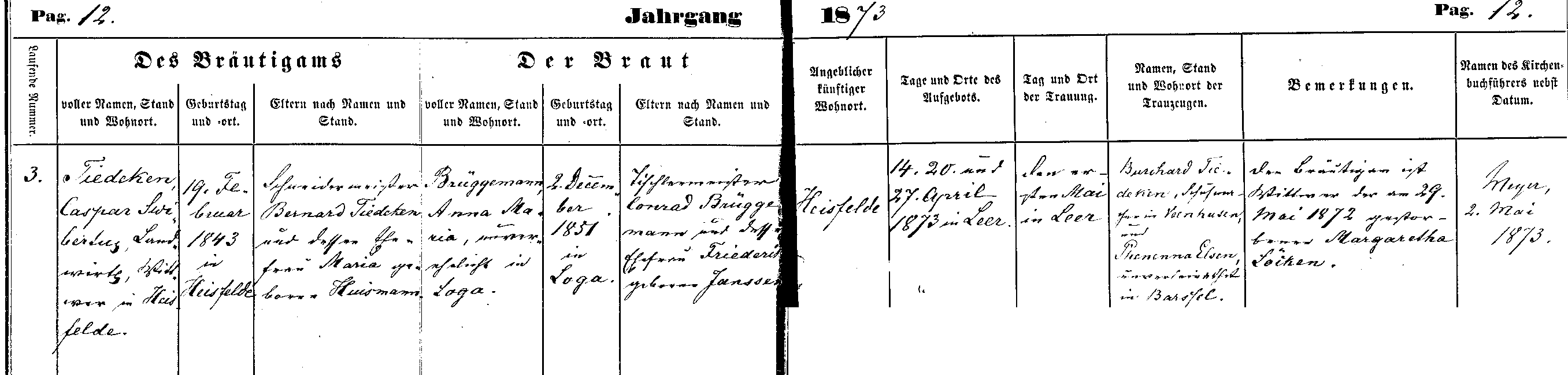
One witness to Caspar and Anna's marriage was a Phenenna Elsen, then single, living in Barssel (the other witness was Burchard Tiedeken, a Schuhmacher (shoemaker) in Veenhusen). Later in life, Anna corresponded with a cousin of hers named Phenenna in Barssel and the letters Anna received have been preserved. In the letters, Phenenna states she is a niece of Anna's stepmother, Gesina Maria Elsen. In the Barssel church archives, I was able to find the birth record of this Phenenna. Phenenna Maria was born August 27, 1856 and baptized the next day. Phenenna died February 5, 1941. Her parents were Johann Henrich Elsen and Gesina Maria Hagen. Her godparents were Gesina Maria Elsen and Friederich Gröneweg. That godmother may have became Anna's stepmother. Phenenna's parents were married December 1, 1855 in Barssel. The marriage record states that Johann Henrich Elsen was the son of Otto Elsen and Phenenna Brickwede, which would also make them the parents of Anna's stepmother, Gesina Maria Elsen.
Sources for this individual: @S31@ @S32@ @S4@ @S33@