THE DAMBOVITA RIVER

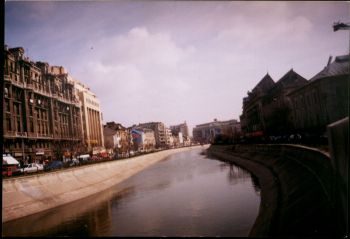 Bucharest is crossed by
the
Dambovita
River (268 km). The river has its sources in the Fagaras mountains.
From one end to the other, on the banks of the river we can see many sights. One
of them, which accompanies the river for a long distance is Bucharest's
subway, with a large underground station in Unirii Square.
Bucharest is crossed by
the
Dambovita
River (268 km). The river has its sources in the Fagaras mountains.
From one end to the other, on the banks of the river we can see many sights. One
of them, which accompanies the river for a long distance is Bucharest's
subway, with a large underground station in Unirii Square.
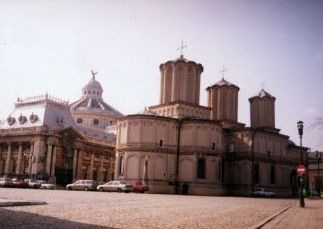 From Unirii Square an alley climbs a
hill which, since 1668 has been the place of the Patriarchal Cathedral.
It was built by the prince Constantin Serban Basarab and his wife Balasa.
From Unirii Square an alley climbs a
hill which, since 1668 has been the place of the Patriarchal Cathedral.
It was built by the prince Constantin Serban Basarab and his wife Balasa.
It holds the relics of St. Dimitrie, the patron saint of Bucharest.
There is also the Palace of the Patriarchal Cathedral where you can admire a large collection of icons.
The Parliament's Old Palace (a neo-classical style building situated near the Patriarchate) was built in 1907 following the plans of the architect Dimitrie Maimarolu. The palace was built on the same location of the conference hall of the National Assembly where, on the 24th of January 1859, Alexandru Ioan Cuza was elected prince of Wallachia.
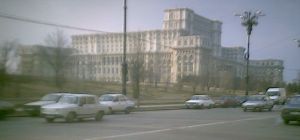 From Unirii Square, towards the west
is Unirii Boulevard ending in front of the Parliament
building.
It is a huge palace where Nicolae Ceausescu wanted to reside. He did not live to
see it finished. It competes with the Pentagon in size.
From Unirii Square, towards the west
is Unirii Boulevard ending in front of the Parliament
building.
It is a huge palace where Nicolae Ceausescu wanted to reside. He did not live to
see it finished. It competes with the Pentagon in size.
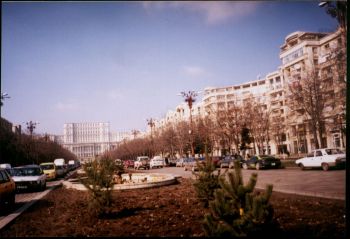 It is located in the new civic centre, on the left bank of
the Dambovita River. By order of Nicolae Ceausescu most of the old buildings
which stood in this area were pulled down to make way for the new buildings. Two
old and extremely beautiful churches were demolished, too.
It is located in the new civic centre, on the left bank of
the Dambovita River. By order of Nicolae Ceausescu most of the old buildings
which stood in this area were pulled down to make way for the new buildings. Two
old and extremely beautiful churches were demolished, too.
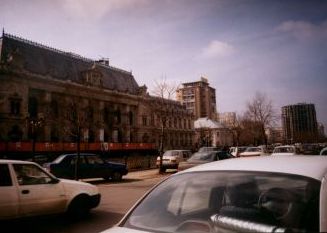 Towards the north, on both sides of
the Dambovita River lies Splaiul Independentei Boulevard.
Towards the north, on both sides of
the Dambovita River lies Splaiul Independentei Boulevard.
Here you can see the Justice Palace, built between 1890 and 1895.
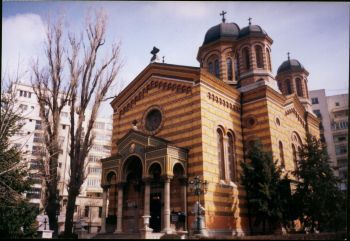 Close to the Justice Palace is the
Domnita Balasa Church, another great architectural monument, erected by
Constantin Brancoveanu's son. In the garden of the church you can admire Domnita
Balasa's monument raised in 1881 by the sculptor Carol Storck.
Close to the Justice Palace is the
Domnita Balasa Church, another great architectural monument, erected by
Constantin Brancoveanu's son. In the garden of the church you can admire Domnita
Balasa's monument raised in 1881 by the sculptor Carol Storck.
Other important sights on the banks of the Dambovita River:
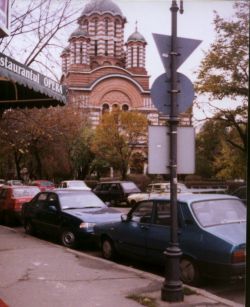 Built in the 18th century, St.
Elefterie Church is one of the most beautiful Orthodox churches in
Bucharest. . It is opposite the Romanian Opera House.
Built in the 18th century, St.
Elefterie Church is one of the most beautiful Orthodox churches in
Bucharest. . It is opposite the Romanian Opera House.
Its catapetasma is made of cherry wood and covered with a thin layer of gold. Inside you can admire a lot of precious icons and many saints painted on its walls.
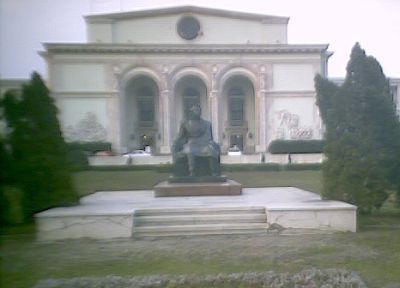 The Romanian Opera House has a wide repertoire of concerts and
its performances are internationally renown.
The Romanian Opera House has a wide repertoire of concerts and
its performances are internationally renown.
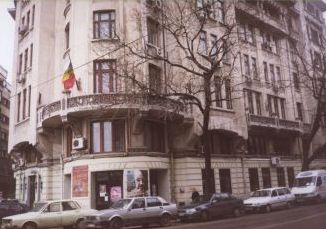 Lucia Sturdza Bulandra
is also on one of the banks of the Dambovita River. It is one of Bucharest's
first theatres.
Lucia Sturdza Bulandra
is also on one of the banks of the Dambovita River. It is one of Bucharest's
first theatres.
It is representative of the European Theatre Union. It hosted the fourth European Theatre Festival that took place in Bucharest in 1995.
Facts collected by the 6th grade students
Photos by the 6th grade students and Andreea S.