Below I will be posting some notes from previous meetings to give you
an idea of what we talk about. The first 15-30 minutes is catch up time.
We chit chat and talk before we begin discussion. Then, we move on to a
summary of last month's meeting and new, unrelated business, such as
possible trips, etc... Then to the lesson. I review the cycle's text,
occasionally bringing up some of the thought questions at the end of the
cycle. Mountainwater also provides some really meaningful rituals and
activities, which are also found at the end of the cycle. They are not
required, but are recommended to enhance the cycle's meaning. If you are
interested, please e-mail me and Diana's Den at [email protected] or use the link
below.
BB,
Olivia
Cycle 1:
"Entry"
Cycle 2:
"Altars"
Cycle 3:
"The Maiden"
Cycle 4:
"The Mother"
Cycle 5:
"The Crone"
Cycle 6:
"Luna"
Cycle 7:
"The Muse"
Cycle 8:
"The Goddess Year": The Dark Half of the Year
Cycle 8:
"The Goddess Year": The Light Half of the Year
Cycle 9:
"Divination"
Cycle 10:
"Spells & Rituals"
Cycle 11:
"Plant Magick"
Links
We learn what are Womyn's Mysteries include menstruation (the blood mysteries), life (cycle of birth-death-rebirth), and sexuality (the power of orgasm and pleasure). There are many more mysteries - the world is full of them. Mountainwater also lists the sacred ways of womyn: living, menstruation, birth, sexuality, aging, sacred/occult practices, finding the Goddess-within, and a connection to nature. Remember: For as long as we are alive, we experience the mysteries. It's just a matter of being aware of them. Allow yourself to consciously live your life.
Mountainwater teaches us the meaning of magick and witchcraft, which can manifest as spells, healing, meditation, and divination. We learn that magick and witchcraft can put us in tune with the mysteries and gives us tools to enhance our lives. She touches briefly on magickal ethics too. We had a lengthy dicussion on ethics in the group - what they are and how we view them. Mountainwater also defines the term witch. "A good witch, therefore, is one who practices the magic and religion of the ancient goddesses (and in some cases gods) and respects the seen and unseen forces of nature." I have reworked this definition: A Dianic Witch is one who practices the magic and religion of the ancient goddesses and respects the seen and unseen forces of nature.
In our study of Goddess Craft, we pull together many aspects of religion, myth, art, and spiritual traditions. The Goddess Traditions are there, but need to be peiced together to recreate the whole. Some aspects we use include mythology, song, poetry/prose, dance, theater, art, intuition, occult practices, nature, natural sciences, and knowledge of ancient cultures.
The differences between traditional and alternative religions (such as the Goddess Religion) are listed. Goddess religion has the presence of female divinity, freedom of self, can be varied forms, no heirarchy, seeks power-within, sexuality and passion are honored.
Moutainwater provides us with a new way to view character traits. Instead of using the female/male division, she suggests using the pentacle: earth, air, water, fire, and spirit. Physical traits are ruled by earth, mental by air, emotional by water, active by fire, and psychic by spirit. This is invaluable, as she just doesn't say the female/male divison is wrong. Mountainwater shows us a new way to view things - something balanced to replace the old patriarchal ways. We are introduced to The Triple Goddess - Maiden, Mother, and Crone.
The cycle closes with some quick comments short ritual acts: focusing on circle casting and The Rainbow Cone Meditation, raising power, and Goddess invocations.
Some of the activities listed at the end of the cycle include: creating a moon wheel to chart your cycles, starting a magickal journal called The Book of Shadows, and making a rainbow cone to enhance your meditation. The Questions to ponder include: define the word witch, what does it mean to you, do you see yourself as one, what is your religious background, what do you feel about the Goddess, and how do you view Her. Mountainwater includes at resource list at the end of each chapter. This cycles resources are: Z Budapest's Holy Book of Women's Mysteries, Patricia Monaghan's The Book of Goddesses and Heroines, Starhawk's Dreaming the Dark and The Spiral Dance, and the We'Moon calendar.
We learned that the self can be an sacred altar:
The earth of our
body;
The air of our breath;
The fire of our passions;
The
water of our emotions;
The spirit of our inituition and dreams.
The act of creating an altar is powerful - spiritually and politically.
When arranging your altar, Mountainwater asks us to consider the placement, altar cloth, and decorations. She suggests some ideas on page 51. She continues, giving us tips on creating an altar. An altar should be in a place where it will undisturbed and safe. The table can be any size or shape, but should be sturdy enough for magickal use. The items on the altar should be personal and symbolic. Mountainwater warns not to overload and clutter the altar. This can be difficult, but if you want to display more items than your altar allows, create small altars throughout your space. Portable altars are mentioned briefly. I supplemented the information with articles found from various magazines, such as "newWitch" and "Pangaia."
The focus then changes to taking care of the altar. She suggests periodic cleansing rituals and creating storage. Before using, Mountainwater recommends blessing and consecrating your new altar. A ritual for this can be found on pages 58-60.
This cycle's project focuses on creating and concrating an altar. The questions go deeper into the altar making experience and give more meaning to the altar making project. Resources include: Laurie Cabot's The Power of the Witch and The Witch in Every Woman, Norma Lorre Goodrich's Priestesses, Jade's To Know, Diane Stein's Casting the Circle and Stroking the Python and finally, Virginia Woolf's A Room of One's Own.
Mountwater breaks up the Maiden Goddess into two types: the Light Maiden and the Dark Maiden.
The Light Maiden is an amazon, a warrior, a liberator, and a huntress. Examples of this Goddess include Diana, Artemis, Athena, Boudica, Kore. She represents the element of air and is the waxing crescent moving to the full moon. She gives the powers of growing, freedom, action, strength, and independance. Her holiday is the Spring Equinox, also called Anados or Goddess Rising.
The Dark Maiden is an enhantress, mermaid, and priestess. Examples of this Goddess include Persephone, Ariadne, Nimue, Bleudowedd. The Dark Maiden is associated with the element of water and is the waning crescent that moves toward the dark moon. She gives the powers of aging, descent, introspection, and magic.
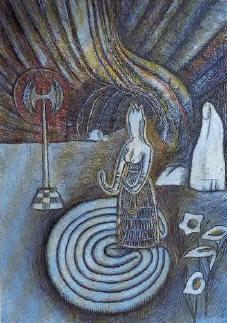
On page 65, Mountainwater gives the traits of the Light and Dark Maidens - in their balanced and unbalanced states. The way to heal the Maiden is to integrate these two aspects. The labyris is a symbol of the Maidens complete and balanced. It is the tool of the ancient Minoans.
Mountainwater discusses how the Maiden is view by society. It is a critical analysis, looking at roles such as "Daddy's Little Girl," "The Sleeping Maiden," and "The Snow Queen." She shows us how the patriarchy has developed a divide and conquer system of keeping womyn from becoming friends and forming valuable relationships.
Page 68 contains some fantastic ways and questions to help explore and heal the maiden inside. The Maiden Ritual on pages is 69-71 is powerful and excellent. The suggested projects include: performing the Maiden Ritual, exploring the magickal child within, and having an amazon adventure. Mountainwater also suggests researching a Maiden Goddess. I did ask the member to do bring some information to share. I shared Persephone/Kore as our meeting was right before the Spring Equinox, when She returns to the earth. Another member shared information on the Inuit Goddess Sedna. Information for both of these Goddesses can be found in the Goddess section on this site, which can be found by clicking here. The Pondering Questions focus on how you experience the Maiden and how you relate to Her. The suggested resources include: Charlene Spretnak's Lost Goddesses of Early Greece, and magickal fiction, such as C.S. Lewis's Chronicles of Narnia and Dion Fortune's Moon Magic.
We started talking about this Cycle and found there was so much to discover and learn that we really needed two meetings to cover it more fully. We began by mentioning some aspects of the Mother, such as life, desire, protection, creation, and connection. She is mature. She builds many things: communities, cultures, children. She is responsibilty.
Her color is Red, the color of the blood mysteries and menstruation. During the years we menstruate, we can concieve. (Compared to the White of the Maiden and Black of the Crone). The blood mysteries are facinating and encourage everyone to read about them. If you do, please share at the meeting or the online group what you learn.
We mentioned the some of names of the Goddess: "Demeter, Madrone, Gaia, Aphrodite, Habundia, Kuan-Yin, Mother Nature, Oceana, Brigit, Nuit, Amaterasu, Maya, Mari, Ix-Chel, Shakti, Pele, Yemaya." I had out a small Mother Goddess altar, where I placed some of the Gdddess figures I had or created: my Venus of Willendorf sculpture, Rhiannon shrine, Medusa statue, Kali figurine, a Bast statue, a picture of the Goddess holding the full moon, and my Water Goddess and Spider Woman paintings. There were stones also on the altar with a lit white rose candle.
We touched on the magickal powers of this Goddess aspect. Briefly, they are: Birthing, Healing, Nurturance, Sexuality, Organization, and Love. Six powers, which can be seen in the 6-sided star (commonly called the Star of David) of the Anahata (or Heart) Chakra, which is the center of love and emotions. The Powers can be seen as a way to connect to the Mother Goddess within and without. And healing can come through self-awareness and awareness of the sacred around us.
Suggested activities included performing The Mother Goddess ritual given in the text, learning about how mothering is viewed in our country and around the world, getting involved with healing the planet, cultivating a relationship with nature around you, and reclaiming your animal allies. Books to read included: Lindsay Badenoch's Daughter of the Runes, Jeannine Parvati Baker's Conscious Conception and Hygieia, A Woman's Herbal, Ina May Gaskin's Spiritual Midwifery, Susan Griffin's Woman and Nature, and Adrienne Rich's Of Woman Born.
The Crone gives us the gift of wisdom and the harvest of experience. That experience can come after any event, a birth or a death. Crones are the keepers of wisdom and pass their teaching on to form the foundations of community.
Crone Goddesses include: Hecate, Cerridwen, Morrighan, Kali, Baba Yaga, Wind Woman, Morag, and Hag O' The Mill. It is harder to find information on the Crone Goddess because it has been supressed in our society. She is repressed because she is a symbol of the dark side of the soul and the one thing we can't defeat - death and time. She is the greatest threat to the patriarchy. However, she is necessary to our spiritual health and peace.
The Crone is associated with the Womyn Alone. But there is nothing bad about this. Solitude is necessary in order to find one's self and to rest from the troubles of the world. Magick itself is often is a soliatary act.The aloneness gives us focus and peace. The power of solitude and silence helps us keep and protect our magick. In magick, we learn that everything beings in the inner worlds of dream and thought.
Crone means choice and fate. When we select one path, we must leave other behind, at least for a little while. She is the crossroads.
To connect to the Crone is to bring wholeness. Three women - Three faces makes a circle. Maiden, Mother, Crone. Together, we move forward.
Crone magick is that of endings and banishings. There are three steps to a banishing spell. One, confront and name that which needs to go. Two, eliminate it. Command it to leave. The elements can be your guide here. Three, create something new, something positive to replace the negative. Nature hates vaccums.
There are many types of Crones, listed here based on the elements.
Remember, we will all be Crones one day.
Spirit Crones:
psychic, out of body experiences, telepathic, clairvoyant, prophetic,
divination, dreams, spell worker
Air Crones: thought, eloquence, poetry, myth, language, verbal spells, asking for aid, prayer
Fire Crones: energy, conservation, storing & spending energy wisely, sexual, passionate
Water Crones: relationships, emotions, compassion, divination, moon magick, insight, mentor
Earth Crones: body, knows the earth, health, care of self and others, healer, seasons, planting/cultivation, herbology, agriculture, harvest
As a last note, we shouldn't be rigid about the appearance of the Maiden, Mother, and Crone cycles in our lives, we are all three at once.
Our talk during June's meeting focused on past lives, dreams, visions, and intuition - all realms of the Crone. We had a lively discussion on naming your path and choosing a path. We noted how the Crone is the crossroads, the choice, something is sacrificed when we choose our paths, even if it is only temporary. We reviewed the Elemental Crones and noted that we all have them inside us, ready to be called out.
The moon, Luna, has always been at the center of Womyn's Magick and Mysteries. It is the ruler of the deeper realms of spirit and the connection to our cycles.
She is known as Luna, Selene, Shing-Moo, Brighid, Mona, Arma, Aphrodite, Hecate, Eurynome, Lucretia, and Diana. The moon is associated with the Goddess, the Feminine, life, womyn, instinct, cycle of life, intuition, emotional realms, and the psychic. Lunar qualities: deep-thinking, vulnerable, emotional, passionate, psychic, intuitive, sensual, dreamy, passive, soft, instinctual, spontaneous, wild.
In ancient times, time was measured by the moon, not sun. The sun has become the opposite of the moon. The sun has come to represent "male qualities," such as action and competition. The moon represents "female qualities," such as passiveness and secrets. Healing and wholeness can come from uniting and honoring the sun and moon within ourselves. The moon and sun both have their own cycles and correspond to womyn's lives. All three work together to make a Womyn whole.
Attuning to your cycles, can foster self-knowledge and understanding.
Moon magick uses the phases and signs of the moon. It also corresponds to the Celtic Tree Calendar.
This topic inspired a dicussion on why creation is important and what our passions are? How do we express ourselves and what does that say about us? The act of creation can include many things: making art, poems, babies, metal crafts, food, calendars, science, ritual, and magick.
We must stay true to our Muse and resist outside temptations, such as money, power, or fame that can pollute our creation. A witch knows the power of Truth, the reality of Maat. Truth is honoring our core and ourself.
The White Goddess by Robert Graves says that all poetry comes from the magickal invocation of the Goddess. But that is only half the truth - ALL CREATION IS INSPIRED BY THE GODDESS. And creation strengthens our connection to Her.
Here is the Process of Creation, as expressed in the pentagram:
Start at the top point. This the Spirit - creation.
Go clockwise
to the 1st arm. This is Air - thought and speech
Continue clockwise to
the 1st leg. This is Fire - will and action.
Go to the 2nd leg. This
is Earth - vision and image.
Reach the 2nd leg. This is Water - desire
and courage.
The process begins again with Spirit - creation and
continues over and over. This Pentagram of Creation is much like the
Pentagram of Magick.
The Maiden, Mother, and Crone also have their Muse aspects.
The
Maiden Muse is untamed and wild inspiration, the power of revolution,
spontaneity, and satire.
The Mother Muse is beautiful and passionate.
She expresses love, healing, and connection with each movement.
The
Crone muse is in alignment with our shadow. She expresses the solitude and
beauty of mystery, night, life, and death.
The Perennial Theme in All Myth is Life/Death, the Change of the Seasons, and the Sacred Year. We see this in the Myth of Persephone and Demeter. We can rewrite the Theme to express the Three Forms of the Goddess - the Mysteries of birth, adolescence, death, separation, and rebirth. The holidays - holydays - can heal the soul.
