TCP/IP
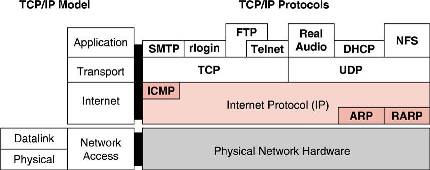
TCP/IP is a communication protocol between the computers that are connected to the internet. TCP is one of the main protocols in TCP/IP networks. TCP/IP refers to suite of data communication protocols that are used to construct the global Internet. TCP/IP has four layers called an architectural model. It provides a common frame for Internet communication. Architectural model includes: Application layer, Transport Layer, Internet Layer and Network Access Layer. It is important to know the four layers in order to understand how TCP/IP works and where the protocols occur.
Application layer is any process that occurs above the transport layer including process that involves user interaction. It also controls the session and determines the presentation of the data. Application layer includes SMTP, HTTP, POP and FTP. The application layer also includes DNS, RIP, SNMP and NFS.
Transport layer is TCP which provides reliable data transmission and UDP which performs no end to end reliability checks. TCP uses a fixed connection. When an application wants to communicate with another application via TCP it has to send a request to an exact address.Then the TCP sets up a �full duplex� in order for those applications to communicate.
Internetwork Layer is referring to IP. Upper and lower layers communicate through IP as they passing through TCP/IP protocols. IP is a connection less protocol. It does not exchange the control information to establish an end to end connection. In this layer the datagram is defined which is the basic unit of transmission in the Internet, Internet addressing schemes is defined, the data between transport and network layer are moved, datagram is routed to remote hosts and datagram is fragmented and resembled.
Hardware Layer is Data Link layer and Physical layer grouped together. It is concerned with getting data across a specific type of physical network (such as Ethernet, Token Ring, etc. Data link layer describes how IP utilizes Ethernet, Token Ring, FDDI, HSSI, and ATM. Physical layer is the hardware that carries the communication signal. Examples of Physical Layer standards are RS-232C, V.35, and IEEE 802.3.