IP Address
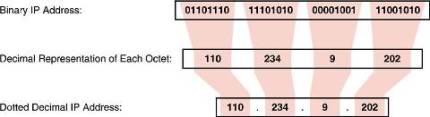
IP was standardized in September 1981. Every computer connected to the internet is assigned an Internet Protocol address. IP address is unique. It is an identifier for a node or host connection on an IP network. IPv4 addresses are 32 bits long and are represented as a sequence of four octets. Each octet is a representation of the 8 bit section of the overall IP address. IP addresses contain both the network segment and the host addresses. The original IPv4 specification provided the ability to differentiate segment and host addresses through the use of address classes.
IP addresses are divided into 3 classes: Class A, Class B,
and Class C. The IP addresses are divided to support networks of varying sizes.
Classful addresses are broken apart on octet boundaries. The first few bits of
each segment address is used to denote the address class of the segment.
Class A network address has an 8 bit network prefix with the
highest order bit set to 0, 7 bit network number followed by 24 bit host
number.
Class B network address has an 16 bit network prefix, with the two highest
order set to 1-0, 14 bit network number followed by 16 bit host number.
Class C network address has a 24 bit network prefix with the highest three
order bits set to 1-1-0, 21 bit network number followed by 8 bit host number.
Classes A, B, and C are most popular classes but there are two
additional Class D and Class E.
Class D is used to support IP Multicasting and with four highest order bits set to 1-1-1-0.
Class E is used for experimental use and with four highest order bits set to 1-1-1-1.
The internet was not envisioned to become this large as it is today. In the early days of internet the network was composed of small number of computers. For most of the organizations Class C is too small because it has 254 hosts per network but the Class B is to large with 65,534 hosts per network. Network divided in order to improve traffic flow. The two separate networks are joined by the routers and they have different ID�s so the router can distinguish between them. In 1985 RFC 950 gave users a way to subnet. It means to provide the third layer of the organization or hierarchy between the existing network ID and the existing host ID. Subnet overcame the issue of registering numbers by assigning each organization one network number from the IPv4 address space.
A subnet mask identifies which bits are used for the subnet ID. A subnet mask is used to determine what subnet an IP address belongs to. The subnet mask is the network address plus the bits reserved for identifying the subnetwork. RFP1009 specifies how a single network ID can have different subnet masks among its subnets.
VSLM supports more efficient use of an organization�s IP address space. The routers on the network where VLSM is implemented must be able to share subnet masks and/or extended network prefixes with each router advertisement. All routers that support VSLM must also support the longest match routing algorithm.
CIDR was announced in September 1993 and is referred to as supernetting. It supports two important features that benefit�s the global internet routing system. It eliminates traditional concept of Class A, Class B and Class C network addresses and a single routing table entry can represent the address space of thousands of traditional classful routes. Without the deployment of CIDR the internet would probably not function today.
The Internet Engineering Task Force developed IPv6, also known as IPng (Next Generation), in December 1998 to address the limitations of IPv4. IPv6 expands IP addresses to 128 bits and eliminates packet fragmentation and its resulting processor overhead. It also utilizes fixed-length field headers. Packets can be set to authenticate their origin and also be encrypted at the network layer.