|
|
Introduction | |
|
SECTION 1
Introduction
SECTION 2
SECTION 3
SECTION 4
|
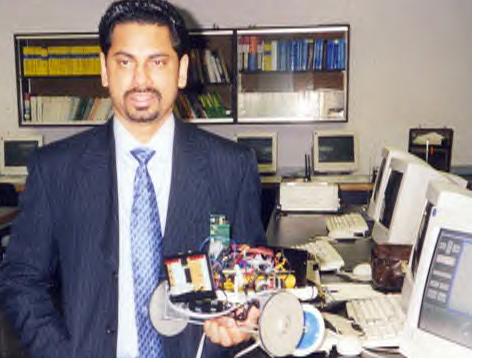
Presentation Photo The word robot comes from the Czech word “robota” meaning drudgery or slave-like labor. While there is no precise definition, a robot is generally defined as a programmable machine that imitates the actions or appearance of an intelligent creature – usually a human. To be classified as a robot, a machine must be able to do two things: 1. Get information from its surrounding; 2. Do something physical, e.g. move or manipulate objects. In addition, there are three rules known as “Asimov’s Three Laws of Robotics” which was coined in the 1940s by Isaac Asimov, that are considered good standards for robots. They are as follows: · A robot must not injure, or allow the injury of, any human being. · A robot must obey all orders from humans, except orders that would contradict the First Law. · A robot must protect itself, except when to do so would contradict the First Law or the Second Law. While
man’s fascination with robotics peaked in the early 1980s, the
concept of “mechanical man” has been around since the 1400s.
However, this concept was not realized until the 1950s and
1960s, with the invention of transistors and integrated circuits. Early
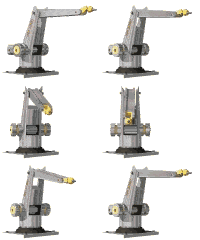
robots were simple mechanical arms, with no artificial intelligence
(AI). These robots
performed precise motions at high speed but had to be constantly
monitored as they sometimes get out of alignment resulting in bad
production units. These
robots were mainly mechanical, stationary, had good precision,
performed at high speed, physically rugged, used servomechanisms, had
no external sensors and no artificial intelligence. In other words, they were ugly, clumsy and stupid.
Early robots were used mainly in factories, with a major use
occurring on production lines assembling automobiles. Today we are seeing and experiencing robotic evolution at its finest. Robots have evolved from ugly, clumsy and brainless machines to being mobile and autonomous. They now incorporate advanced features such as artificial intelligence, speech recognition, speech synthesis, navigation systems, and tele-operation. Robots are no longer big and clumsy, in fact their size and shapes varies dramatically. Some robots are small enough to travel through a human body to repair clogged arteries while others are large enough to carry humans around. Likewise some robots resemble insects – insect robots, while others look like humans – android. Robots are now at the forefront of exploration and medical sciences. In the late 1990s man witnessed a few great robotic “missions” – Pathfinder mission to Mars and J.J.’s mission to the Titanic. The Pathfinder rover Sojourner took pictures, sample soil and rocks and relay information back to earth while cruising around Mars’ surface. J.J. on the other hand, is an underwater robot that explored the Titanic wreck at a depth of 12,500 feet, too deep for human divers. Another famous robot is The Deep Drone that helped recover the black box from EgyptAir Flight 990, which crashed into the Atlantic in 1999. In the medical arena, robotics advancement is being utilized in various ways. One such example is the endorobot that travels through the human stomach and intestine. By monitoring conditions within the digestive system, doctors can diagnose and treat conditions without performing major surgery. Robots are being used to perform neurosurgery and other types of surgery as well. The use of robots enables surgeons to perform minimal invasive surgical procedures that would have otherwise been major surgery Gone are the days when robots were confined to being “industrial robots” working in factories and performing boring jobs, instead robots are now assigned some very exciting and dangerous jobs. While robots are still ideal for jobs that are repetitive and require precise movements, they are also assigned jobs that are too dangerous or deadly for humans. Robots are being used to defuse bombs, inspect chemical spills or radioactive “hot-zones” in nuclear power plants, and to explore outer space and the dark depths of the ocean… The uses of robotics are endless.
|