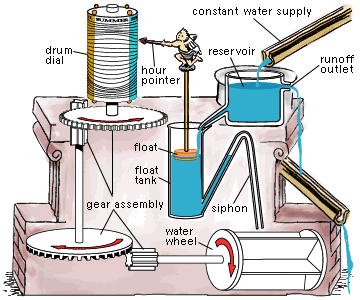
| Artificial Intelligence Timeline: From Ancient Times to Sputnik (1400BC to 1960s) 1400BC clepsydra a water clock created by the Babylonians that is an ancestor to industrial robots 500BC Aristotle Greek philosopher. invented syllogistic logic, the first formal deductive reasoning system 270BC Ctesibius Greek engineer. created organs and waterclocks with moveable human figurines 6AD clocks the Chinese invents the clock, the first modern measuring device 8AD Pygmalion by Ovid. About a statue (Galatea) that comes to life in answer to prayers to Venus myth 190AD abacus the Chinese invents the abacus, the earliest calculating machine 1300 Talking Heads mechanical automaton heads. Owners reputed to be Roger Bacon and Albert the Great 1456 Gutenberg invention of printing machines with moveable type. The Guttenberg Bible printed in 1456 Bible 1525 Hans Bullman Nuremberg. created the first automaton in human form 1580 the Golem most famous is by Rabbi Judah Leow ben Benzule of Prague. publishes the Golem, a man-creature made out of clay and brought to life. 1600 the Leviathan published by Hobbes, containing material and combinatorial theory of thinking 1617 John Napier Scotland. invents "Napier's bones", a mechanical counting device 1623 Wilhelm German. invents the 1st mechanical calculating machine. Schickard 1642 Blaise Pascal creates the 1st mechanical digital calculating machine 1673 Gottfried von improves on Pascal's machine to do multiplication and division. Envisioned a universal Leibniz calculus of reasoning by which arguements could be decided mechanically 1700s the Turk created by Wolfgang Von Kempelen, a mechanical "chess player" 1727 android 1st reference to the word by Scottish Albertus Magnus in an attempt to create an artificial man 1737 Jacques French. creates several automatons musicians and the famous "mechanical duck" Vaucanson 1760 Freidrick Von German. creates a writer automaton with a library of 107 words Knauss 1772-75 Pierre Jacquet creates several automatons of writers, musicians, and artists Droz 1780 Ben Franklin United States. discovers that lightning is electricity 1800s George Boole developed binary algebra representing some "laws of thought" Ada Byron worked on programmable mechanical calculating machines (Lady Lovelace) 1804 Joseph Marie creates an automated loom with punched cards Jacquard 1811-1816 Luddites destroyed machinery in England. Led by Ned Ludd 1818 Mary Shelley writes "Frankenstein" 1822 Charles Babbage English. creates the difference engine. In 1823 commences work on the analytical engine but dies before the machine is finished. 1883 Thomas Edison discovers the "Edison Effect", that electricity travels through a vacuum 1889 talking doll an autonamon unveiled in the Paris Exhibition in collaboration with Thomas Edison 1900s Principia Bertrand Russell and Alfred North Whitehead collaborate in this work which revolutionizes Mathematica formal logic logical analysis Russell, Ludwig Wittgenstein and Rudolf Carnap lead philosophy into logical analysis of knowledge 1920 Der Golem Paul Wegener's silent film based on the Golem character 1921 Karel Kapek Czheckoslovakian. created the word "robot" for his play "Rossum's Universal Robot" RUR, which opened in London in 1923 1927 Fritz Lang "Metropolis", movie that deals with a robotic "False Maria" 1931 Boris Karloff stars in the adaptation of Shelley's work "Frankenstein" 1932 Alpha metal-style robot exhibit in London 1936 Alan Turing writes "On Computable Numbers" which outlines the modern computer 1939 Elektro and unveiled for the New York Fair by westinghouse, a metal robot and robot dog Sparko 1941 computer 1st electronic computer computer 1st stored program computer by Hungarian John van Neuman - the EDVAC Isaac Asimov discusses the three laws of robotics 1943 Warren writes "A Logical Calculus of the Ideas Immanent in Nervous Activity" which lays the foundation McCullough for neural nets and Walter Pitts 1945 Vannevar Bush Writes "As We May Think", (Atlantic Monthly, July), his vision of the future where robots assist humans in many activities 1948 Norbert Weiner publishes "Cybernetics" In collaboration with Arturo Rosenblueth and Julian Bigelow 1950s Margaret Cambridge. designs semantic nets for early machine translation Masterman 1950 Alan Turing introduces the Turing test as a test for machine intelligence 1950 Elmer and 3-wheeled robots for exploration created by W Grey Walter Elsie 1950 Isaac Asimov publishes "I, Robot" 1950 Claude Shannon publishes detailed analysis of chess playing as search 1951 Gort movie "The Earth tood Still" features a robot named "Gort" 1951 Astro makes comic book debut in Japan (Mighty Atom) and inspires a generation of robot designers 1952 Arthur Samuel IBM. 1st game playing program for checkers, machine learning programs acheived sufficient skill to challenge world champion and contributed to the high performance of checker players 1956 Dartmouth the Birth of A.I., John McCarthy first coined the term "Artificial Intelligencce" Conference 1956 Robbie the movie "The Forbidden Planet" features the robot "Robbie". Designed by Robert Kinoshita Robot 1956 Logic Theorist demonstrated the first AI program written by Allen Newell, JC Shaw, and Herbert Simon (Carnegie Institute of Technology, now Carnegie Mellon University) 1956 the transistor John Bardeen and Walter Brattain and William Schokley share the Nobel prize in physics 1957 Sputnik USSR. 1st artificial satellite to orbit the earth 1957 General Problem Newell, Shaw, and Simon Solver (GPS) 1958 LISP John McCarthy, MIT said to resemble common sense knowledge and is associated with the growing field of AI 1958 Herb Galemter theory prover in geometry, exploits semantic model of the domain in the form of diagrams and Nathan of typical "classes" Rochester (IBM) |