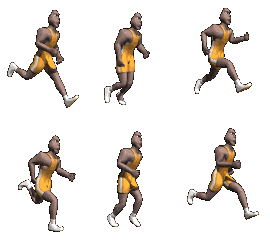
"Acceleration" is an aspect of the running process which follows the recovery phase. Once there is some semblance of balance restored, the body in motion either decelerates or it accelerates . The causal walker who tripped over the crack in the side walk recovered and decelerated back to walking speed. This was the goal of the casual walker. The
runner who falls forward out of the stance recovers, and accelerates to the next phase of the running process by establishing and maintaining maximum stride length and stride rhythm.
According to the definition of physics, "acceleration" is defined as the rate change of velocity with respect to time. "Power" is definded as change in work rate with respect to unit of time. In order to increase accelertion, one would have to perform the same task but increase the amount of velocity in less time than before. Therefore, we are actually talking about the power phase of running. The multi-dimensional runner at the top illustrate rate increases in velocity/ work, with respect to time.
Gradual inclines like hills and stadium stairs are excellent resources one can use to develop the skill of accelerating. The torso leans at the beginning of the grade, and slowly rises the closer the runner gets to top. Acceleration is a skill that must be developed. Tom Tellez did an analysis based on a 10.0 second 100 meter dash. This break down of the race allowed an estimated distribution of factors, which allow sprinters to reach their maximum potential as a sprinter. Those factors consist of the start(1%), recovery(5%), acceleration(64%), maintenance(18%) and deceleration(12%).
The percentages represent the contribution each factor makes during that 10.0 second 100 meter effort. However, the percentages point to acceleration. If acceleration accounts for 64% of the race then it stands to reason that runners should account for 64% of the practice time.
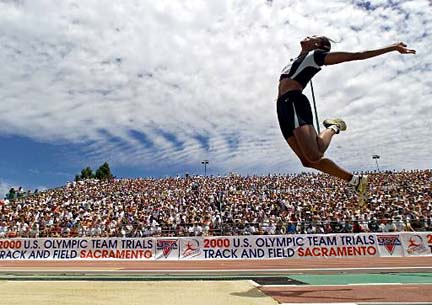
One's ability to develop and master the skill of acceleration determines the amount of speed one is able to maintain. As with sprinters, so it is with long jumpers; acceleration rate determines how long these jumpers soar in the air as well as the length of the jump. The length of the run way exceeds the length of the long jump pit by far. Do you think acceleration is important to the long jumper?
Conclusion: Acceleration is a skill that must be developed. The runner's turnover rate increases until they reach peak acceleration or peak speed. Gradual inclines and stadium stairs are excellent resources.
|