 |
|
|
 |
|
 |
|
 |
 |
|
| The Start.... Breaking "Static Inertia" |
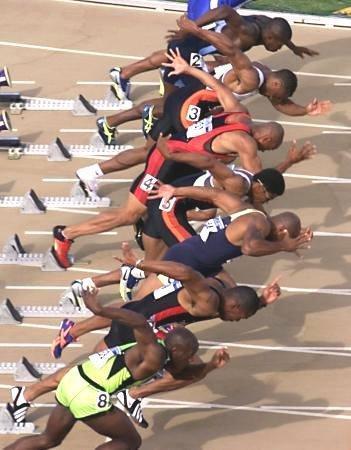
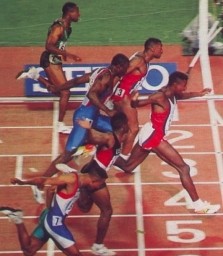
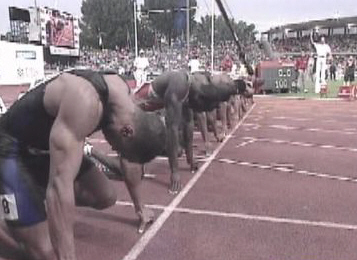
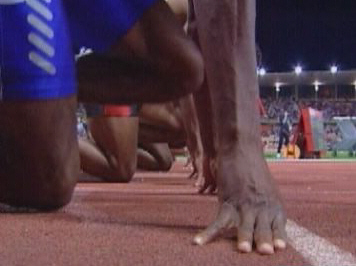
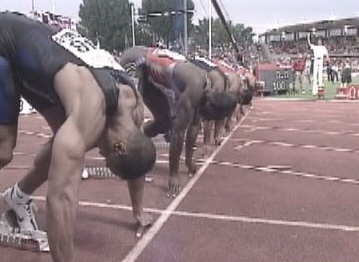
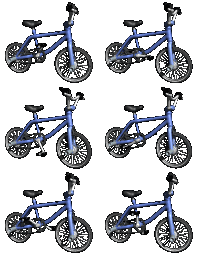
According to the law of physics, "inertia" is defined as the tendency of a body to resistacceleration; the tendency of a body at rest to remain at rest or a body in motion to remain in motion in a straight line unless acted on by an outside force. Therefore, "inertia" can be static or dynamic. "Static", according to the law of physics is defined as relating to bodies at rest; forces that balance each other and fixed or stationary bodies having no motion. "Start" is defined as beginning an activity or movement. It can be sudden or progressive. Athletes use three types of stance to disrupt "static inertia": 2-Point, 3-Point or 4 Point. Each stance is designed to support, balance and distribute the athlete's weight so the start is executed effectively. An effective start allows the athlete to literally step out of their stance into a running pattern which will allow them to accelerate to full speed. According to Tom Tellez's analysis of sprinting... the start is 1% of the race, but it is an important 1%. The athlete must be comfortable and feel natural throughout all phases of the start including the...Seeeet! phase of the start. Notice photo #1. depicts sprinters at their "Mark". The front leg is cocked with hip flexed and glutes coiled like a (1.) huge coiled spring...waiting to be sprung. The back leg with knee bent...resting on the ground stablizing the athlete's balance and body weight. In Photo #2. sprinters are posed with the back leg is flexed and prepared to cycle through as the front leg extends. The latter propels the body forward setting up a repetitive cycling pattern." As previously mentioned, the athlete literally cycles out of their stance as if mounting a bicycle in a standing position pushing down on the flexed pedal (2.) with their entire body weight. The same is true in all stance cases including football players assuming a 3-Point Stance. The 1% Tom Tellez alluded to concerning the start consists of assuming good comfortable stance. Next is mental preparation. Mental preparation involves one forming a clear picture of the mechanics and coordination of such counter- balancing mechanisms as opposite arms with opposite legs. Picture #1. depicts sprinters (in this case) assuming that confortable stance. Picture #2. depicts sprinters moving from a person sitting on a stationary bicycle to a standing (3.) position prior to cycling. In this case the sprinter's body weight is shifted forward but centered on the front leg just as would be the case with a cyclist. Too much weight causes the body to spend more time re-establishing static balance rather than setting up the pattern that pertains to dynamic balance. Remember! It is important to execute a good start...not a great start. A good start is not passive but it feels as if the runner is literally stepping out of his or her stance into a comfortable running patterning consisting of the runner's maximum stride length. (See Picture #3.) Conclusion: Think about it...a rocket lifts off the launch pad with what is considered a good start..."we have lift-off"... yet it travels 22,000 mph (towards space). Top-fuel race cars travels 223-224 mph (1/4 mile) with what is considered a good start. A substance is placed on the track so top-fuel drivers can "smoke out" their tires making the surface sticky causing positive traction eliminating tires from spinning causing the driver to lose control of the vehicle. Cheetahs are clocked at 68-71 mph with what is considered a good start. Human beings are clocked at 22-23 mph yet most do not understand the "good start" vs "great start" concept. As a result they place too much emphasis on the start which cause slipping or tripping resulting in poor performance. Learn to use your stance is your launch pad and "Lift off" to optimal performance. Football Baseball Softball Soccer |
 |
|
|
|
 |
 |
|
 |
 |
 |
 |
 |