| Beginning The Running Process... "Starting From Scratch." |
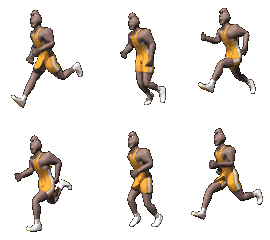
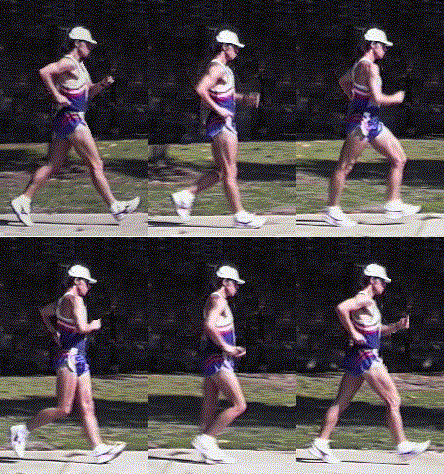
Tom Tellez, University of Houston Track Coach and Coach for Santa Monica Track Club suggesting that sprinters slow-down and they will go faster is a paradox. On one hand you wonder how this is possible... on the other hand it makes sense. When driving your car you press on the gas pedal and your car accelerates until you reach the speed limit (peak speed); then you ease up on the pedal so you can maintain what is considered...full speed. Wow! I thought to myself...it takes more effort to set a body in motion then it is to keep this body in motion. Ha! I thought I had such an experience when I ran my fastest 40 yard time. Once I hit top speed... I eased up on the effort (full speed) and relaxed until I began the natural process of deceleration to the finish line. I experienced my worse start that day. The irony? Years later LeRoy Burrell of the Santa Monica Track Club set the World 100 Meters Record after experiencing one of the worse starts of his career. Years later, I discovered something as ironic and paradoxical as running my fastest after a bad start while walking on the treadmill in between practice and coaches meetings. My time was limited so I decided to challenge myself by reaching peak walking speed and maintain this intensity for 15 minutes. I warmed up for 5 minutes increasing the speed each minute until I reached top speed. I noticed my stride increased as I increased the speed on the treadmill. Once I reached my exercise time limit (5 minutes), and started decreasing speed to cool down, the length in my stride decreased as well. I couldn't wait get back on the treadmill the next day. I thought... Wow! You increase length of your stride to compensate for increasing the treadmill's track speed. Notice! The speed walker's stride length is relative the momentum and speed he has created. In this case, the impetus to walk fast is not the surface as in the case of the treadmill. He has to create this which will be addressed later. Notice! Before we move from walking to running that both aspects of the feet is making contact with the ground...the front foot is making contact with the surface while the back foot pushes the body forward similar to that of the rotating unicycle illustrated to the right. Walking on the treadmill provided the insight needed to understand proper running mechanics. I noticed the correlation between the shoulders and hips. Though the shoulders and hips rotate in a manner that counter-balance with each step. The articulation of shoulders and arms are compact and remain so the faster the person walks or run. Notice!... The arms never rise above 45 degrees. This is particularly true when athletes back peddle. The legs cycle backward as if peddling a unicycle as illustrated above. Posture is another aspect that relates to the beginning of the running process. Standing motionless in front of a mirror looking at the body from a side view I noticed a body perfectly aligned at the joints. Ears aligned with the shoulders, elbows, wrists, hips, knees and ankles. The hands were hanging at pocket depth. Standing motionless while making these observations describes "static balance." When you step forward your body falls into a lean at 135 degrees and is stopped by the forefoot with the ankle flexors, stablizing muscles of the knees and hip flexors absorb the brunt of the force. The same leg makes the transition and the ankle utilizes extensors along with the knees and hip while the hind leg assumes the role of utilizing flexors. The legs follow the same sequence through out the time your body is in motion. Observing a body in motion describes "dynamic balance." The key to running fast is discovering and utilizing maximum stride length and then turning or cycling that stride as fast possible thus shortening the distance. The less steps it takes to get from point A to point B...the faster the time will be recorded. As you can see...this is really going back to basics. Conclusion: Individuals who are willing to revert back to basics and discover ways of forcing the body into natural mechanical adaption will run faster and reach peak performance. |
 |
|
|
 |
|
 |
 |
 |