next up previous contents
Next: Gaussian speckles. Up: Three dimensional intensity correlation Previous: Three dimensional intensity correlation   Contents

Evolution equation of the field correlation.

For $ q\ll k$, Eq. (3.5) can be approximated by:

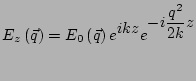
$\displaystyle E_z\left(\vec{q}\right) = E_0\left(\vec{q}\right) e^{\displaystyle i k z} e^{\displaystyle - i \frac{q^2}{2k} z}$ (A.1)

In this approximation, neglecting the phase term $ \exp\left(i k z\right)$, the field follows a Schröedinger equation:
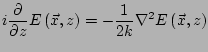
$\displaystyle i\frac{\partial}{\partial z} E\left(\vec{x},z\right) = -\frac{1}{2k}\nabla^2 E\left(\vec{x},z\right)$ (A.2)

The three dimensional field correlation is defined as follows:

$\displaystyle C_E\left(\Delta \vec{x},\Delta z\right) = \frac{1}{S}\int_S{E\lef...
...) E\left(\vec{x}+\Delta \vec{x},z+\Delta z\right) \mathrm{d}\vec{x}\mathrm{d}z}$ (A.3)

In order to obtain an evolution equation for $ C\left(\Delta \vec{x},\Delta z\right)$, as $ \Delta z$ increases, we evaluate the first derivative of the correlation function:

$\displaystyle \frac{\partial}{\partial \Delta z} C_E\left(\Delta \vec{x},\Delta...
... z} E\left(\vec{x}+\Delta\vec{x},z+\Delta z\right)\mathrm{d}\vec{x}\mathrm{d}z}$ (A.4)

Using eq. (A.2):

$\displaystyle \frac{\partial}{\partial \Delta z} C_E\left(\Delta \vec{x},\Delta...
...a^2 E\left(\vec{x}+\Delta\vec{x},z+\Delta z\right)\mathrm{d}\vec{x}\mathrm{d}z}$ (A.5)

The operator $ \nabla$ acts on the first argument of $ E\left(\vec{x},z\right)$, thus it can be considered as acting on $ \Delta \vec{x}$:

$\displaystyle \frac{\partial}{\partial \Delta z} C_E\left(\Delta \vec{x},\Delta...
...ht) E\left(\vec{x}+\Delta\vec{x},z+\Delta z\right)\mathrm{d}\vec{x}\mathrm{d}z}$ (A.6)

This proves that the evolution equation for $ \left(\Delta \vec{x},\Delta z\right)$, as $ \Delta z$ increases, is a Schröedinger equation:

$\displaystyle i\frac{\partial}{\partial\Delta z}C_E\left(\Delta\vec{x},\Delta z\right)= -\frac{1}{2k} \nabla^2 C_E\left(\Delta \vec{x},\Delta z\right)$ (A.7)

This equation can easily be solved in Fourier space:
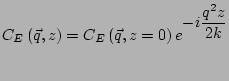
$\displaystyle C_E\left(\vec{q},z\right)=C_E\left(\vec{q},z=0\right) e^{\displaystyle -i\frac{q^2 z}{2k}}$ (A.8)

We can now extend eq. (3.65) to the three dimensional case:

$\displaystyle C_{I}\left(\Delta \vec{x},\Delta z\right) = \left< I\left(\vec{x}...
... I \right>^2 + \left\vert C_E\left(\Delta \vec{x},\Delta z\right) \right\vert^2$ (A.9)


next up previous contents
Next: Gaussian speckles. Up: Three dimensional intensity correlation Previous: Three dimensional intensity correlation   Contents
2003-01-09
Hosted by www.Geocities.ws

1