


Next: Determination of the sign
Up: Three dimensional intensity correlation
Previous: Evolution equation of the
Contents
In this section we consider gaussian speckles, and
we evaluate their three dimensional correlation function.
Far field speckles are often generated by scattering a gaussian beam,
so that the far field speckles have a gaussian correlation function.
We consider gaussian speckles in near field, since the case is
analitically solvable, and involves some calculations
used in quantum mechanics.
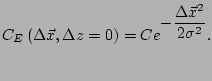
The field correlation function of the scattered light, in the plane
orthogonal to  , is gaussian:
 |
(A.10) |
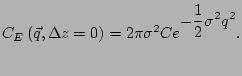
In the Fourier space:
 |
(A.11) |
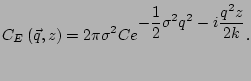
Using eq. (A.8):
 |
(A.12) |
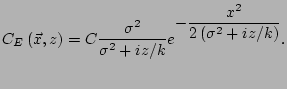
Coming back to real space:
 |
(A.13) |
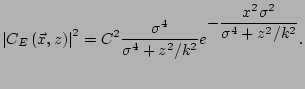
Now we evaluate the modulus of the field correlation function,
the quantity needed in eq. (A.9) to determine
the intensity correlation function:
 |
(A.14) |
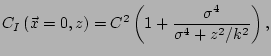
We can now evaluate the intensity correlation function for  :
:
 |
(A.15) |
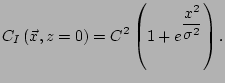
and for  :
:
 |
(A.16) |
While the transverse correlation function follows a gaussian
law, the longitudinal one is a Lorentzian, The diameter of the
speckles is about  , while their length is
  .
.
Next: Determination of the sign
Up: Three dimensional intensity correlation
Previous: Evolution equation of the
Contents
2003-01-09